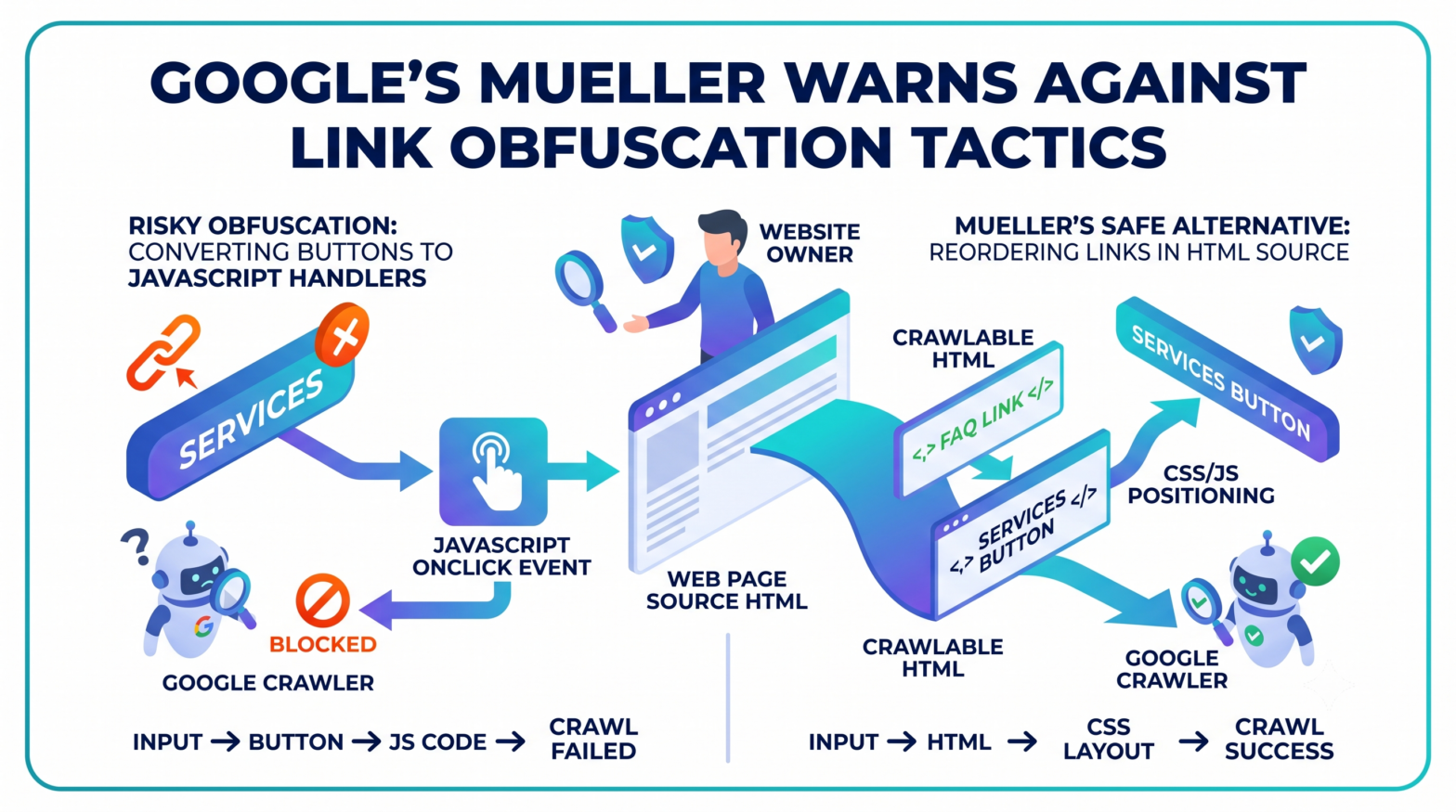
Website owners who convert navigation buttons into non-links to manipulate Google's anchor text signals are damaging their site's technical structure for an outcome Mueller says is unlikely to produce any visible difference. Google Search Advocate John Mueller responded directly to that practice in a recent r/bigseo Reddit thread, calling the approach an exercise in overthinking and steering the questioner toward a safer alternative.
The Tactic Mueller Addressed
The Reddit thread centred on a homepage that links to the same services page twice, once through a prominent "Services" button near the top of the page, and again through an FAQ section further down, with anchor text the site owner preferred Google to use for ranking purposes.
To force the FAQ link to be treated as the primary signal, the site owner planned to make the button stop functioning as a link in the page's code. It would still work when clicked by users, but the underlying markup would no longer identify it as a link, leaving the FAQ link as the only standard anchor element pointing to the services page.
The motivation behind the plan is rooted in a longstanding and unresolved SEO debate known as first link priority. The theory holds that when Google's crawlers encounter multiple internal links to a single URL from a referring page, Google's algorithm considers only the first link and its anchor text for ranking purposes. In a 2018 Webmaster hangout, Mueller stated: "This isn't something we have defined, where we say 'It's always like this, it's always the first link, always the last link, always an average of the links.'" He added that even if someone figures out how Google handles it at a given time, "that's not necessarily how we'll do it tomorrow."
First link priority has gone unconfirmed since at least 2008, roughly as long as people have been running tests to pin it down.
What Mueller Said in the Thread
Mueller's reply did not confirm or deny whether first link priority governs how Google reads anchor text from duplicate internal links. His response addressed the scale of the expected benefit and the cost of pursuing it.
Mueller wrote
"I suspect you're overthinking it, Google has practice dealing with lots of websites so I wouldn't expect you to see any visible change there. That said, if you wanted to experiment with this, I'd suggest doing something more along the lines of using CSS / JS to position things on the page, regardless of where the link is placed in the HTML."
His suggested workaround preserves both links in the markup. The FAQ link would be repositioned earlier in the HTML source, so it appears first in code order, while CSS handles the visual layout, keeping the button visually prominent on the page. Both elements continue to function as proper links.
Why Converting Buttons to Non-Links Is a Technical Risk
The flaw in the original plan goes beyond the uncertain SEO payoff. Converting a navigation button from a proper anchor element into a JavaScript-driven click handler does not hide the link from Google; it removes it entirely from Google's crawl graph.
Google's link best practices documentation, last updated December 10, 2025, states:
"Generally, Google can only crawl your link if it's an `` HTML element (also known as anchor element) with an href attribute." The document notes that most links in other formats won't be parsed and extracted by Google's crawlers, and that Google "can't reliably extract URLs from `` elements that don't have an href attribute or other tags that perform as links because of script events."
Elements that navigate via JavaScript onClick handlers without an href, or links revealed only after a click, are invisible to crawlers, which means the destination page becomes invisible through that path as well.
The practical consequence is that the site owner would not be hiding the button's anchor text from Google while preserving the FAQ link's signal. The button would cease to be a crawlable link at all, stripping one pathway Google uses to discover and assess the services page.
The Structural Alternative Mueller Recommended
Mueller's suggestion keeps the HTML valid and both links intact. He recommended "using CSS / JS to position things on the page, regardless of where the link is placed in the HTML", meaning the FAQ link's anchor element would appear earlier in the source code, with CSS positioning used to render the button visually at the top of the page as visitors expect.
This approach means the page's appearance to users does not change, both links remain crawlable `` elements, and no markup is broken in the process of reordering link signals.
The Broader Risk of Link Obfuscation
Mueller's response fits a consistent pattern in Google's public guidance. Mueller has previously said that while the algorithm may prioritize the first link in some cases, it's not a strict rule, and behaviour may vary. First link priority was never a fixed part of Google's system; it was more of an SEO theory that sometimes appeared to work but wasn't reliable.
Tactics built on attempting to hide links from Google's crawler, whether through JavaScript substitution, CSS visibility tricks applied to anchor elements, or converting links into buttons, carry real structural downside. Google's documentation states that good anchor text is "descriptive, reasonably concise, and relevant to the page that it's on and to the page it links to," and that it "provides context for the link, and sets the expectation for your readers", adding that the better the anchor text, the easier it is for Google to understand what the linked page is about.
For SEO practitioners reviewing internal linking architecture, Mueller's exchange confirms that reordering links within the HTML source is a lower-risk path than altering the markup type of navigation elements. Sites where navigation buttons are already implemented as JavaScript handlers rather than anchor elements with href attributes should audit those elements against Google's crawlable links documentation, as any page reachable only through such elements may not be receiving crawl signals Google can act on.
Mueller's recommendation changes the order of links in the code without removing a link, and he gave no indication that changing link order within HTML would produce a visible difference in rankings.