Discovery-stage shoppers may be among the last users to see a traditional Google SERP, and Google's most senior search executive has now said so publicly. Elizabeth Reid, VP and head of search at Google, made the remarks during an hour-long conversation on Bloomberg's Odd Lots podcast on April 23, 2026, drawing a direct line between query intent and which search surface Google presents to users, a distinction that carries significant implications for e-commerce and category-page SEO.
How Google Distinguishes Its AI Surfaces
Reid opened her answer by linking classic Search and AI Mode together under the "Search" umbrella, positioning Gemini as something fundamentally different. From there, she described consistent behavioural patterns across those surfaces.
For informational queries, Reid said the probability of users reaching for Search or AI Mode is higher. For creative or productivity queries, such as asking for a document to be rewritten in a more formal tone, Gemini is the more likely destination.
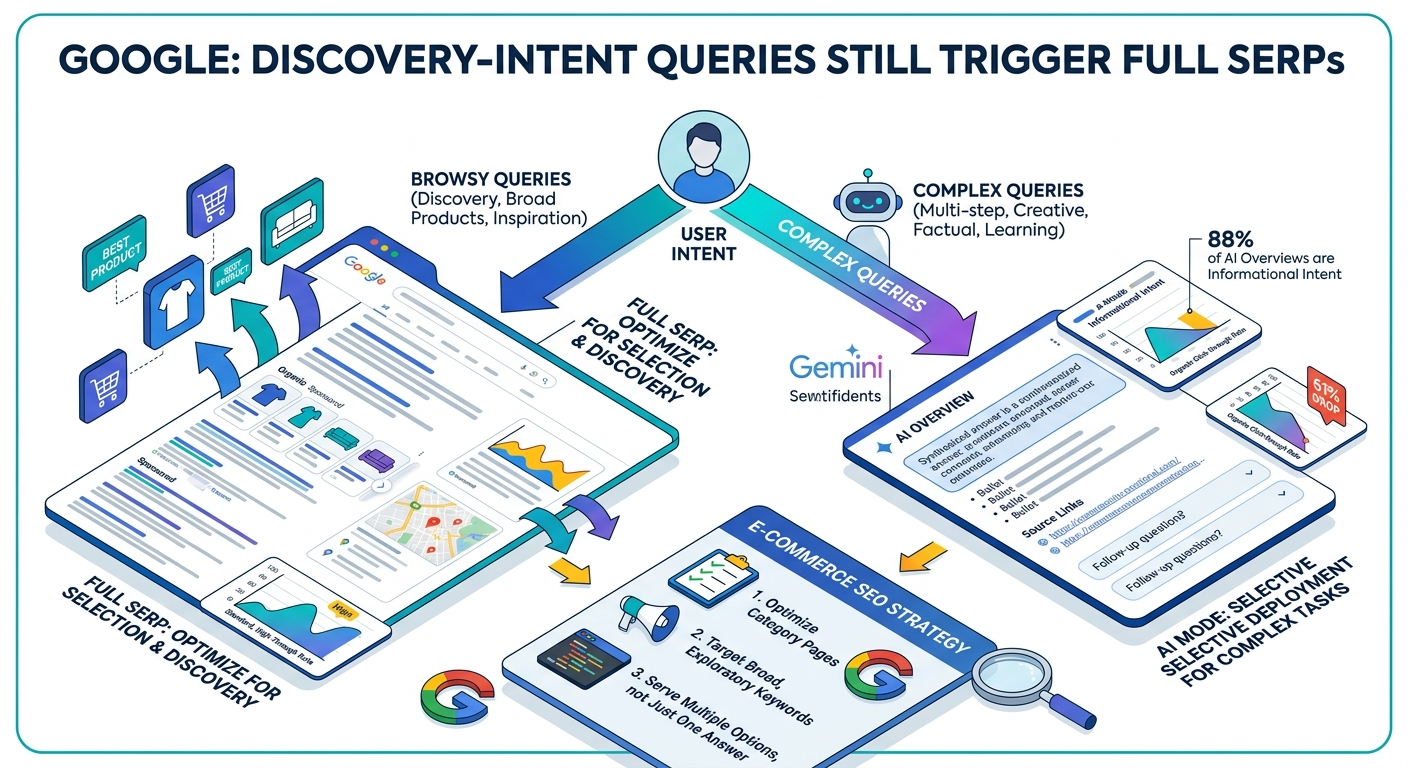
The clearest signal for organic search stakeholders came in Reid's description of how users choose between AI Mode and the standard results page. She noted that some users access AI Mode primarily via AI Overviews, transitioning from there, while users who navigate directly to AI Mode tend to do so for complex, multi-step queries where they expect follow-up questions, contrasting this with what she called browsy queries, where users may prefer to see all of the SERP.
What "Browsy Queries" Actually Means Inside Google
The term "browsy queries" is not new marketing language; it has been in use within Google's internal and public-facing documentation across multiple product areas. A former Google and DeepMind software engineer described in her LinkedIn profile building a machine learning model to identify "browse intention" queries on Google Search, specifically, those that "present engaging content on search result pages for browsy queries (e.g. 'best places to visit in Orlando')", an invention she credited with improving global search click-through rate by 5%. The term also appears in a Google job description for a commerce software engineer, placing it explicitly in the context of shopping queries.
In its Google Ads Help documentation, Google uses the same language in the context of shoppable video ad formats. The support page states that new shoppable formats "will be shown to potential customers in lower intent, more 'browsy' Search placements earlier in their shopping journey."
Across all three contexts, what is consistent is that browsy queries are defined by a discovery-level intent stage. Google uses the classification to identify users who want to keep exploring, not receive a direct answer. The commerce job description positions browsy queries as a quality of commerce search specifically, while the ads documentation places browsy query users at the discovery phase, earlier in the shopping journey.
Why This Is Consequential for E-Commerce Traffic
Reid was direct that AI Overviews are not deployed indiscriminately. "We shouldn't give you AI for the sake of giving AI," she said. "The point is for it when we think it adds value to people." That selectivity has practical consequences.
The distinction becomes concrete when comparing query types. A search like "Corgi" without a question mark signals browsing behaviour; users want pictures and breed pages, not an AI-generated explanation. An AI summary in that context would add nothing and might displace content the user was actually trying to reach.
This matters especially because independent research has documented significant click-through rate pressure where AI Overviews do appear. Seer Interactive's analysis found that the organic click-through rate for queries with AI Overviews fell from 1.76% in 2024 to 0.61% in 2025, a 61% drop. Reid's comments suggest that queries with discovery intent, broad product categories, inspiration-driven searches, and exploratory shopping terms are among those less likely to trigger an AI Overview in the first place.
Data from Heroic Rankings shows that 88% of keywords that trigger AI Overviews are of informational intent, which supports the implication that transactional and discovery-stage queries remain a comparatively safer surface for traditional organic listings.
What This Signals About Organic Search for Product and Category Pages
Google treats browsy queries as exploration problems. What makes them complex is that they carry under-specified user intent; these are consumers who may be looking for inspiration. For an SEO or an online merchant, that means a user has intent but has not yet narrowed down what they want.
For SEOs managing product category pages, this carries a practical implication. Pages targeting broad, discovery-stage keyword phrases, "men's running shoes," "summer kitchen gadgets," "best laptop bags under $100," are likely landing in query territory that Reid's comments indicate still favours a full SERP. These are searches where users want options, inspiration, comparisons, or a chance to keep exploring, and AI Mode is not necessarily the best surface for every such query. Pages that serve multiple options rather than a single synthesized answer are structurally aligned with what discovery-intent users are seeking when they reach organic results.
Reid also emphasized that AI Overviews often display more links than before, creating new opportunities for websites to surface. While quick factual queries may see fewer clicks, other types of searches, especially those tied to learning, research, or purchases, still drive strong engagement.
Reid described AI Overviews as primarily cutting what she called "bounce clicks", instances where users click a page, grab a quick fact, and immediately leave, a characterization that independent researchers have disputed as unverifiable without Google releasing its underlying click-quality data. Outside observers cannot verify from Reid's Bloomberg appearance whether AI Overviews are cutting only low-value clicks or cutting across query types more broadly, as independent data measures total clicks and click-through rates, not the subset Reid describes as low-value.
Reid's Remarks in the Context of Google's Broader AI Search Rollout
Google reported during its third-quarter 2025 earnings call that AI Overviews were driving more than 10% additional queries globally for the types of searches where they appear. Reid's framing on Bloomberg positions that growth is additive rather than cannibalistic, but the organic traffic data publishers are reporting tells a more complicated story.
Chartbeat data published in the Reuters Institute's Journalism and Technology Trends and Predictions 2026 report found that global publisher Google search traffic dropped by roughly a third. Google Discover referrals fell 21% year-over-year across more than 2,500 publisher websites.
Reid's April 23, 2026, Bloomberg Odd Lots conversation was described as one of the most detailed public accounts she has given of how she thinks about search, artificial intelligence, and advertising. On the question of discovery-intent queries and the full SERP, her statement was unambiguous: when users want to browse, they reach for the results page, and Google knows it.