

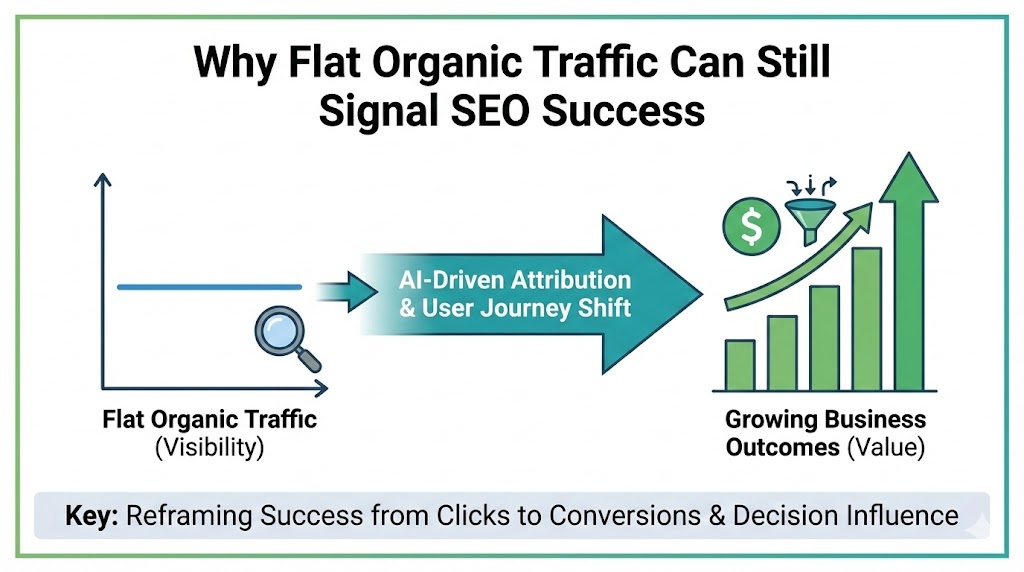
For many marketing teams, a flat organic traffic chart still triggers concern. Traffic has long been the most visible proof point for SEO performance, and when it stalls, questions about effectiveness quickly follow.
In 2026, that assumption is increasingly outdated. Search behavior, SERP design, and AI-generated answers have reshaped how value flows from organic visibility to business outcomes—often without showing up as a click.
Traffic plateaus no longer equal stalled performance
In recent campaigns across competitive industries, it has become common to see organic sessions level off or even decline while core business metrics improve. Conversion rates rise. Lead quality increases. Revenue attributed to organic grows year over year.
This disconnect is largely driven by the expansion of AI-generated answers and rich SERP features. Users now receive synthesized responses directly on results pages, reducing the need to click through—even when a brand’s content is contributing to the answer.
When content informs an AI-generated response, the influence still exists. It simply appears later in the funnel, often as branded searches, direct visits, or assisted conversions that traditional SEO reporting does not fully capture.
The attribution gap created by AI answers
AI-powered search experiences have introduced a structural attribution challenge. Users may read a brand’s insights in an AI-generated overview, internalize the recommendation, and convert days or weeks later through another channel.
In analytics platforms, that conversion rarely traces back to organic search. The initial exposure disappears from reporting, even though search was the entry point.
As zero-click searches continue to rise, this pattern is becoming the norm rather than the exception. In that context, judging SEO purely by traffic volume misses much of its downstream impact.
Reframing traffic as a secondary KPI
Organic traffic still matters, but it can no longer stand alone as the primary measure of success. Its role has shifted from a goal to a diagnostic signal—useful, but incomplete.
A more accurate view of SEO performance pairs traffic trends with indicators of intent and value, such as:
-
Conversion rate and revenue per organic visitor
-
Growth in branded search demand
-
Assisted conversions influenced by organic discovery
-
Engagement metrics on high-intent landing pages
When organic sessions remain flat while these indicators improve, SEO is often becoming more efficient rather than less effective.
Why fewer clicks can indicate stronger positioning
As AI systems surface answers directly in results, visibility and traffic are decoupling. Impressions can increase even as clicks decline.
This shift favors brands whose content is consistently cited, summarized, or reflected in AI-generated answers. The benefit shows up as authority and recall, not immediate sessions.
In practical terms, this means SEO teams are competing less for raw clicks and more for presence in decision-shaping moments that precede conversion.
Metrics that reveal real SEO impact
When traffic stops telling the full story, alternative metrics become essential. Common indicators of healthy performance include:
-
Rising revenue or lead value per organic session
-
Improved conversion rates on entry pages
-
Strong rankings for high-intent, comparison, and pricing queries
-
Increased share of voice in SERP features and AI summaries
-
Higher qualification scores for organic leads
In many cases, declining top-of-funnel traffic is offset by stronger bottom-of-funnel outcomes.
Communicating flat traffic to stakeholders
The challenge for marketing teams is rarely understanding this shift—it is explaining it.
Effective communication starts with business outcomes, not traffic charts. Leading with revenue growth, conversion improvements, or cost efficiency reframes SEO as a performance driver rather than a visibility exercise.
Providing industry context also matters. With more searches ending without a click, maintaining stable traffic can indicate competitive resilience rather than stagnation.
The most persuasive comparisons focus on quality over volume: fewer visitors who convert versus higher traffic that does not.
When flat traffic is a warning sign
Flat traffic is not always benign. It becomes concerning when accompanied by declining rankings, worsening engagement, falling conversion rates, or loss of visibility relative to competitors.
In those cases, stability may be masking erosion rather than efficiency.
The key distinction is whether flat traffic coincides with stronger business outcomes or weakening relevance.
Redefining what successful SEO looks like
In today’s search environment, effective SEO aligns with revenue contribution, not maximum session counts.
Success is increasingly defined by:
-
The quality of organic demand generated
-
Visibility across evolving SERP and AI interfaces
-
The ability to influence decisions even without a click
As search continues to evolve, traffic will remain a useful metric—but no longer the definitive one. Flat lines on dashboards may now signal that SEO is adapting to how users actually discover, evaluate, and choose brands.