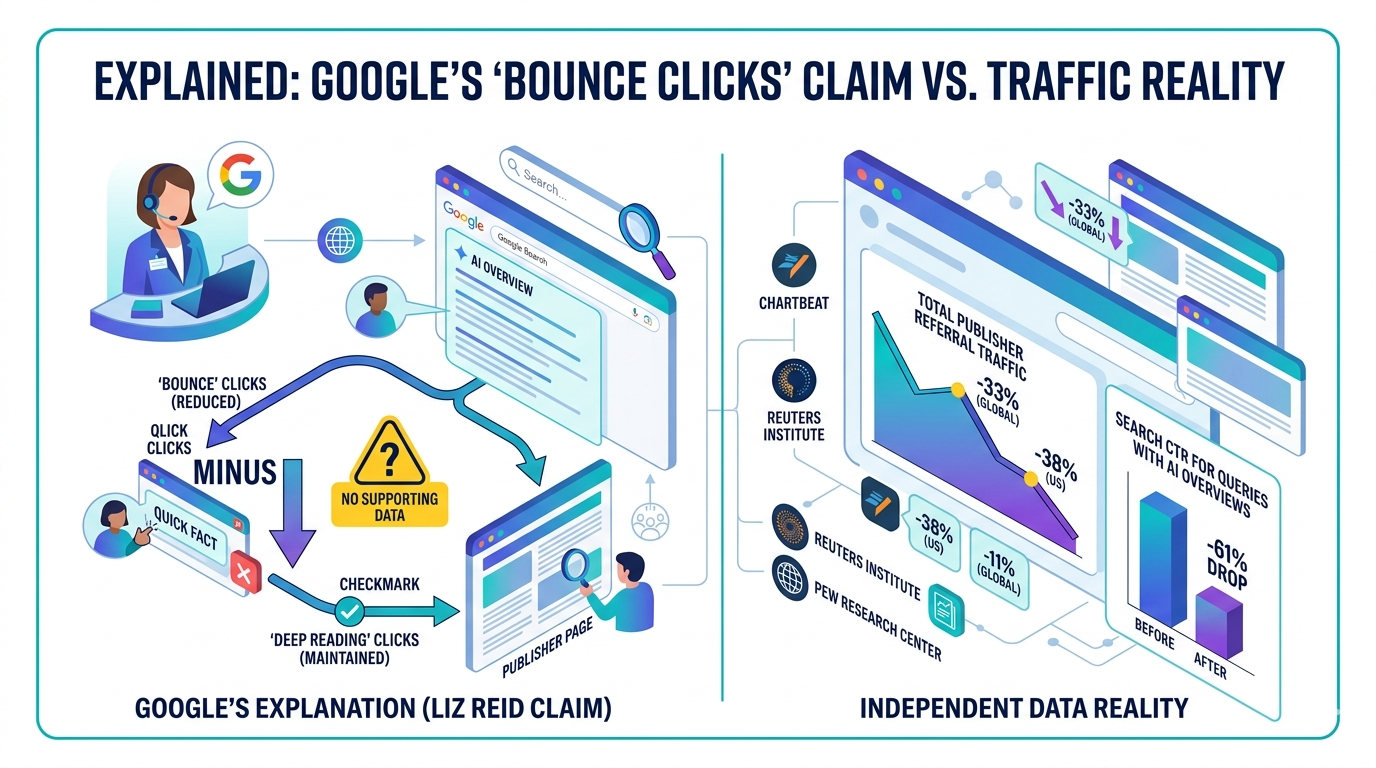
Publishers losing referral traffic from Google Search are no closer to an independent explanation from the company. Google's head of Search, Liz Reid, appeared on Bloomberg's Odd Lots podcast and repeated her claim that AI Overviews are reducing "bounce clicks" from publisher pages, a position she has maintained across multiple public appearances since mid-2025, consistently without supporting figures.
Reid sat for the conversation with Bloomberg's Odd Lots podcast on April 23, 2026, hosted by Joe Weisenthal and Tracy Alloway. The hosts questioned her directly about how AI Overviews affect publisher traffic and advertising revenue.
What Reid Said on Bloomberg
Reid said AI mostly cuts "bounce" clicks, when users click a page, grab a quick fact, and leave. Users who want to read more deeply, she argued, still click through. She acknowledged that some queries generate fewer ad clicks but contended that growing overall query volume offsets those losses.
On Bloomberg, she told Weisenthal and Alloway that Google tracks whether people come to search more often as one of its key signals, without providing numbers. Weisenthal and Alloway asked about traffic and monetization, but the interview did not include follow-up questions requesting evidence for Reid's explanation.
A Position Held Since August 2025
The Bloomberg appearance is the third major public forum in which Reid has advanced the same explanation. On August 6, 2025, Reid published a blog post in which she stated that total organic click volume from Google Search had been "relatively stable" year-over-year. She added that Google was "actually sending slightly more quality clicks to websites than a year ago," defining quality clicks as those where users don't quickly click back.
In an October Wall Street Journal interview, she explicitly used the phrase "bounced clicks" and said that ad revenue with AI Overviews had been relatively stable.
Across all three appearances, the core argument has not changed. In none of those three appearances has Reid provided supporting data. Her August blog post included no charts, percentages, or year-over-year comparisons. The company did not share any numbers to support its claims.
Google has not publicly shared data that would let outside observers test that distinction.
What Independent Research Shows
Multiple independent studies covering different methodologies and publisher sets point in the same direction.
Aggregate data sourced from the analytics company Chartbeat, published in the Reuters Institute's Journalism and Technology Trends and Predictions 2026 report, shows that Google traffic from organic search to over 2,500 sites was down by a third (33%) globally between November 2024 and November 2025, and by 38% in the United States. The Reuters Institute noted the data does not isolate AI Overviews as the sole cause. Google Discover referrals also fell 21% year-over-year across those publisher websites.
Seer Interactive's September 2025 study, covering 3,119 informational queries across 42 organizations, tracking 25.1 million organic impressions, found that organic CTR for queries with AI Overviews fell from 1.76% in June 2024 to 0.61% by September 2025, a 61% drop. Organic CTRs for informational queries with AI Overviews were down 61%, while paid CTRs fell 65%. Seer noted those queries tend to be informational searches that historically had lower CTRs.
The Pew Research Center study tracked over 900 adults who consented to having their browsing behaviour recorded across 68,879 unique Google search queries during March 2025. Only 8% of users who encountered an AI summary clicked a link to visit a website. Users who saw only a standard search result clicked through 15% of the time, nearly twice as often.
Digital Content Next, whose membership of 19 companies spans major national newsrooms to global entertainment brands, recorded a median year-over-year Google Search referral decline across eight weeks in May and June 2025, with losses outpacing gains two-to-one. DCN reported a median 10% year-over-year decline in Google search referrals across those 19 member publishers. DCN CEO Jason Kint said at the time that the member data offered "ground truth" about what was happening to publisher traffic.
The Gap Between Claim and Verification
Reid's "bounce clicks" framing offers a qualitative explanation for the traffic declines that independent researchers have measured in total. The explanation is internally coherent: if AI Overviews absorb only the queries where users would have visited a page briefly and returned to Google, then total click volume could fall while the remaining clicks carry higher engagement value. The problem is that this distinction has never been accompanied by the data that would confirm it.
Publishers and advertisers cannot verify from Reid's Bloomberg appearance whether AI Overviews are cutting only low-value clicks or cutting across query types. The independent data measures total clicks and click-through rates, not the subset of clicks Reid describes as low-value. DCN CEO Jason Kint has called for "auditable data" on Google AI Overview click-through rates by query type, content category, and geography. Google has been widely criticized for making statements about "relatively stable" click volume and "high quality" clicks without sharing actual figures or allowing websites to analyze their own AI Overviews data.
Practical Implications for Marketers and Publishers
For digital marketers and SEO practitioners, the absence of Google-sourced segmented data means traffic decisions cannot be grounded in the platform's own characterization of click quality. Publishers relying on search referral traffic for ad revenue exposure have no mechanism through Google Search Console to separately identify AI Overview impressions from standard organic clicks, making it difficult to attribute traffic changes to specific product features. Until Google releases segmented click data by query type and Overview presence, the "bounce clicks" distinction cannot be applied to individual site-level traffic analysis.
DCN warned that as AI models improve and update faster with daily training, even the moments of publisher advantage that remain may vanish. Reid, for her part, confirmed on Bloomberg that Google tracks how often users return to Search as a key internal signal, a metric that reflects Google's platform health, not publisher referral volume.