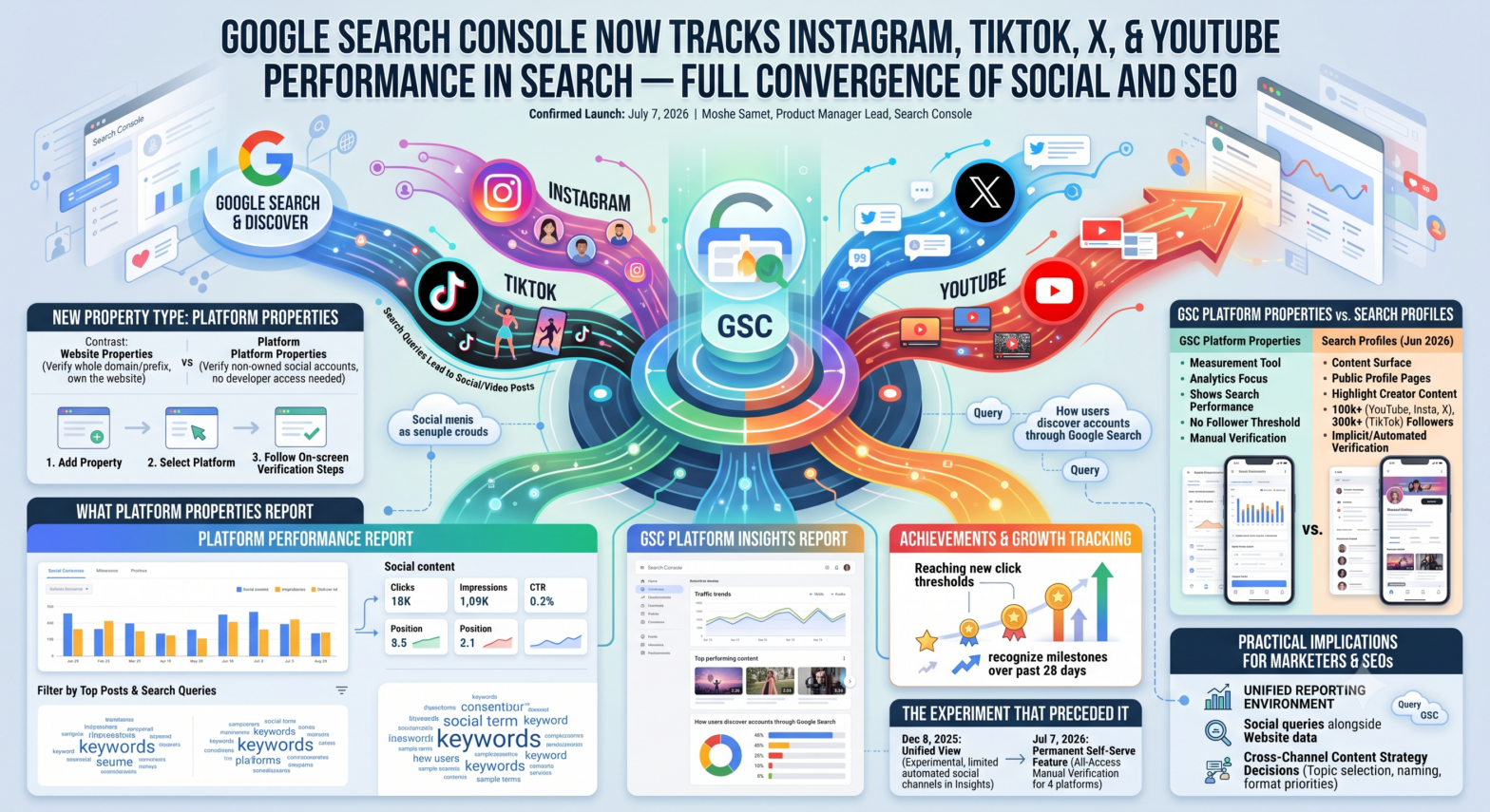
Google Search Console can now report on how content from Instagram, TikTok, X, and YouTube performs in Google Search and Discover, extending its measurement tools beyond websites for the first time. Moshe Samet, Product Manager Lead for Search Console, confirmed the launch in a July 7, 2026 Google Search Central Blog post, introducing a new property type called "platform properties."
Platform properties are a new Search Console property type designed to help site owners and creators understand how their social and video posts perform on Google Search and Discover, including which search terms lead people to their Instagram, TikTok, X, and YouTube content.

The announcement marks a structural shift in what Search Console is: for years, Search Console only understood two kinds of property, a whole domain or a specific URL prefix, both of which required users to own and verify the website. Platform properties break that rule, allowing creators to connect a social account they have no developer access to and see the search data behind it.
What Platform Properties Report
Google confirmed that platform properties offer three reporting features. The Performance report provides data on clicks, impressions, and other key metrics, while allowing users to filter results by top-performing posts and search queries. The Insights report offers a snapshot of recent traffic trends, highlights the best-performing content, and shows how users discover creator accounts through Google Search. The Achievements section tracks growth by recognizing milestones, such as reaching new click thresholds from Google Search over the past 28 days.

Performance data from platform properties can be exported and analyzed in third-party tools, consistent with how existing website property data is handled in Search Console.
Who Is Affected and Who Can Access It
The feature is aimed at creators, publishers, brands, and site owners, including people who don't even have a standalone website, meaning users can now see how Google Search sends people to an Instagram profile, a TikTok post, an X account, or a YouTube video.
Platform properties allow users to verify social media accounts hosted on domains they do not own, something that was previously not possible in Search Console. Some accounts may appear automatically: some users have already reported that their X profiles appear in Search Console without needing to complete the new verification process.
How to Set Up a Platform Property
To add a platform property, users open the Search Console verification page or the property selector dropdown and click "Add property," then select one of the four available platforms, Instagram, TikTok, X, or YouTube, and follow the onscreen verification steps to securely authorize the connection.
Rollout Timeline
The platform properties will become available gradually over the coming weeks. Not all Search Console users will see the option immediately. Google directs creators to its help center documentation for setup guidance and has provided a "Submit feedback" link inside Search Console and in the Google Search Central Community.
How This Differs from Search Profiles
Platform properties are a measurement tool, not a content surface. They are distinct from Search profiles, which Google introduced in June 2026 as public profile pages for qualified creators and publishers. A Search profile is a shareable page that consolidates a creator's content for followers, whereas a platform property focuses on analytics, showing how posts perform in Search rather than directly exposing them to an audience.
Google launched Search profiles as a new way for publishers and creators to shape their presence on Search, describing them as a dedicated, shareable space to highlight content across platforms and help audiences find accurate, up-to-date information about sources. Eligibility for Search profiles requires a public profile with at least 100,000 followers on YouTube, Instagram, or X, while creators whose primary platform is TikTok need at least 300,000 followers. Platform properties carry no such follower threshold.
The Experiment That Preceded It
On December 8, 2025, Google announced an experiment in Search Console that offered site owners a unified view of their Google Search performance across their websites and social channels, expanding the Search Console Insights report to include performance data not only for websites but also for associated social channels. That update was experimental and limited to a small set of properties, with Google only showing social profiles it could identify automatically; users could not add profiles manually.
The July 7 platform properties launch converts that experiment into a permanent, self-serve feature with manual verification available across four platforms.
What This Means for Marketers and SEOs
The practical implication for digital marketers is significant. Social media teams and SEO teams have historically operated with separate measurement stacks, native platform analytics on one side, Google Search Console on the other. Platform properties create a single reporting environment where query-level search data from Instagram, TikTok, X, and YouTube sits alongside website performance data. Eligible users can add and verify those profiles manually inside Search Console, then track clicks, impressions, top-performing content, search queries, and user countries in one place. For brands managing cross-channel content strategies, this data could reveal which social content is generating organic search discovery, and inform decisions about content naming, topic selection, and format priorities across platforms.
Google's own Search Central archive shows a recent run of Search Console reporting additions, including social channels in December 2025, weekly and monthly views, an AI-powered configuration tool, a branded queries filter, and Search Generative AI performance reports in June 2026, with platform properties representing the most direct integration of social discovery into Search Console's core reporting tools to date.