
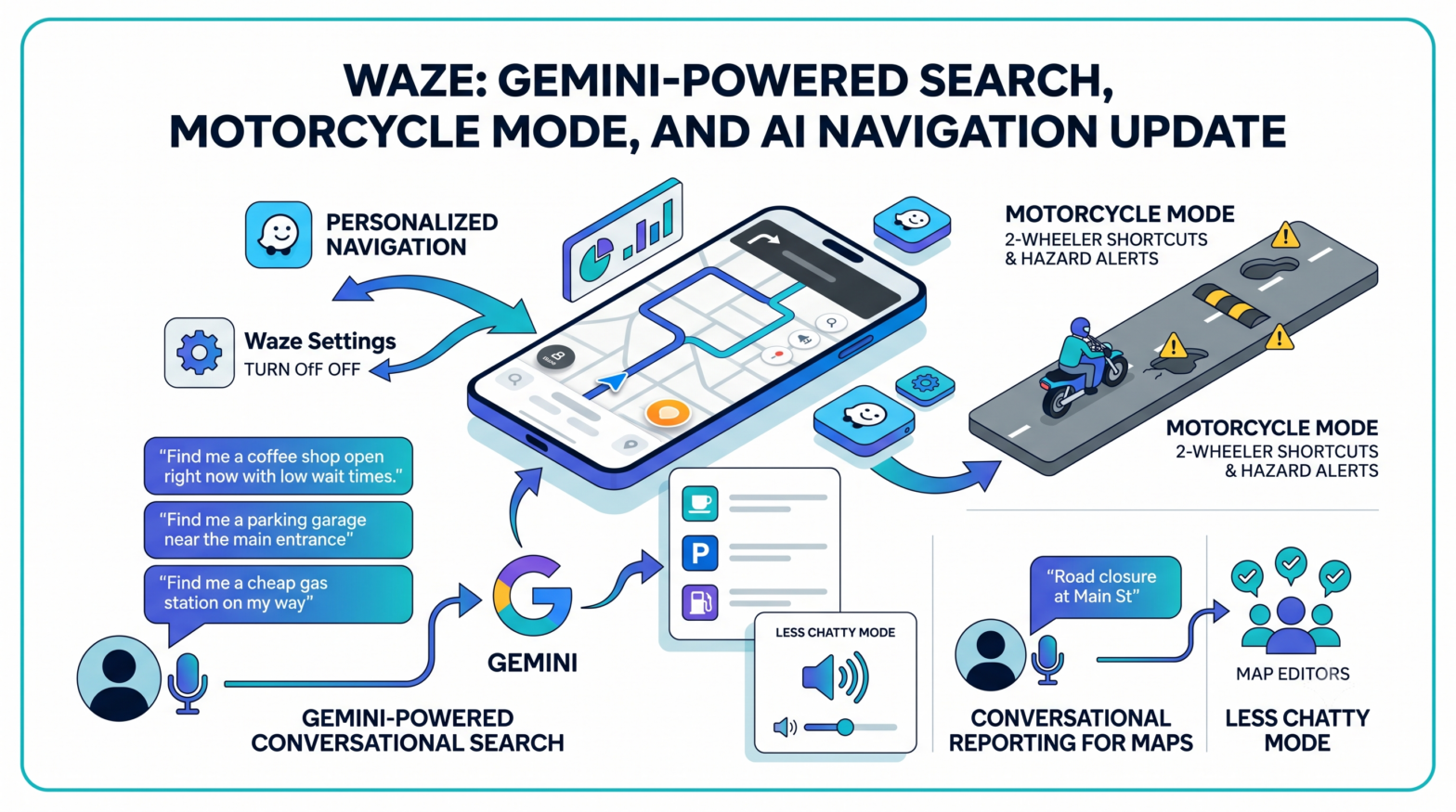
Waze users on Android and iOS will receive five new AI-driven capabilities beginning this week, with availability varying by feature and region. Waze announced on July 13, 2026, that it is adding AI-powered personalized route suggestions and a conversational search tool powered by Google's Gemini assistant.
Personalized Route Suggestions Now Live Globally
Waze will now suggest routes based on a user's previous trips, in addition to its hyperlocal understanding of a city's traffic patterns, so if a user prefers driving on highways over local streets with multiple stops, those routes will appear first. Users who do not want personalized routes can choose alternate routes or turn off personalization in settings. Personalized navigation is rolling out now globally on Android and iOS.
Gemini Destination Search Launching to Beta Users
Waze is introducing a voice-led destination search feature built with Gemini, launching first to the Waze beta community. The tool is designed for users who know the type of place they want but do not have a precise destination in mind. As confirmed in Waze's July 13 blog post on blog.google, users can tap the search voice icon to ask questions like "Find me a coffee shop that's open right now," "Find me parking close to Grand Mall," or "Find me a gas station nearby with the lowest prices," and Waze will respond with a list of options. Finding a destination with Gemini capabilities is rolling out now to the Waze beta community globally on Android and iOS.
Motorcycle Mode Debuts in Seven Countries
Motorcycles can access narrower streets and are more sensitive to road surfaces than cars. Waze's new Motorcycle mode uses AI to incorporate two-wheeler shortcuts and restrictions, helping riders find the best route and get an accurate ETA. The mode also surfaces hazards that are particularly tricky for riders, including potholes, speed bumps, raised crosswalks, shoulder endings, and narrow bridges, all supported by Waze's real-time traffic data and a dedicated group of motorcycle map editors. Motorcycle mode is rolling out now in Argentina, Brazil, Colombia, Malaysia, Mexico, Peru, and the Philippines on Android and iOS, with more countries on the way.
Conversational Reporting Extended to Map Updates
Waze's Conversational Reporting feature, which already uses Gemini capabilities to let users report traffic incidents like slowdowns by talking naturally, has been extended to include map updates such as road closures and outdated addresses. Users can speak directly to the app to flag an issue, and the details are then sent to local map editors for verification before any change is made to the map. Reporting road updates conversationally is rolling out now globally on Android and iOS.
Reduced Voice Prompts With "Less Chatty" Mode
When users enable Less Chatty mode, Waze minimizes the number of voice prompts and keeps them short. Critical reminders about hazards, turns, and lane changes are still delivered, but less frequently. Less Chatty mode is rolling out now globally on Android and iOS.
Implications for Marketers and Local Businesses
The Gemini-powered destination search, even in its current beta state, introduces a new layer of intent-driven discovery for local businesses within Waze. Queries such as "Find me a gas station nearby with the lowest prices" are structured more like conversational prompts than keyword searches, which may shift how businesses optimize their presence for in-app visibility. Marketers managing local listings on Google-owned platforms should monitor how Gemini-driven search within Waze surfaces business data relative to standard map search.
In outlining the changes, Gai Berkovich, Vice President and General Manager of Waze, said:
"Whether you're riding a motorcycle or want fewer voice prompts when you're listening to music, Waze's latest features, including new Gemini updates, give drivers more flexibility on the road."