
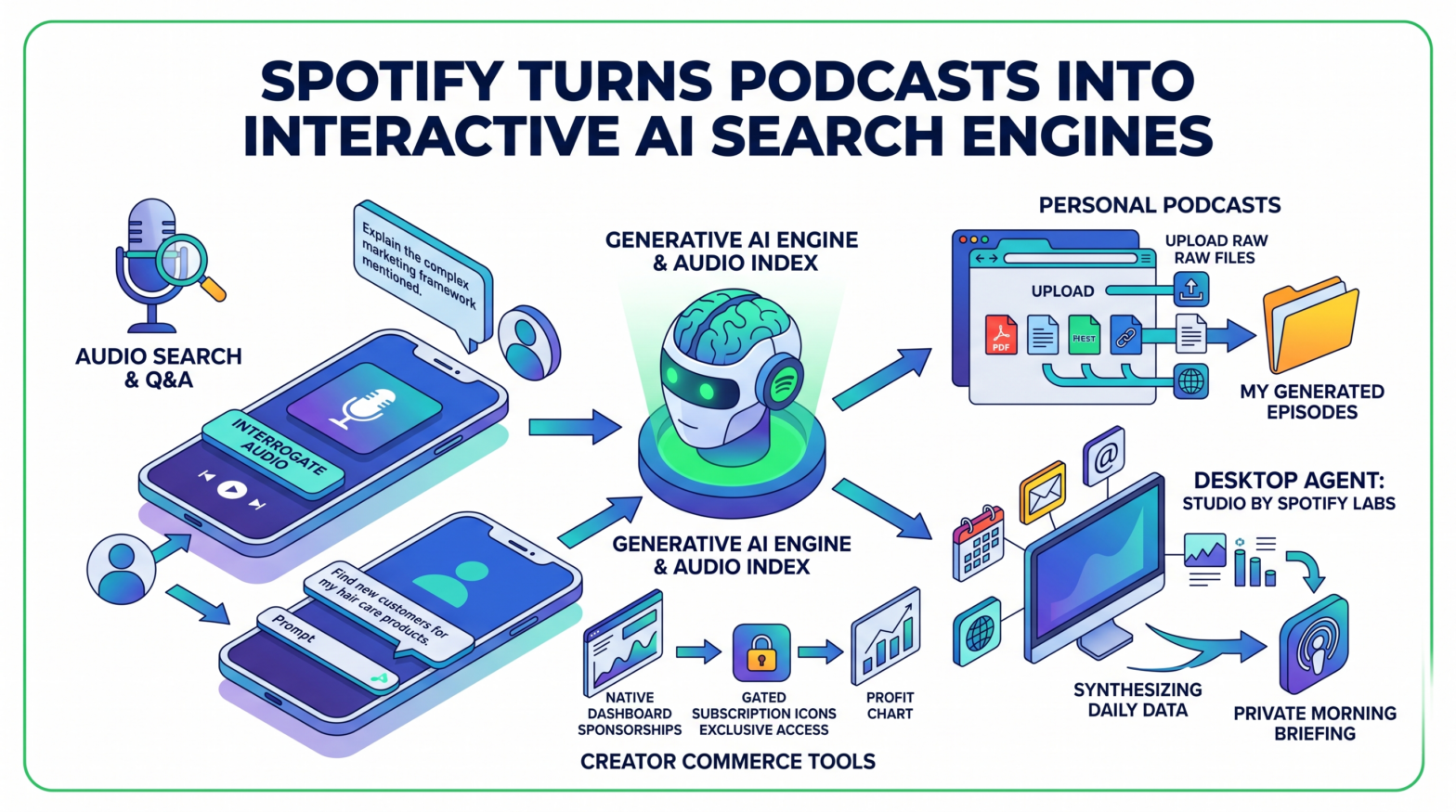
The era of passively consuming a 45-minute podcast just to extract one specific insight is over. Spotify is actively turning its streaming platform into a highly personalized, generative AI search engine.
The company used its 2026 Investor Day to reveal a sweeping overhaul of how users interact with audio. For years, the user behaviour on Spotify was strictly linear: search for a creator, press play, and listen.
Now, users can generate the creators themselves.
Prompting Replaces Pressing Play
Spotify is rolling out a feature explicitly designed to bypass traditional discovery algorithms, dubbed Personal Podcasts. The tool allows users to generate entirely new, bespoke audio episodes based on natural language prompts.
A listener can type, "Give me a five-minute breakdown on global economics," or "Tell me about local concerts happening this weekend." The platform's AI infrastructure synthesizes the information, generates the audio using a customized voice, and drops the finished episode directly into the user's private library.
Users are not limited to short text prompts. They can feed the system raw materials, uploading PDFs, text files, and web links to shape the output.
It is the audio equivalent of Google's NotebookLM. Instead of relying on the platform to surface a relevant pre-recorded show, the listener generates exactly what they want to hear.
The Desktop Agent Nobody Saw Coming
The most disruptive element of the rollout isn't happening on mobile. It is happening on the desktop.
Spotify introduced Studio by Spotify Labs. Positioned as a standalone desktop application, the tool operates as an autonomous agent. With explicit user permission, Studio connects directly to a user's calendar, email inbox, and web browser.
The app pulls from those daily digital habits to automatically generate personalized audio briefings. A user commuting to work no longer needs to curate a playlist of daily news shows. Studio will synthesize their upcoming meetings, unread emails, and specified industry news into a single, private podcast tailored for that specific morning.
Interrogating the Audio
For existing creator-driven content, the listening experience is shifting from a broadcast to a dialogue.
Spotify launched an AI-powered Q&A feature for Premium subscribers in the United States, Sweden, and Ireland. The tool allows users to pause an episode and interrogate the material. If a guest mentions a complex marketing framework, the listener can ask the AI to explain the concept without leaving the app.
The system processes queries about the episode's core themes and immediately recommends other podcasts covering the exact same topic. It is a direct counter to Google's recently launched Ask YouTube feature. The goal is locking user curiosity inside the Spotify ecosystem rather than losing them to a traditional text-based search engine.
A New Commerce Layer for Creators
As AI changes how audio is consumed, the underlying monetization structure is evolving to keep creators invested.
Spotify is expanding its creator sponsorship tools, giving podcasters a native dashboard to manage brand partnerships directly. The platform is also introducing gated subscriptions, allowing creators to charge for exclusive access to premium episodes and community experiences.
Social networks like Instagram and Snap have offered similar monetization gates for years. Spotify is finally closing the gap, ensuring its top creators do not migrate audiences to Patreon or Substack to generate direct revenue.
Practical Implications for Marketers
For digital marketing agencies and brand strategists, Spotify's pivot toward generative audio disrupts traditional podcast advertising and SEO. If a significant portion of user behaviour shifts toward AI-generated daily briefings and personal podcasts, the surface area for traditional mid-roll ad placements shrinks. Simultaneously, brand visibility in audio will increasingly depend on whether an entity's content is structured and authoritative enough to be cited by Spotify's underlying language models when generating these custom episodes. Optimizing for "audio search" now requires ensuring branded content is easily ingestible by the AI agents assembling private morning briefings.
Spotify is betting that the future of the medium is not just about having the best catalogue of creators. It is about letting the user dictate exactly what the catalogue sounds like on any given day.