
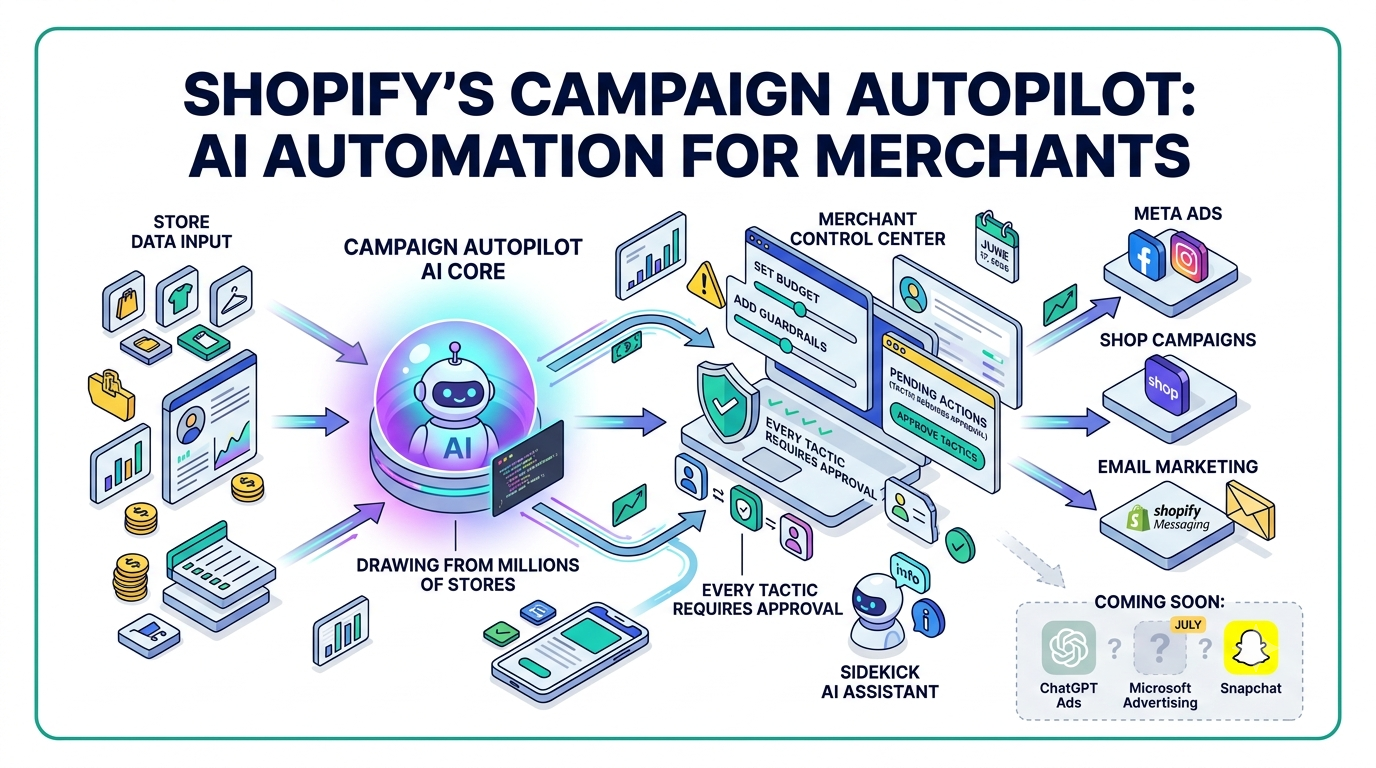
Shopify merchants on paid plans now have access to an AI-powered tool that creates, manages, and optimizes advertising campaigns without requiring manual setup across individual platforms. Shopify confirmed in its June 17, 2026, Spring Edition announcement that Campaign Autopilot is now available in early access, accessible through the Shopify admin under a newly renamed Growth tab.
What Campaign Autopilot Does
Campaign Autopilot automatically creates and manages marketing for Shopify stores from the Growth page in the Shopify admin, using a store's products, customers, and sales data to recommend specific marketing actions across channels, including Shopify Messaging, Shop Campaigns, and Meta Ads.
Merchants set a budget, add guardrails, and can approve what runs before it goes live. Campaign Autopilot then handles campaign creation, budget distribution across channels, and ongoing adjustments based on performance.
Autopilot only runs tactics that the merchant approves, and does not change existing manual campaigns, one-off emails built outside Autopilot, or other channel configurations managed independently. It also does not alter product prices, descriptions, or store settings.
Channel Coverage at Launch and Upcoming Additions
Campaign Autopilot currently runs AI-powered marketing campaigns across Facebook, Instagram, Shop, and email from a single console. The tool is in early access at launch and is not yet generally available to every merchant. Three additional channels, Microsoft Advertising, ChatGPT Ads, and Snapchat, are listed as coming soon. Shopify confirmed in its June 17 blog post that Microsoft Advertising integration is scheduled for July.
Coming channels include ChatGPT Ads, Microsoft Advertising in July, and Snapchat. Shop Campaigns within Autopilot also runs across ChatGPT, Microsoft Monetize, and Pinterest alongside existing channels.
How the System Uses Store Data
To generate and optimize marketing tactics, Autopilot accesses a store's active product catalogue, including titles, descriptions, images, prices, and inventory status, as well as customer segments, purchase history, email subscriber lists, order history, revenue data, conversion metrics, and existing campaigns across connected channels.
Campaign Autopilot uses a merchant's existing product images and catalogue to build campaigns and does not generate AI creative on the merchant's behalf.
Shopify draws on what is working across millions of stores, including which channels drive orders by category, region, and growth stage, meaning Campaign Autopilot's recommendations reflect patterns from real stores rather than generic benchmarks.
Merchant Controls and Approval Requirements
One of Shopify's stated operating principles with Campaign Autopilot is that all actions remain in the merchant's control. Merchants can approve recommendations, change parameters, adjust the budget, change the target return on ad spend, and pause any tactic at any point in time. All outputs are recommendations.
Autopilot cannot spend beyond the guardrails a merchant configures for paid advertising, and each paid tactic still requires approval before it runs. Every tactic requires approval in the Pending Actions section on the Growth page before Autopilot executes it on a connected channel.
Permissions control whether Autopilot can run tactics independently or must request merchant approval before creating email campaigns and ad campaigns. These permissions can be set during initial setup or updated later from the Growth page.
Pricing and Eligibility
Autopilot itself is free to use and carries no additional fees. Merchants still pay for the marketing activities they approve and run through the tool. When merchants approve Meta Ads tactics, Meta bills ad spend directly, and those charges are not added to the Shopify subscription invoice.
The feature is in early access and is currently available only to certain merchants. Shopify confirmed in its June 17 announcement that merchants who qualify will find the option in the renamed Growth tab, while others can sign up to be notified when access opens.
The Admin Navigation Change
Alongside Campaign Autopilot, Shopify has renamed the Marketing tab in the admin. The Marketing tab in the Shopify admin has been renamed Growth, a change Shopify describes as reflecting what it is building rather than a cosmetic label update. The Growth tab is the location for both automated and manual marketing tasks, and still contains the marketing summary, Shopify Campaigns, and Automations.
Sidekick Integration
Campaign Autopilot and Shopify's AI assistant Sidekick work together within the admin. Merchants can ask Sidekick for help with growth goals or to interpret marketing results at any time. Sidekick is available globally.
Shopify's Stated Positioning and Its Limitations
Samir Pradhan, Shopify's Vice President of Product for Merchant Marketing, told Adweek that the tool aims particularly to help merchants better use email, which he described as generally underused by merchants. Separately, Shopify's Director of Product for Shop Campaigns, Venkat Prabhu, described the tool's ambition in a June 17 podcast interview: "We are launching Campaign Autopilot that basically builds the capabilities of a digital marketing agency straight into the Shopify admin."
Shopify also disclosed explicit limitations in its June 17 product blog. The platform stated that no marketing tool can guarantee specific results, that Campaign Autopilot requires time to learn which audiences, channels, and ads perform for a given store, and that results are not immediate even when campaigns are automated.
Practical Implications for Marketers
Campaign Autopilot reduces the mechanical overhead of multi-channel campaign management, connecting accounts, distributing budget, and running optimizations, tasks that previously required either dedicated platform expertise or agency support. However, the tool operates within guardrails and approval workflows that merchants must actively configure and monitor. Strategic decisions, which products to promote, which customer segments to prioritize, and which creative direction reflects the brand, remain outside the tool's scope. Merchants with existing Meta or Shop campaigns will not see those campaigns altered, but they will need to assess how Autopilot-created campaigns interact with their overall account structure and budget allocation across platforms.
Campaign Autopilot warrants a careful pilot with tight budget guardrails before any brand lets it run unattended, as autonomy without oversight is how marketing budgets can quietly erode.