

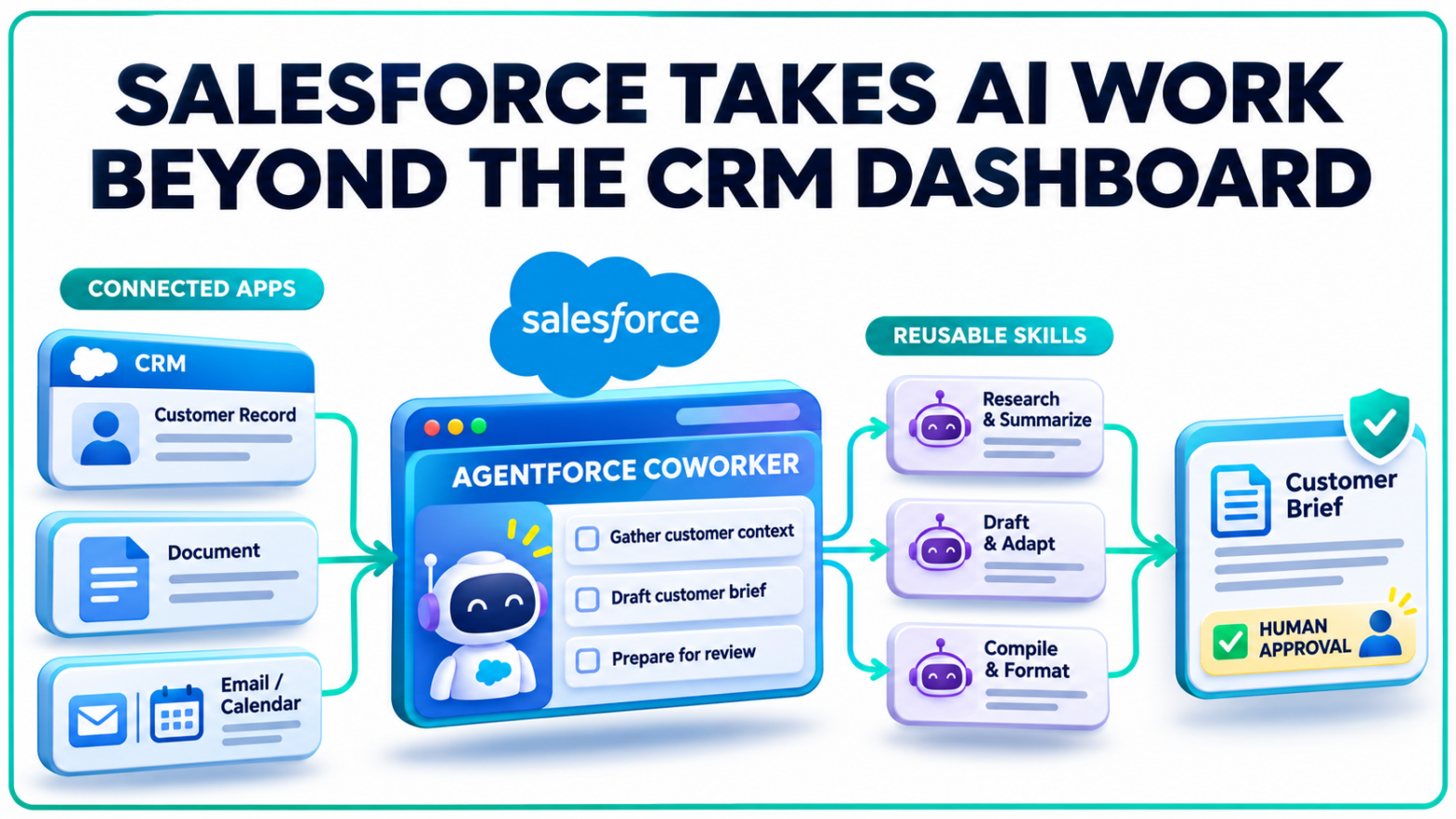
Employees can ask AI to prepare a customer brief. Getting it to find the right records, involve the right systems and return work for approval is a different assignment.
Salesforce is expanding Agentforce Coworker around that second task. In its November 4 announcement, the company reported more than 185,000 users and a 21-fold increase in usage over three months. Those figures describe adoption and activity; they do not establish a corresponding increase in productivity.
The operational question is how much work employees can delegate through one interface when the information and actions required sit across several applications.
Agentforce Coworker Becomes the Route Into Other Agents
Salesforce describes Agentforce Coworker as a common entry point for business questions and assignments. Employees describe the outcome they need, and the system coordinates relevant Agentforce agents, flows and processes.
That arrangement changes the employee’s role in choosing software. Someone preparing for a quarterly business review can request preparation and a follow-up draft without first identifying each specialist agent involved. Salesforce’s product page says Coworker returns completed work for approval.
Retrieval, analysis and execution remain distinct activities. Finding an account record answers a question. Explaining a stalled deal requires interpreting the available information. Updating a business system adds an action with its own permissions and consequences.
The company’s earlier expansion of AI agents into marketing put automated execution closer to campaigns, content and pipeline management. Coworker addresses the employee-facing coordination problem: how to reach the appropriate capability without navigating the underlying collection of tools.
A shared interface does not make every request executable. The available agents and configured business processes still determine what work the system can complete.
Customer Context Has to Reach Beyond the Account Record
Salesforce’s Data 360 platform provides part of the underlying information layer. The platform brings customer interactions across sales, service, marketing and web activity into unified profiles. It also supports structured records and unstructured material, including documents and call logs.
Those sources serve different purposes. An account field can show a renewal date; a service interaction can explain an unresolved problem. A document may contain the terms needed to interpret both.
Connecting information is therefore more than a search convenience. The meaning of a business request depends on the relationships between records, activity and supporting material. Salesforce positions Data 360 as the layer that supplies that context to employees and agents.
Its administrator guidance makes the practical dependency explicit: Coworker can only find useful answers in sources it can reach. A pricing document stored in an unconnected location remains outside the answer, regardless of how clearly the employee phrases the request.
For marketing and revenue operations teams, the practical implication is familiar. Account definitions, source ownership and access rules remain part of the work. A conversational interface can simplify a request, but connected records still need to be current, and teams still need a clear distinction between preparing customer-facing material and approving its use.
Reusable Skills Put Workflow Automation Into Shared Instructions
Coworker’s Skills feature lets employees save a workflow, invoke it with a short request and share it with colleagues. Salesforce says each person runs the Skill within their own permissions.
The reusable element is the procedure. Access to the underlying information still follows the person executing it.
That distinction matters for workflow automation. Sharing a useful sequence across a team does not require every employee to receive identical access to customer records or business actions.
Salesforce’s administrator documentation also separates requests for information from requests that need a dedicated agent. Policy questions may require a connected knowledge source. Processes that apply business rules, update records or hand work to another team may require a specialist agent with a defined scope.
The configuration work happens underneath the short request: which sources the agent uses, which questions it answers and which actions it can take. A reusable instruction sits on top of those choices.
Fast Activation Still Has Licensing and Data Requirements
Salesforce’s technical setup documentation lists Enterprise, Unlimited and Agentforce 1 as supported editions. Overall access requires Data Cloud or Data 360 to be provisioned and activated.
Usage-based access depends on eligible credit entitlements. Seat-based access requires an applicable licence. Administrators also need the relevant profile and permission set to enable, configure or grant access to Coworker.
The product page lists a standalone licence at $50 per user per month, with unlimited Coworker searches and 30 MB of indexing per user each month.
A quick activation process describes one part of deployment. Connecting the right sources and assigning user access are separate requirements, and the setup documentation says the way administrators grant access varies with users’ licence types.
Salesforce’s administrator guidance says CRM answers respect existing record and object permissions. External-source access controls are also enforced. Employees using the same interface can therefore receive different information because their authorized access differs.
The November Rollout Leaves Recurring Work for December
The November 4 release schedule lists Google Workspace and Microsoft 365 connectivity, Conversation History, Skills and the new per-user pricing option as available now.
Microsoft Teams access, iOS and desktop applications for Mac and Windows are scheduled for general availability during November. A Coworker MCP server and a free trial for Flex Credits customers are also listed for that month.
Scheduled tasks and Daily Digest are expected in December, alongside Coworker access in several Salesforce industry mobile applications.
The dates separate work an employee can initiate with currently available features from recurring assignments that depend on a later release. Salesforce says availability can vary by region and customer agreement; December features remain expected releases rather than generally available capabilities.