
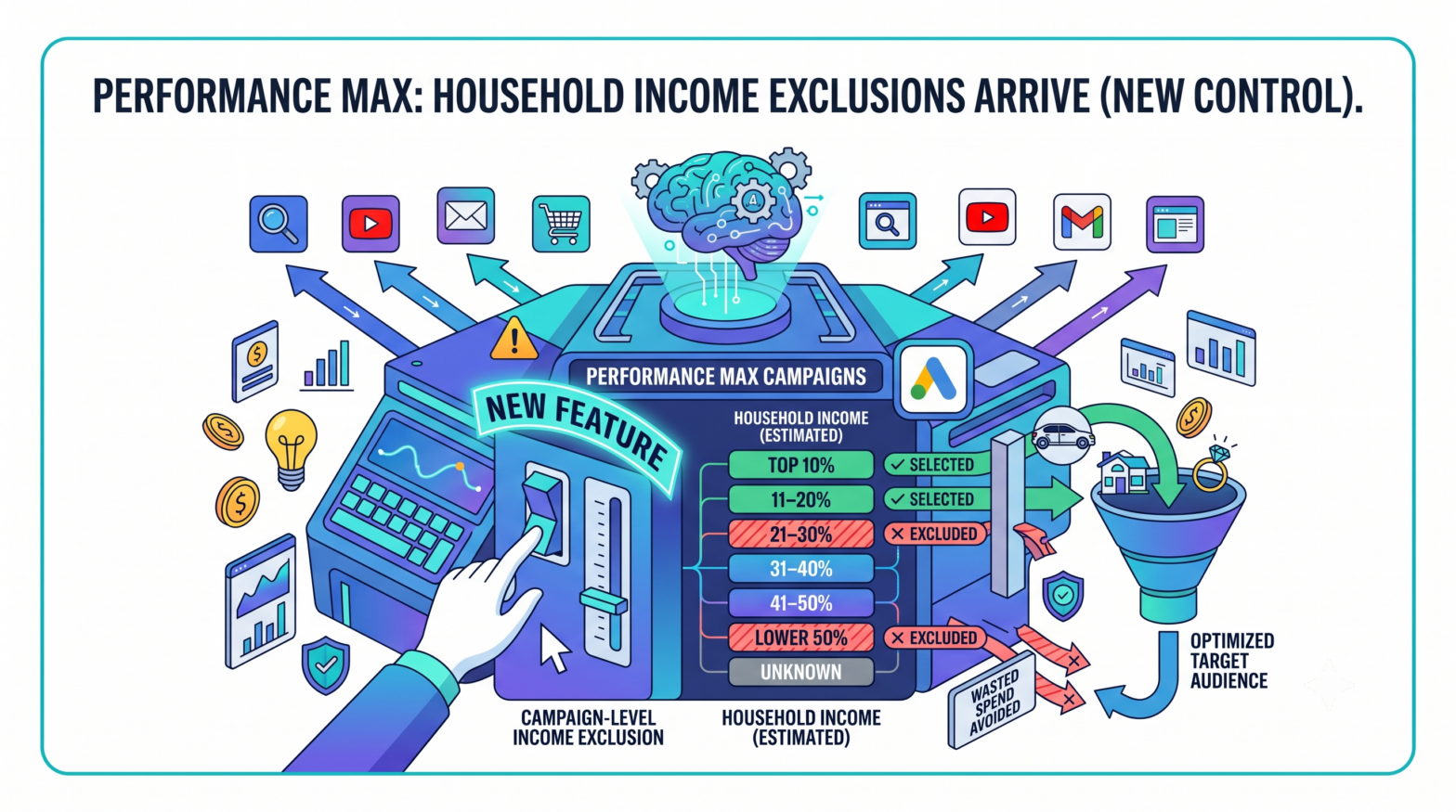
Performance Max advertisers may be gaining access to a demographic control that has never before existed within the campaign type. A new household income exclusion setting has been spotted inside a European Performance Max campaign by paid search expert Thomas Eccel, who shared the discovery on LinkedIn on July 24, 2026.
Google has not issued a formal announcement confirming the feature or providing a timeline for broader availability. No official entry has appeared on the Google Ads Announcements page or the Google Ads Product Blog as of publication. The sighting represents an apparent limited or test rollout.
A Gap in Demographic Control That Has Persisted Since PMax Launch
Household income exclusions have been available in Search, Display, Demand Gen, and Video campaigns, but not in Shopping or Performance Max. That gap has been a consistent limitation for advertisers managing premium or income-sensitive product categories inside PMax since the campaign type launched.
Google's own campaign settings documentation confirmed as recently as early 2026 that demographic exclusions in Performance Max were limited to age and gender, with that initial rollout described as addressing only the most critical demographic exclusion needs. Household income was not part of that rollout.
The broader pattern of expanding PMax controls is established. Google confirmed in its Google Ads Announcements that it has launched features aimed at giving advertisers more visibility and control in Performance Max, including campaign-level negative keyword lists, increased search theme limits, and more demographic targeting. Age-based demographic controls and device targeting became fully available in Performance Max, and Google subsequently launched a new beta for gender-based demographic controls. Household income exclusions, if confirmed, would represent the next step in that sequence.
What the New Setting Shows
The new setting appearing in a European Performance Max campaign enables advertisers to exclude users based on Google's estimated household income. The exclusion options correspond to the same brackets Google uses across its other campaign types.
Those brackets are: Top 10%, 11–20%, 21–30%, 31–40%, 41–50%, Lower 50%, and Unknown household income. The feature appears within campaign settings, allowing advertisers to remove selected income brackets from targeting.
It is worth noting that household income targeting is the least precise of Google's four basic demographic categories because it is always inferred, and its availability is limited to approximately 20 countries. The countries where the feature is supported include Australia, Brazil, Canada, Colombia, Hong Kong, India, Indonesia, Israel, Japan, Malaysia, Mexico, New Zealand, Philippines, Singapore, South Korea, Taiwan, Thailand, United Arab Emirates, the United States, and Vietnam.
Significance for Income-Sensitive Campaign Categories
For advertisers running Performance Max campaigns in categories where household income is a meaningful purchase signal, campaign-level income exclusions would allow budget to be directed away from segments unlikely to convert. Industries such as luxury goods, financial services, automotive, and premium home services stand to benefit from aligning campaign delivery with their target audience, while brands focused on value-conscious shoppers could conversely exclude higher-income segments.
The practical implication for paid search managers is the ability to apply income-based guardrails at the campaign level without disabling PMax's automated optimization across inventory. In other campaign types, income exclusions have historically been applied at the ad group level; a campaign-level implementation in PMax would make the control more direct and consistent across all asset groups within a campaign. Advertisers should note that because household income data is always inferred rather than declared, its accuracy is lower than other demographic signals, and exclusion decisions should be validated against actual conversion data before being made permanent.
Feature Status and Availability
The sighting was limited to a single European account. Google appears to be rolling out household income exclusions for Performance Max campaigns, though if the feature is widely released, it would mark the first time advertisers could exclude specific household income segments directly at the campaign level in PMax. Google has not confirmed whether this represents a beta test, a limited regional rollout, or an inadvertent early release of a feature in development.