
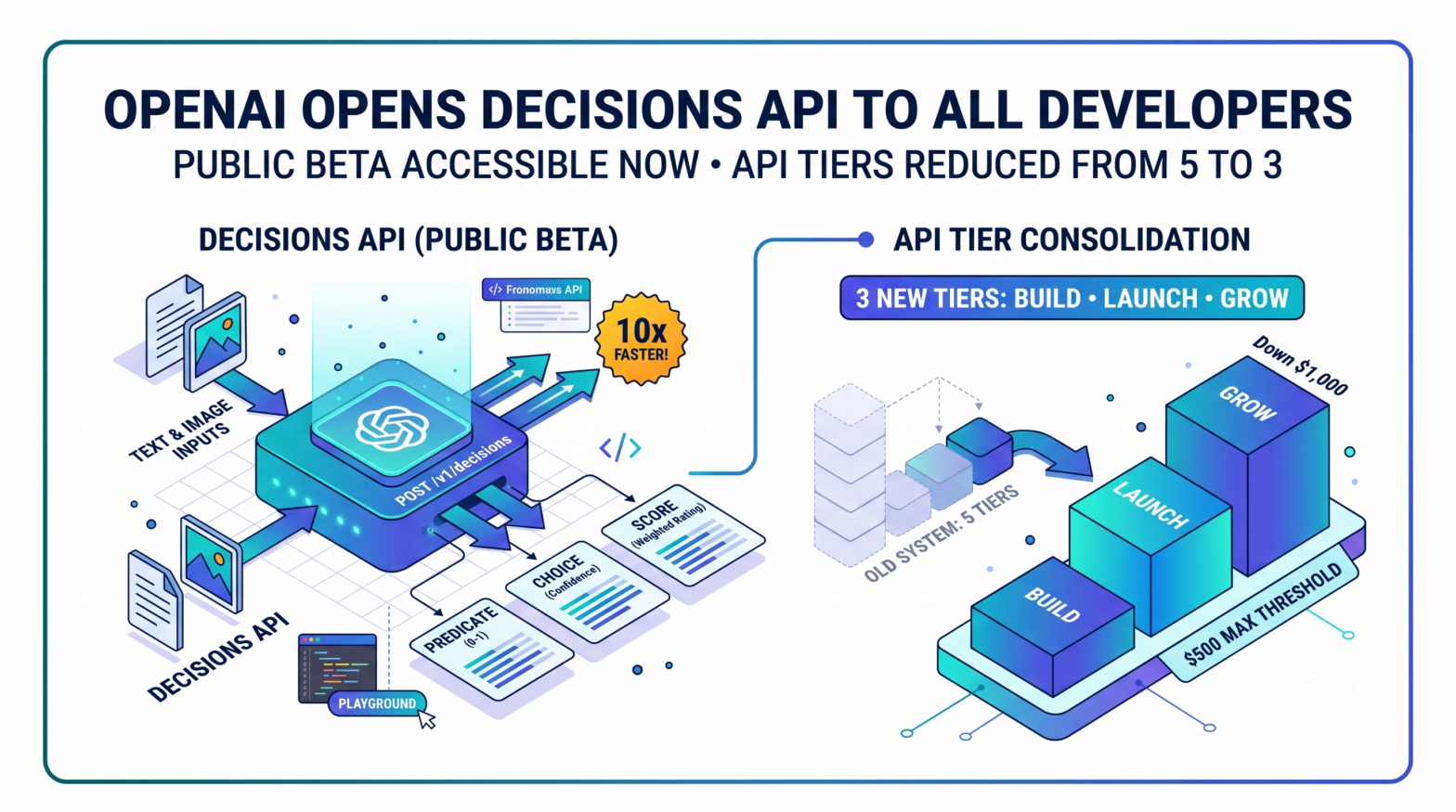
OpenAI developers can now access a dedicated classification endpoint for the first time without a waitlist. On October 6, 2026, OpenAI made its Decisions API available to all developers in public beta, one week after previewing it to selected customers at DevDay on September 29, 2026. On the same date, the company also restructured its API rate-limit system, reducing five paid tiers to three.
What the Decisions API Does
The Decisions API is in public beta, with general availability expected in the coming weeks. GPT-6 Luna is the only model currently available, accessed through a dedicated POST /v1/decisions endpoint.
Rather than generating free-form text, the endpoint evaluates an input against developer-defined questions, and returns typed answers in three forms: predicates (the probability that a statement is true), choices (one option from a fixed set, with confidence scores), and scores (a probability-weighted rating against ordered levels).
The API is now available to all developers in public beta, and can be tested in the Playground at platform.openai.com/decisions, where developers can experiment with questions and inputs ahead of writing code.
Speed and Pricing
OpenAI says the endpoint makes decisions up to 10x faster than calling GPT-6 Luna through the Responses API. The company pitches it for classifying content, routing requests, and selecting the right model, tool, or next action for an agent. The 10x figure is a comparison against OpenAI's own Responses API; no independent benchmark has been published alongside it.
The endpoint is priced at $0.10 per 1 million input tokens, with cache reads, cache writes, and output tokens all unbilled.
It returns three typed shapes: predicate (0–1), choice with confidence, and score across ordered levels, and ships with HIPAA eligibility and US/EEA data residency. Text and image inputs are both accepted, but image inputs must be inline base64 data URLs; hosted image links and uploaded file IDs are not supported.
API Usage Tiers Reduced From Five to Three
Alongside the Decisions API beta, OpenAI announced a structural change to how it assigns rate limits across its API platform. OpenAI consolidated its five paid API usage tiers into three levels named Build, Launch, and Grow, and reduced the cumulative payment threshold for its highest standard tier from $1,000 to $500.
The three paid usage tiers are Build, Launch, and Grow. An organization's usage tier upgrades automatically as its total credit purchases reach each threshold.
OpenAI says existing paid organizations will move to the new structure automatically. The migration requires no application, support request, or code change. Updated tier assignments and model-specific limits are visible on the dashboard's limits page.
The outgoing system used Tiers 1 through 5, with upper tiers gated not only by cumulative spend but also by the minimum time elapsed since a first successful payment. The October 6 usage-tier change simplified the ladder from five names to three without altering which plans can access specific models, a reorganization, not a broadening of access.
Practical Implications for Developers
The Decisions API introduces a purpose-built alternative to using the Responses or Chat Completions APIs for classification, content moderation, and agent routing tasks. Because the endpoint returns constrained typed outputs rather than prose, developers working on pipelines that previously used JSON-schema prompting or structured output workarounds may find the dedicated endpoint reduces both latency and integration complexity. The tier consolidation lowers the cost threshold for reaching the highest rate limits, which may be relevant for smaller organizations currently operating near the Tier 4 and Tier 5 spend thresholds under the old structure.
The OpenAI developer forum announcement confirmed that five paid usage tiers become three: Build, Launch, and Grow, and that organizations can qualify for Grow, the new highest tier, with $500 in total API payments, down from $1,000 for the previous highest tier.