

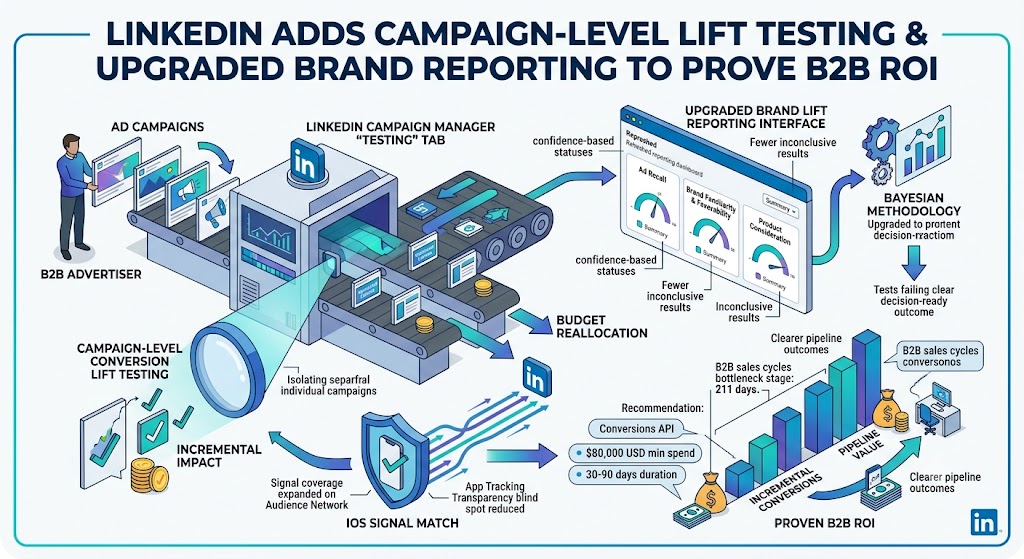
LinkedIn has expanded its incrementality measurement suite inside Campaign Manager with four new capabilities aimed at helping B2B advertisers prove that their campaigns are generating conversions that would not have occurred otherwise. LinkedIn announced the updates in a post on the LinkedIn for Marketing Blog, describing the changes as part of a Q4 push to give advertisers "clearer, more trustworthy decision-ready incrementality assessments."
Campaign-Level Conversion Lift Testing Replaces Account-Level Testing
The most significant structural change is the move from account-level to campaign-level Conversion Lift Testing. LinkedIn's Marketing Solutions Help documentation confirms Conversion Lift Testing is available to Campaign Manager users, and according to LinkedIn's blog announcement, the prior version ran tests at the account level, which made it difficult to isolate which individual campaigns were driving incremental results. The updated tool allows advertisers to run lift tests tied to specific campaigns.
According to LinkedIn's blog post, an unnamed company providing AI-powered contact center and communications solutions used the campaign-level test to move beyond last-click attribution. The test found that audiences exposed to the campaign were 26% more likely to convert than the control group, a result the company used to shift budget toward the highest-performing campaign strategies. TechWyse was unable to independently verify this figure through a separate primary source; it is sourced exclusively from LinkedIn's own published blog post.
LinkedIn's own Marketing Blog has noted that Conversion Lift Testing can help advertisers "secure a budget for brand campaigns that deliver more value and growth in the long run," a recurring theme in the platform's push to connect brand investment to measurable pipeline outcomes.
LinkedIn's Testing product page states that testing on the platform allows advertisers "to confidently evaluate and iterate on LinkedIn Ads" and to "show the data-driven value" of their investment. The campaign-level test is built directly into Campaign Manager and draws on LinkedIn's deterministic first-party member data, meaning advertisers can measure and act on results in the same interface where campaigns are planned and optimized.
Brand Lift Testing Reporting Gets a Design Overhaul
Brand Lift Testing measures the observed impact ads have on brand metrics such as ad recall, brand familiarity and favorability, and product consideration. LinkedIn's blog post states the reporting interface has been refreshed with clearer summaries, confidence-based lift statuses, and audience-driven insights, with the stated goal of making results accessible to marketers who are not data analysts.
Brand Lift test results can help advertisers measure the impact of ads on their brand using metrics such as absolute brand lift, estimated total lift, and relative brand lift. Survey data collected through the tests is anonymized and aggregated to protect member privacy.
Brand Lift Testing helps gauge the impact of ads on brand metrics, including awareness, consideration, familiarity, and favorability, and is designed to help advertisers close the loop on brand marketing efforts and better optimize for future brand value. The redesigned interface does not change the underlying methodology; it reorganizes how results are displayed.
iOS Measurement Gap Addressed in Conversion Lift
A persistent challenge in digital measurement has been the signal loss created by Apple's App Tracking Transparency framework. With the introduction of stricter privacy rules and data restrictions, attribution has become increasingly difficult because, for iOS users who do not share their IDFA, traditional attribution is no longer possible.
LinkedIn's blog post states the platform has introduced a privacy-preserving approach to match iOS traffic for measurement purposes, expanding signal coverage across the LinkedIn Audience Network. According to the announcement, these enhancements, previously available only in Brand Lift Testing, now extend to Conversion Lift Testing as well. The stated outcome is more accurate comparisons between exposed and control groups, particularly in campaigns running across the Audience Network.
LinkedIn's own help documentation acknowledges that due to "industry-wide privacy changes, Brand Lift Testing cannot measure lift for a portion of traffic on LinkedIn Audience Network," and the new iOS measurement update is LinkedIn's stated effort to reduce that blind spot specifically for Conversion Lift.
Bayesian Methodology Now Powers Lift Test Conclusions
LinkedIn's blog post also describes a methodology update designed to reduce the number of lift tests that return inconclusive results. The platform has shifted to a Bayesian approach to incremental measurement. The Bayesian method calculates the probability that a desired user action was caused by exposure to advertising, using posterior probability and statistical distributions. According to LinkedIn's announcement, the change is intended to produce more consistent detection of meaningful incremental impact and reduce the frequency of tests that fail to reach a clear decision-ready outcome.
What This Means for B2B Marketers in Practice
For B2B advertisers managing campaigns on LinkedIn, the shift to campaign-level testing is a practical change in workflow. Previously, an account-level lift test would aggregate results across all active campaigns, making it difficult to identify which specific campaigns were driving incremental conversions versus which were capturing demand that would have converted regardless. Campaign-level granularity allows for more precise budget reallocation decisions. According to Dreamdata's 2025 Benchmark Report, the average B2B buying journey is 211 days, with the biggest bottleneck occurring between the MQL and SQL stages, where leads can take more than three months to advance. In that context, the ability to isolate which campaigns are genuinely accelerating the pipeline, rather than merely appearing in attribution paths, has direct relevance to budget decisions across long sales cycles. LinkedIn recommends a minimum spend of $80,000 USD, a campaign duration of 30 to 90 days, and the use of the Conversions API to achieve conclusive test results, as stated in the blog post.
LinkedIn confirmed in its blog post that all four updates, campaign-level Conversion Lift Testing, the Brand Lift Testing interface refresh, the iOS measurement expansion, and the Bayesian methodology update, are now accessible through the Testing tab in Campaign Manager.