

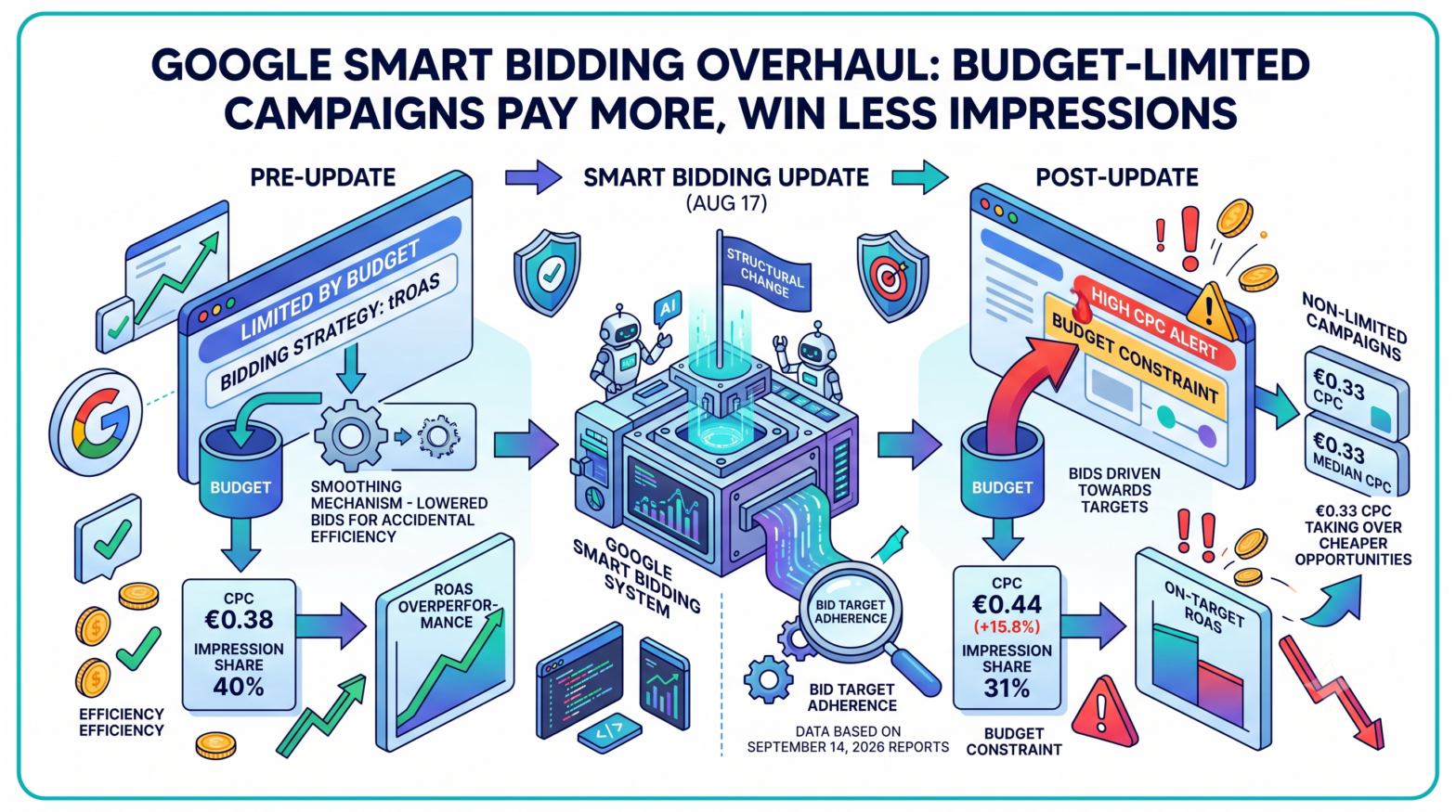
Budget-limited campaigns running Target ROAS or Target CPA bidding strategies are now paying more per click and winning fewer impressions, following a structural change to Google's Smart Bidding system. On August 17, 2026, Google updated its bidding systems to deliver more consistent and predictable performance based on the targets advertisers set, even when budget adjustments are made. The global rollout was completed on August 27, 2026, and the new bidding behaviour is now fully live across all affected accounts.
What Google Changed and Why
Previously, when a campaign carried a "Limited by budget" status and used a target-based bid strategy such as Target CPA or Target ROAS, some campaigns overperformed on bidding targets and saw performance fluctuations when budgets were adjusted. Google has confirmed that was never the intended behaviour.
Starting August 17, Google updated bidding target optimization to help campaigns limited by budget deliver more predictable performance in line with their bidding targets, especially as advertisers scale their campaigns. Google's own Help Center documentation illustrates the practical consequence directly: a budget-constrained campaign with a Target CPA of $10 that had been achieving a $5 CPA would, once the update took effect, start delivering closer to the $10 target originally set.
The update applies to Search, Shopping, Performance Max, Demand Gen, and Travel campaigns managed in Google Ads or Search Ads 360, as well as Demand Gen campaigns managed in Display & Video 360. App Campaigns, Video reach campaigns, and Video view campaigns continue using the previous bidding behaviour.
The Mechanism That Was Removed
Google had been lowering bids on budget-limited campaigns to stop them exceeding budget, which meant most of those campaigns were effectively rank-limited by CPC rather than by budget, and that situation is now reversing.
The practical effect of that mechanism on campaign performance was significant. Before August 17, more than half of the budget-limited campaigns in Smarter Ecommerce's analysis were exceeding their ROAS targets. Among campaigns that were not budget-limited, only 30% overdelivered, while 57% landed on target. In other words, budget-constrained campaigns were systematically outperforming their stated efficiency targets, not because of superior optimization, but because suppressed bids produced cheaper clicks.
Post-Update CPC and Impression Share Shifts
Mike Ryan, Head of Ecommerce Insights at Smarter Ecommerce, published post-update median CPC data on September 14, 2026, drawing on campaign-level data tracked across the rollout window. Smarter Ecommerce's analysis found median CPCs for budget-limited tROAS campaigns increased 15.8% after August 17, while CPCs for campaigns that were never budget-limited fell 13% over the same period.
The impression share data shows an equally sharp reversal. Before August 17, the median budget-limited campaign lost roughly 45% of impression share because of ad rank and just 4% because of budget. After the update, rank losses fell to around 30%, while losses caused by budget jumped to roughly 33%. Overall median impression share for budget-limited campaigns fell from 40% to 31%, suggesting campaigns are now hitting their budget constraints more directly instead of stretching those budgets through lower bids.
CPC Effects Across the Broader Auction
Median CPCs for budget-limited campaigns rose from €0.38 to €0.44, while CPCs for non-limited campaigns fell to €0.33. Ryan's analysis suggests cheaper auction opportunities previously captured by constrained campaigns may now be shifting toward advertisers without those budget limitations.
What Advertisers Can Do
Google recommends reviewing settings and ensuring they align with business goals, especially for "Limited by budget" campaigns that historically performed better than their targets. Google does not automatically adjust bidding targets or budgets.
For campaigns performing better than their stated target where advertisers want to maintain current actual performance, Google's Bid Target Adjustment Tool, available since July 6, 2026, allows advertisers to adjust targets based on recent campaign performance.
Ryan's analysis points to several practical responses for affected campaigns: accepting reduced reach and higher CPCs if the prior ROAS overperformance was incidental; moving tROAS targets closer to historically delivered performance to moderate CPC increases; increasing budgets where the underlying economics support it; or switching from target-based bidding to Maximize Conversions, a strategy that cannot carry a budget-limited status by design since its objective is to maximize conversions within whatever budget is available. These are reported implications of the update based on how Smart Bidding systems function, not guaranteed outcomes. Individual campaign results will vary.
ROAS Verdict Still Pending
The post-update CPC and impression share data are now measurable. The full ROAS outcome for previously overdelivering campaigns is not. Conversion attribution takes time to settle, and Ryan stated that a complete performance assessment would require 30 to 60 days of post-rollout data, placing a fuller read on campaign efficiency sometime between mid-September and mid-October 2026.
Google Ads Liaison Ginny Marvin stated that advertisers who want to preserve the efficiency they are currently achieving can move their target towards their current average performance.