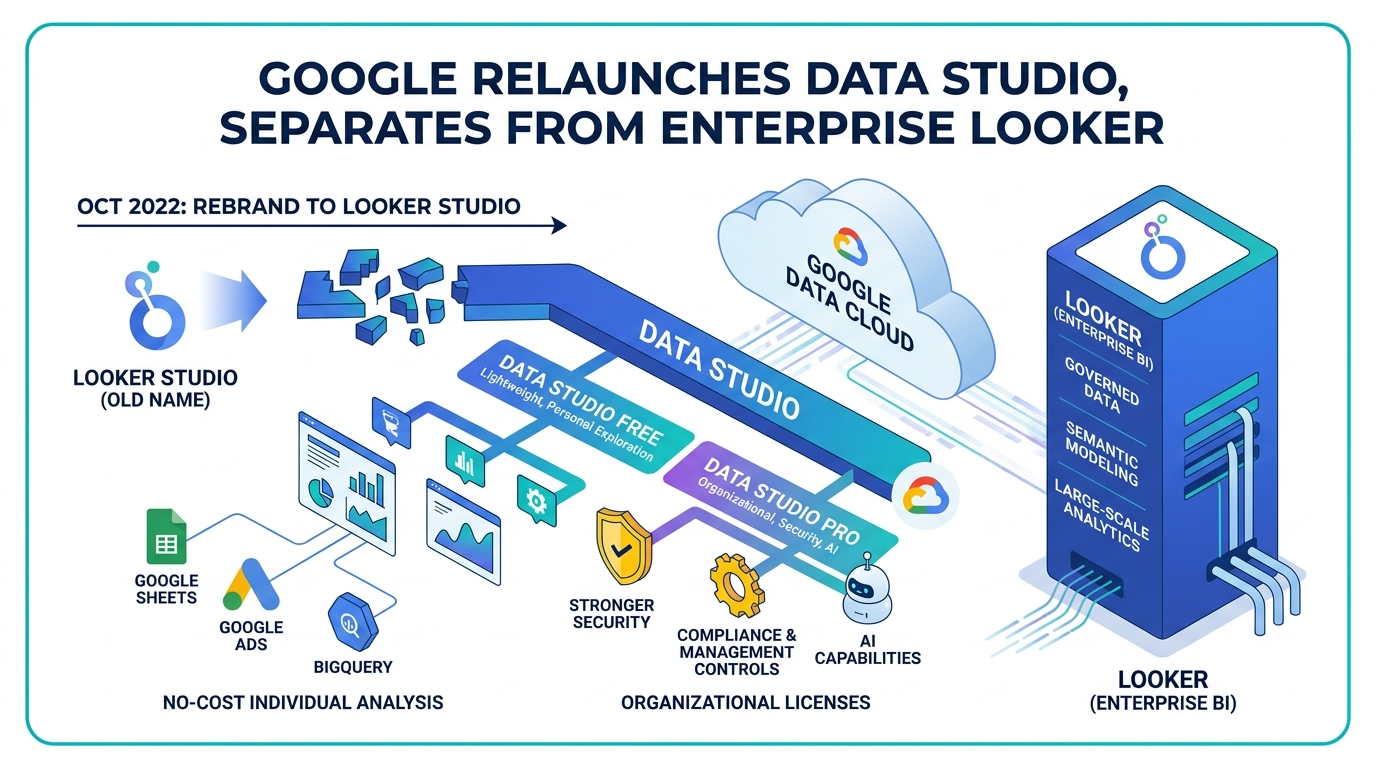
Google Cloud users who rely on Looker Studio for data visualization will find the product operating under a new name. On April 11, 2026, Google announced it is retiring the "Looker Studio" name and reintroducing Data Studio as the official brand for its lightweight analytics and visualization tool.
As of April 13, 2026, Looker Studio is called Data Studio, a name the product previously held before Google reversed course, returning to it with what it describes as a new, expanded mission.
Google Cloud Blog Confirms the Name Change
According to the Google Cloud Blog, Data Studio is described as "playing a significant role in the AI era serving Google Data Cloud content," giving users a single place to browse and interact with a variety of Google data sources and assets: from Data Studio reports, to BigQuery conversational agents, to data apps built in Colab notebooks.
The announcement marks the end of a naming experiment that began three and a half years ago. On October 11, 2022, at Google Cloud Next, Google announced that all its Cloud BI products would be rebranded under the Looker name, making Data Studio into Looker Studio. The intention at the time was to consolidate the company's business intelligence portfolio under a single unified umbrella, with the Looker brand, acquired by Google in 2020, positioned as the flagship BI platform, and Data Studio absorbed into the "Looker family" of products.
Data Studio and Looker Now Serve Distinct Roles
Under the restructured product line, the two tools now occupy formally separated positions in Google's analytics portfolio. Looker will remain Google Cloud's enterprise business intelligence platform, focused on governed data, semantic modelling, and large-scale analytics. Data Studio, by contrast, is being positioned as the faster, more flexible option for personal exploration, ad hoc reporting, and lightweight dashboards across services like BigQuery, Google Sheets, and Ads.
As stated in the Google Cloud Blog, with Looker serving as the enterprise BI platform, Google is evolving Data Studio to complement Looker independently. Looker has also recently seen significant investments in its self-service and visualization offerings, including agentic capabilities for use cases that demand trusted, governed data powered by a central semantic model.
Two Editions: Data Studio Free and Data Studio Pro
The new Data Studio experience is available in two editions. The standard tier continues to offer no-cost individual analysis and visualization, serving as the entry point for creating and sharing ad-hoc reports and transforming data into interactive dashboards.
Data Studio Pro is aimed at larger organizations that need stronger security, compliance, management controls, and AI capabilities, with licenses sold through the Google Cloud and Workspace admin consoles.
Existing Reports and Data Sources Carry Over Automatically
For existing users, all reports, data sources, and assets will be transitioned with no action required. Google has described the upgrade as largely transparent for users who rely on the product in their daily work.
The transition is fundamentally a naming change, meaning the underlying functionality of existing dashboards and data connections remains intact.
What the Separation Means for Marketers and Analytics Teams
For digital marketing practitioners, the clearer product boundary between Data Studio and Looker has practical implications. Data Studio's direct connectivity to Google Ads, Google Sheets, and BigQuery makes it the more accessible path for campaign reporting, performance dashboards, and ad hoc analysis without requiring enterprise BI infrastructure. Teams that previously needed to evaluate which "Looker" product fits their use case now have a more direct answer based on whether their needs are exploratory or governed. Data Studio Pro's availability through the Google Workspace Admin Console may also simplify procurement for organizations already operating within Google Workspace.
Further Details Expected at Google Cloud Next '26
Google plans to share more about the relaunch and its broader analytics strategy at Google Cloud Next '26 later this month. Google Cloud Next 2026 takes place April 22–24, 2026.
Looker has recently seen significant investments in its self-service and visualization offerings, including agentic capabilities for use cases that demand trusted, governed data powered by a central semantic model, according to the Google Cloud Blog announcement confirming the relaunch.