

Product ratings have always been valuable data wrapped in an awkward delivery system.
Google is changing that.
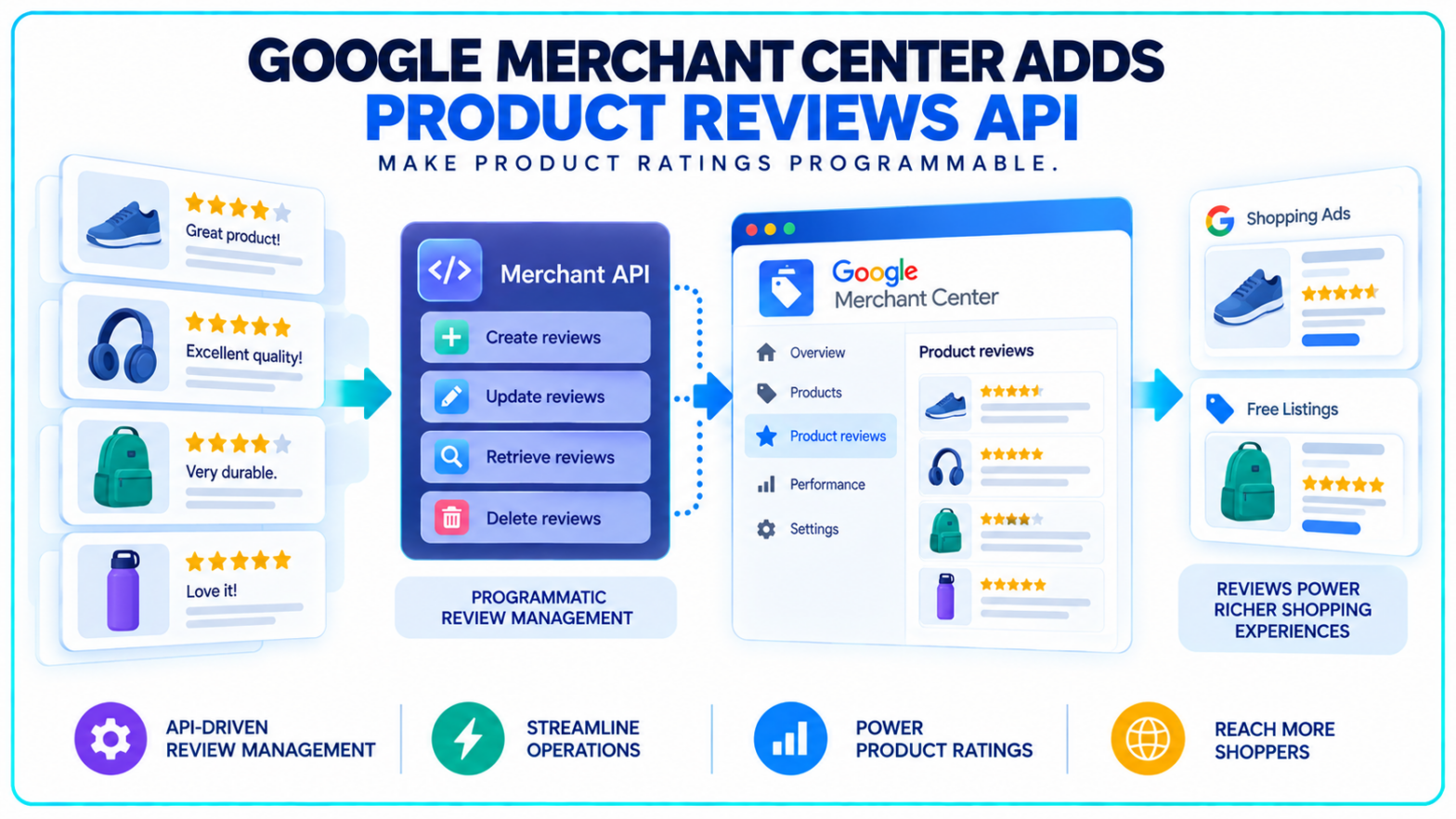
Merchant Center now supports product review management through the Merchant API, allowing eligible retailers and commerce platforms to create, update, retrieve and delete review data programmatically rather than depending entirely on XML uploads, scheduled feeds or review aggregators.
The change does not alter how Google collects or evaluates reviews. It changes how merchants can send them.
For large catalogues and retailers receiving new reviews every day, that distinction removes a stubborn manual layer from Product Ratings management.
The Merchant API Can Now Manage Individual Reviews
Google has added “Add product reviews using API” as an official submission option inside Merchant Center.
The updated Google Merchant Center product reviews documentation lists the Merchant API alongside scheduled fetches, SFTP, Google Cloud Storage and direct file uploads as a way to supply review data.
The API itself goes further than simply accepting another version of a feed.
According to Google’s Merchant API documentation for product reviews, developers can create or update a review using the accounts.productreviews.insert method, retrieve individual reviews, list reviews associated with an account and delete entries programmatically.
That gives retailers more granular control over review data.
Under a conventional XML workflow, merchants generally assemble a complete review data source and send it to Google as a file. If an existing review needs to disappear, Google’s file-based documentation instructs merchants to remove it from the next submitted data source.
API management allows those operations to become part of a retailer’s existing commerce infrastructure instead.
A review platform, internal ecommerce system or middleware application could theoretically push changes to Merchant Center as the underlying review dataset changes, provided the integration meets Google’s access requirements.
API Access Does Not Remove Product Ratings Requirements
There is an important limitation.
The new product reviews API is not an open endpoint that every Merchant Center account can begin using immediately.
Google says merchants need an active product review feed, must be enrolled in the Product Ratings program and must submit an allowlist request through its Shopping API support form before managing product reviews with the Merchant API.
The Product Ratings eligibility requirements also still apply. Merchants submitting their own review data need at least 50 reviews across their products, and Google subjects submitted data to quality and policy review.
New review sources do not necessarily appear immediately, either. Google says initial processing and onboarding can take two to four weeks.
So the API changes data operations, not programme eligibility.
Retailers still need valid product identifiers such as GTIN, or brand and MPN combinations, so Google can match a submitted review with the correct item. Review content also remains subject to Google’s policies.
That quality layer has become more explicit elsewhere in Search. TechWyse recently covered Google’s tightened rules around fake and incentivized review content, which reinforced that review visibility depends on the integrity of the underlying data rather than simply having review markup or a feed available.
Review Operations Can Move Closer to the Product Feed
The larger change is architectural.
Google Merchant Center has traditionally been built heavily around data sources. Products, promotions, inventory and reviews are supplied to Google, processed, checked and then connected to the surfaces where shoppers may encounter them.
API support lets product reviews operate more like live commerce data.
Consider a retailer handling thousands of products and a steady stream of customer ratings. Under a file-driven process, changes may be bundled into XML, validated, exported and then uploaded or fetched on a schedule. Even when that process is automated internally, Merchant Center still receives the result as a feed.
The Merchant API opens a more direct route.
That is particularly relevant as Google continues making the product catalogue a common data layer across Shopping ads, free listings and AI-driven commerce experiences. TechWyse recently examined how Merchant Center is becoming a more unified retail reporting layer rather than simply a dashboard for submitting product feeds.
Reviews now fit more naturally into that model.
The product record describes what is being sold. Inventory and pricing establish availability. Review data adds the customer feedback that can appear as aggregate Product Ratings alongside those products.
Making another part of that stack programmable reduces the number of commerce datasets that have to be maintained through separate manual workflows.
Better Automation Does Not Guarantee More Rating Stars
Product reviews uploaded to Google can contribute to aggregate ratings displayed across Google shopping experiences.
Google says Product Ratings can appear on Shopping ads and free product listings, with reviews compiled from several sources including merchants, review aggregators, review sites and Google users.
Submitting review data does not guarantee that Google will display stars for every product.
Matching still matters.
Google relies on unique product identifiers to connect a review with the appropriate item. Poor GTIN coverage, incorrect brand or MPN values and inconsistencies between review data and the main catalogue can interfere with that process.
That makes the API useful for automation, but not a substitute for clean product data.
The same principle increasingly applies across Google Shopping. TechWyse reported earlier this year that Google is expanding Merchant Center reporting into AI-driven shopping experiences, where the accuracy and completeness of merchant-supplied product information becomes part of how brands are represented in newer discovery environments.
Reviews add another dataset that needs to stay synchronized with the product catalogue.
A faster submission pipeline cannot correct mismatched identifiers on its own.
Merchant Center Is Moving Away From File-Only Commerce Management
The timing is notable because Google is already pushing developers toward the Merchant API more broadly.
Google’s legacy Content API for Shopping reached its scheduled sunset in August 2026, with Google directing developers toward the newer Merchant API for programmatic Merchant Center management.
Product review support makes that replacement more complete.
For ecommerce teams, agencies and platforms, the practical opportunity is to examine where review data currently enters the Merchant Center workflow. Businesses maintaining large or frequently changing datasets may now be able to connect review systems directly to the Merchant API rather than repeatedly generating and transferring complete XML files.
Smaller merchants with stable review volumes may have less reason to change. Google still supports direct uploads, scheduled fetches, SFTP and approved third-party aggregators, and those methods can remain simpler when the dataset does not justify an API integration.
TechWyse has also tracked Google’s expansion of Merchant Center tools for agencies managing multiple retail accounts. Product review automation adds another task that can move out of repetitive account-level maintenance and into a centralized technical workflow.
Google has not removed the existing review-feed system.
It has added a programmable route beside it.
For merchants already building around the Merchant API, product ratings no longer have to remain one of the few pieces of Shopping data managed through a separate file pipeline.