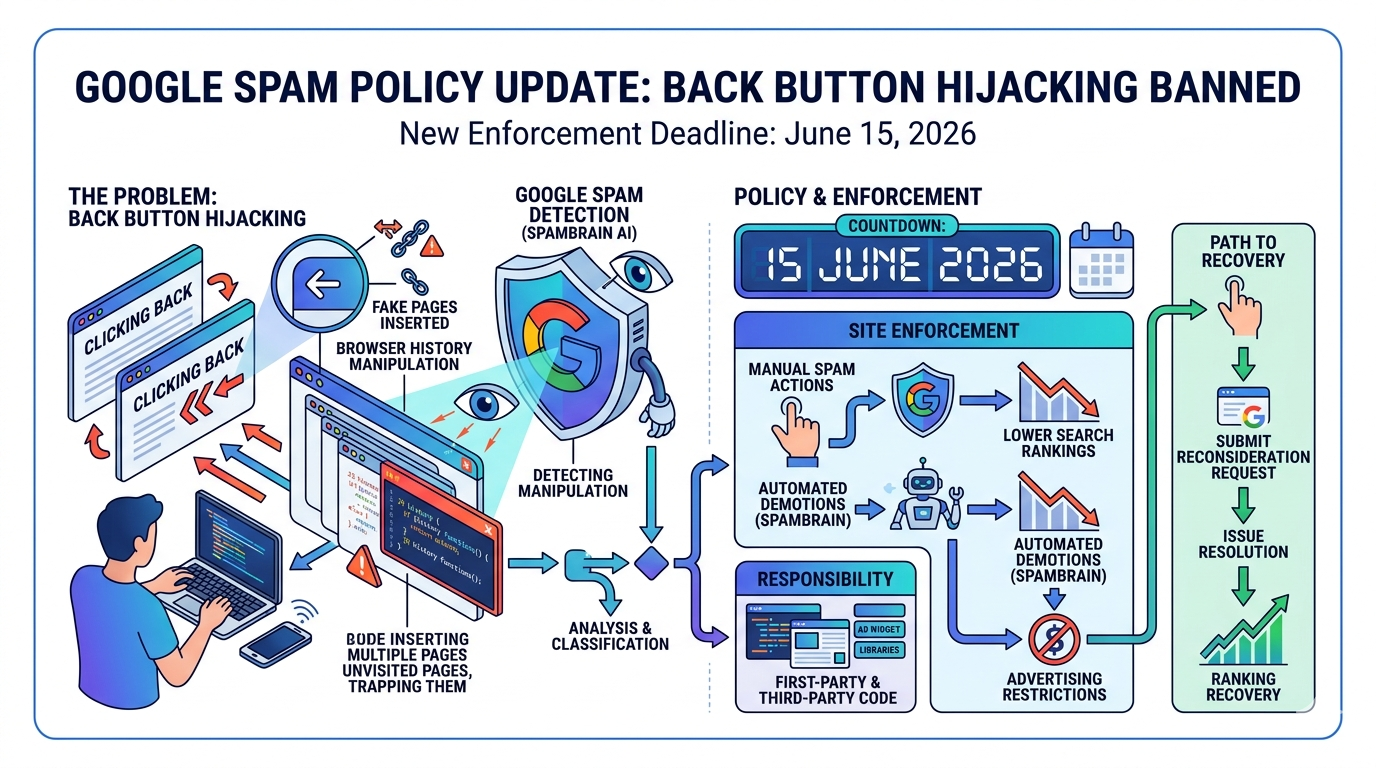
Sites that manipulate browser navigation to trap users or redirect them without consent now face ranking penalties in Google Search. Google Search Central announced on April 13, 2026, a new spam policy that explicitly bans back button hijacking, with pages found in violation subject to manual spam actions or automated demotions, and enforcement set to begin on June 15, 2026.
What the Policy Covers
Back button hijacking is defined in Google's updated spam policies documentation as a practice where "a site interferes with user browser navigation by manipulating the browser history or other functionalities, preventing them from using their back button to immediately get back to the page they came from." Users affected by the practice may be sent to pages they never visited before, presented with unsolicited recommendations or ads, or otherwise blocked from normal browser navigation.
The addition falls under Google's malicious practices category, a section that covers behaviours causing a gap between user expectations and actual experience, including malware distribution and unwanted software installation. Google expanded the existing spam policy category rather than creating a new one.
Why Google Is Acting Now
The announcement was posted on April 13, 2026, by Chris Nelson on behalf of the Google Search Quality team via the Google Search Central Blog. In the post, Google cited a documented increase in the behaviour as the reason for formal action. Google stated that back button hijacking has been on the rise and, because it is objectively harmful to user experience, it is being designated a "malicious practice", a classification that means sites manipulating browser navigation can face consequences, including lower search rankings.
Google's announcement also noted that the practice has measurable effects on user trust. Google stated that user experience comes first, and that back button hijacking interferes with browser functionality and breaks the expected user journey. The post added that people report feeling manipulated by these experiences, and that repeated exposure makes them less willing to visit unfamiliar sites.
Scope of Responsibility: First-Party and Third-Party Code
Sites currently using any script or technique that inserts or replaces deceptive or manipulative pages into a user's browser history, preventing the back button from functioning as expected, are required to remove or disable it before the June 15 deadline.
Google noted that some instances of back button hijacking may originate from a site's included libraries or advertising platforms, placing responsibility on site owners regardless of the source. Google's wording indicates sites can be affected even when the issues come from third-party libraries or ad platforms, placing responsibility on websites to review what runs on their pages.
Sites using advertising scripts, content recommendation widgets, or third-party engagement tools should audit those integrations before June 15.
Enforcement Mechanism and Recourse
Google's primary spam detection tool is SpamBrain, an AI-based system that continuously processes web content against known violation patterns. When Google identifies a new category of manipulation, that category can be incorporated into SpamBrain's detection models over time.
Sites that receive a manual action have a formal path to recovery. As stated in Google's April 13 blog post, if a site has been affected by a manual action and the issue has been resolved, owners can submit a reconsideration request through Google Search Console.
Implications for Site Owners and SEO
For site owners and digital marketers, this policy change has direct technical SEO implications. Landing pages that use aggressive exit-intent overlays, interstitials, or JavaScript-based History API manipulation to retain users or serve additional ad inventory should be audited immediately. The enforcement implications extend beyond organic search: as of December 2024, Google began linking manual search penalties to advertising eligibility, meaning a site subject to a manual spam action for back button hijacking could face advertising restrictions as well. Sites dependent on both organic traffic and Google Ads revenue carry compounded exposure under this framework.
Google confirmed the two-month advance notice was intentional, publishing the policy ahead of enforcement on June 15, 2026, to give site owners time to make any needed changes.