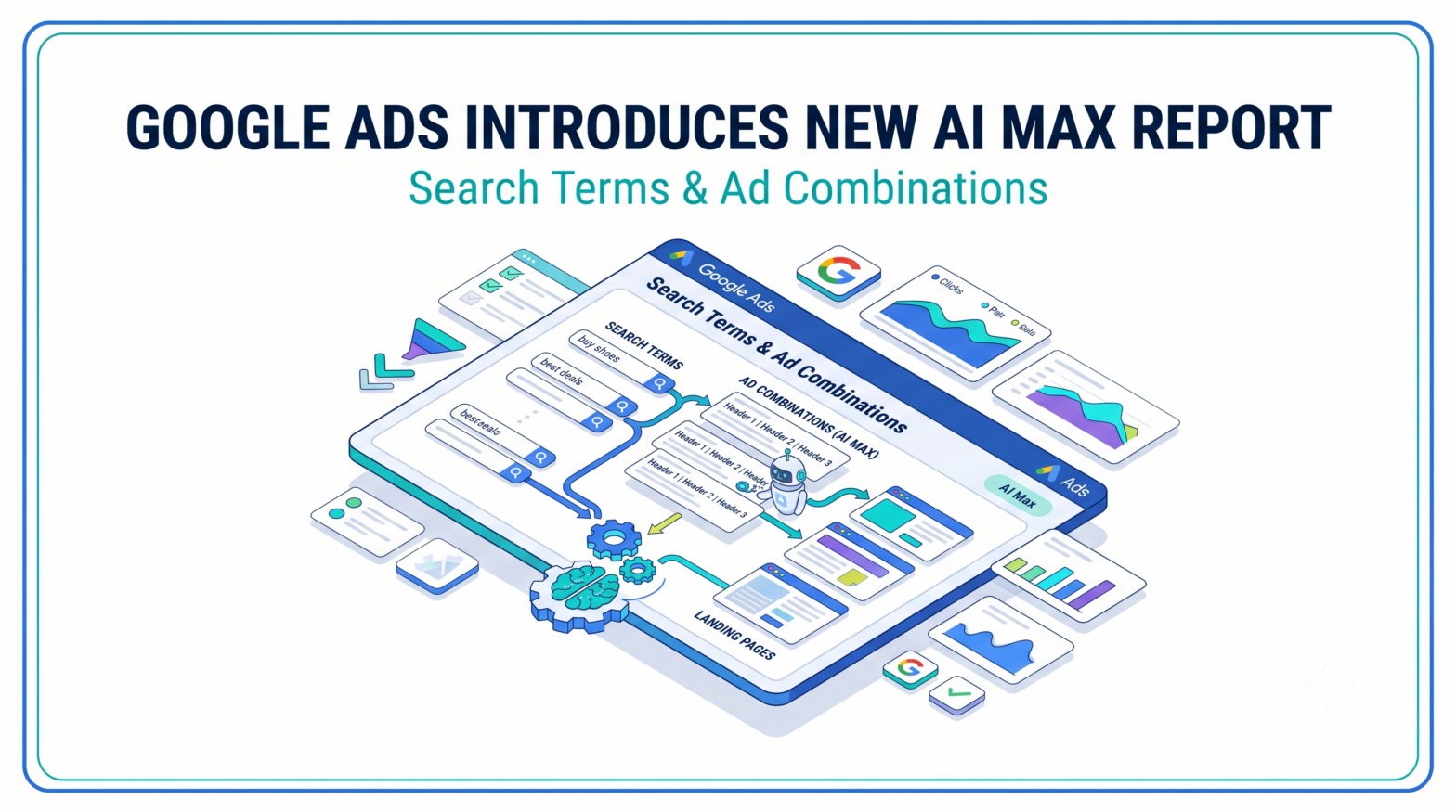
Google Ads advertisers running AI Max for Search campaigns now have a new reporting tool that surfaces search queries, ad copy, and landing pages in a single view. The report, called Search terms and ad combinations, has begun appearing in select Google Ads accounts as of October 13, 2026, with broader rollout timing not yet announced by Google.
The report is accessible within the Google Ads interface by selecting the Search terms dropdown and choosing "Search terms and ad combinations." It lists the search terms that triggered ads and shows the headlines, landing pages, campaigns, and ad groups that made up the full customer ad journey.
What the Report Shows
Google's API documentation for the `AiMaxSearchTermAdCombinationView` resource describes it as providing a view of the combination of search terms and ad components, with the resource name including details about the customer, ad group, search term, landing page, and headline. The resource includes fields for the ad group where the search term served, the search term itself, the dynamically generated landing page, and the concatenated headline assets.
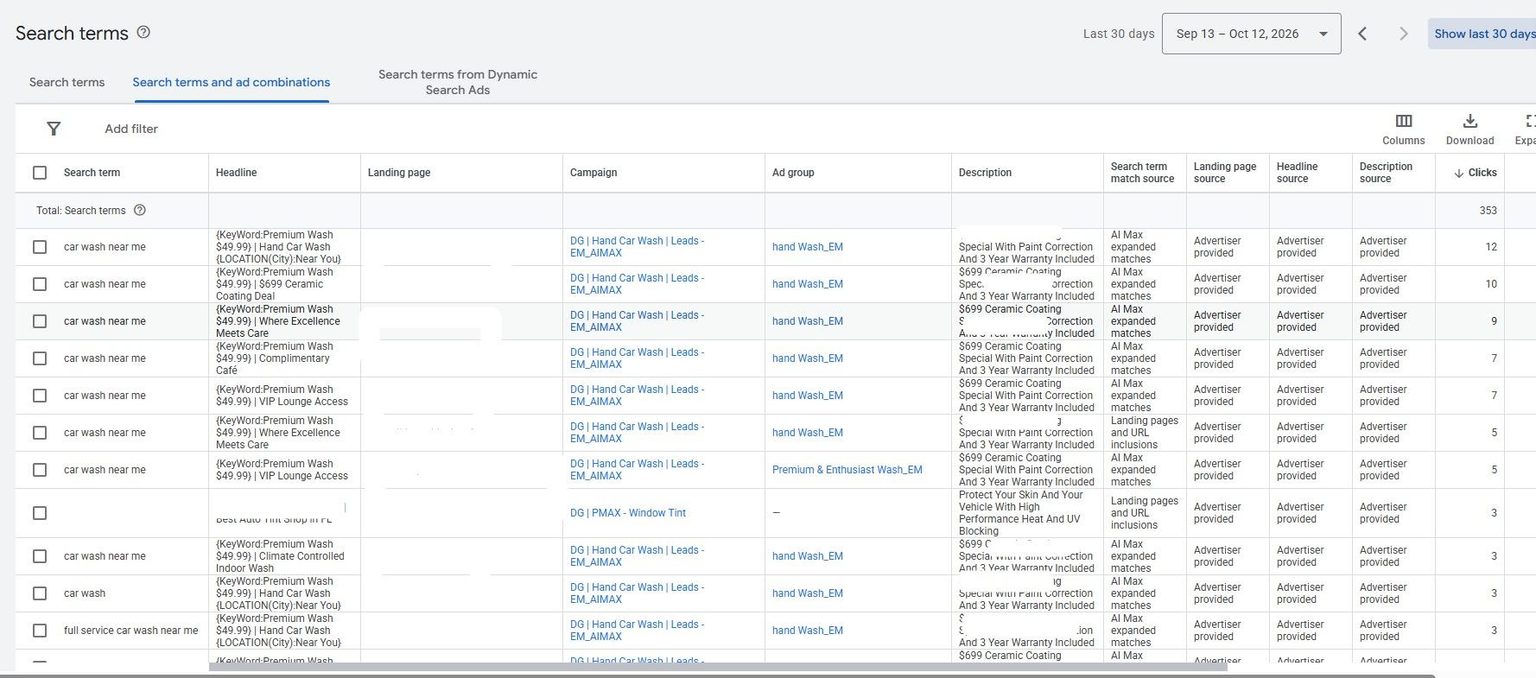
Within the report, the headline field displays a concatenated string of up to three headline assets, separated by a pipe character. In addition to these fields, the report surfaces match sources, indicating whether traffic came from AI Max expanded matches or from landing page and URL inclusions, and asset sources, showing whether ad assets were provided by the advertiser.
The Match type column in the search terms report indicates how closely the search terms that triggered ads are related to the actual keywords in the account. Advertisers should note one data consideration: when filtering for match type equal to "AI Max," the search terms report may show lower numbers, because that filter does not account for "Other search terms."
Background: AI Max for Search
AI Max for Search campaigns are a comprehensive suite of targeting and creative enhancements designed to bring Google's AI capabilities into existing Search campaigns. Google began rolling out AI Max for Search campaigns in beta in late May 2026, having announced the feature at Google Marketing Live 2026. AI Max can expand matching through broad match and keywordless technology, drawing on keywords, creative, and URLs. Its text customization and Final URL Expansion settings can adapt ad copy and destinations. Google describes it as an optimization layer rather than a new campaign type.
Support for `ai_max_search_term_ad_combination_view` was formalized in the Google Ads API to report on performance for combinations of search terms, headlines, and landing pages, showing which search queries triggered ads and how those specific combinations performed. A future API release is expected to include an additional view incorporating Performance Max data.
Report Availability and Known Limitations
The report has been confirmed in at least one Google Ads account, but broader availability and rollout timing have not been announced by Google. The report was first observed by Google Ads specialist Natasha Kaurra, who shared details of the feature on LinkedIn.
Advertisers using the report should also be aware of an important timing consideration. Google advises waiting at least two weeks after enabling AI Max in a new or existing Search campaign before making changes such as adding negative keywords, so the system has sufficient data to stabilize.
Practical Implications for Advertisers
Advertisers running AI Max for Search campaigns can use this report to audit whether Google's automation is pairing high-spend search terms with appropriate ad messaging and landing page destinations. Because AI Max operates across broad match and keywordless traffic simultaneously, discrepancies between query intent and served ad copy can go undetected in standard search term reports. This consolidated view allows campaign managers to cross-reference query intent, creative output, and landing page selection in a single interface, reducing the manual effort of reconciling data across separate reporting surfaces. Decisions based on this report should account for conversion performance and cost per qualified lead, not click volume alone.
Google's official Help documentation describes the report as a tool to understand AI Max automation traffic and its value, assess headline and landing page relevance to search terms, and simplify account structure with automation insights.