
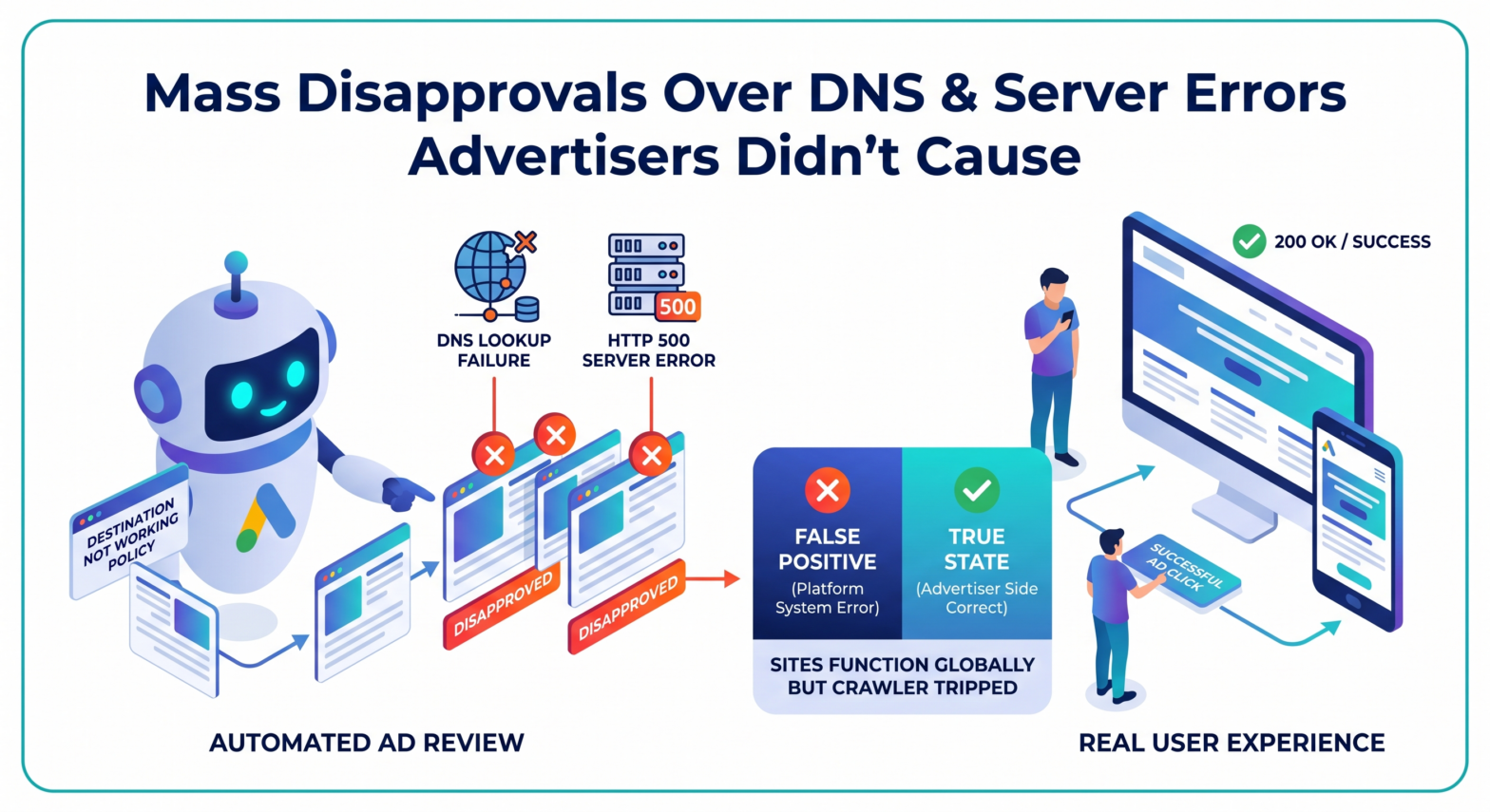
Hundreds of Google Ads accounts were abruptly paused this week after the platform's automated review system flagged landing pages for DNS lookup failures and HTTP 500 server errors, errors that advertisers and their IT teams say did not exist. Google has not issued a public statement acknowledging the incident as of publication.
Scope of the Reported Disruptions
PPC advertisers began flagging widespread problems this week across Google Ads accounts, with multiple agency leaders reporting that clients were affected simultaneously. Ryan Berry, Managing Director at Cornerhouse Media, said more than 1,500 ads were disapproved in a single account at approximately 1:30 p.m. UTC.
Google Ads trainer Charlotte Osborne reported two separate cases in the same week, one tied to a DNS error and another to an HTTP 500 error, with no issues found on the client side. Google Advertising specialist Joshua Barr said he received "lots of emails overnight" about disapproved ads and had been dealing with similar problems for weeks. Several paid search specialists confirmed they were seeing the same issue across multiple accounts.
In several cases, hundreds or thousands of ads were disapproved at once, often without any clear reason tied to actual website performance. Many advertisers reported receiving overnight notifications about disapproved ads, while others noticed abrupt drops in traffic and conversions due to paused campaigns.
How Google's Ad Review System Triggers Disapprovals
The disapprovals were issued under Google's "destination not working" policy. According to Google's Advertising Policies Help Center, Google requires that ad destinations work on common browsers and devices, and destinations that don't function properly or that return an HTTP error code for Google AdsBot web crawlers on common devices globally are subject to disapproval.
Google also requires that ad destination content be crawlable by Google AdsBot web crawlers to confirm that users are directed to a destination that reflects the ad they clicked. This means the review process is conducted by automated systems, not by a live human checking the advertiser's site.
If Google's crawler encounters a DNS issue, timeout, 4xx response, 5xx response, redirect problem, location-based failure, or blocked access, the ad can be disapproved even if the page loads correctly for end users. A DNS error generally means Google had trouble resolving the domain to reach the site, while a 500 error means the request reached the server, but the server failed to return a valid response.
Why Functional Sites Can Still Fail Crawler Review
Landing pages may behave differently for crawlers across different geographies, devices, or network paths. Security rules, CDN settings, redirect logic, and intermittent server issues are common causes of this discrepancy.
Google Ads depends heavily on automated checks, and if those checks become more sensitive to timeouts, redirect behaviour, server headers, or blocked crawler access, advertisers can see more disapprovals without having intentionally changed anything in their campaign setup.
Three explanations are plausible when mass disapprovals occur across unrelated accounts in a compressed timeframe. The first is genuine technical instability; a shared hosting provider, DNS provider, CDN, or security service can introduce intermittent failures that may not be visible to every user but can still be detected by crawlers hitting the site from different locations and user agents. The second is a platform-side issue, where a crawler problem, timing issue, or false positive generates a wave of disapprovals that do not reflect the actual user experience. That outcome should not be assumed immediately, but it cannot be ruled out when multiple accounts show the same pattern. The prudent response is to treat the disapproval as real until destination problems have been ruled out, while documenting account-level impacts in case the issue is broader.
Practical Steps for Affected Advertisers
For advertisers dealing with these disapprovals, Google's policy documentation outlines a structured path to resolution. Advertisers should confirm that their ad leads to a site or app returning an HTTP 200 response code globally, and even if the site appears to be working as intended, they should test for issues and check for HTTP error codes using Google AdsBot web crawlers.
Google advises that if an advertiser believes their ad was incorrectly flagged under this policy, they should file an appeal to initiate a new review. Advertisers can verify URL accessibility by using Chrome DevTools with the user agent string set to Google AdsBot.
From a technical infrastructure standpoint, reviewing logs, uptime monitoring, DNS history, redirect behaviour, crawler access settings, and recent site changes is the recommended first step before concluding the problem originates on Google's end. If everything in that audit is clean and many advertisers are reporting similar issues at the same time, a platform-side false positive becomes more plausible. Checking the exact policy reason, affected URLs, server response behaviour, redirect chains, firewall controls, and recent infrastructure changes will help narrow the cause, as mass impact typically points to a shared origin.
Google had not issued a formal response or posted an incident report on the Google Ads Status Dashboard acknowledging this specific wave of disapprovals as of April 16, 2025.