
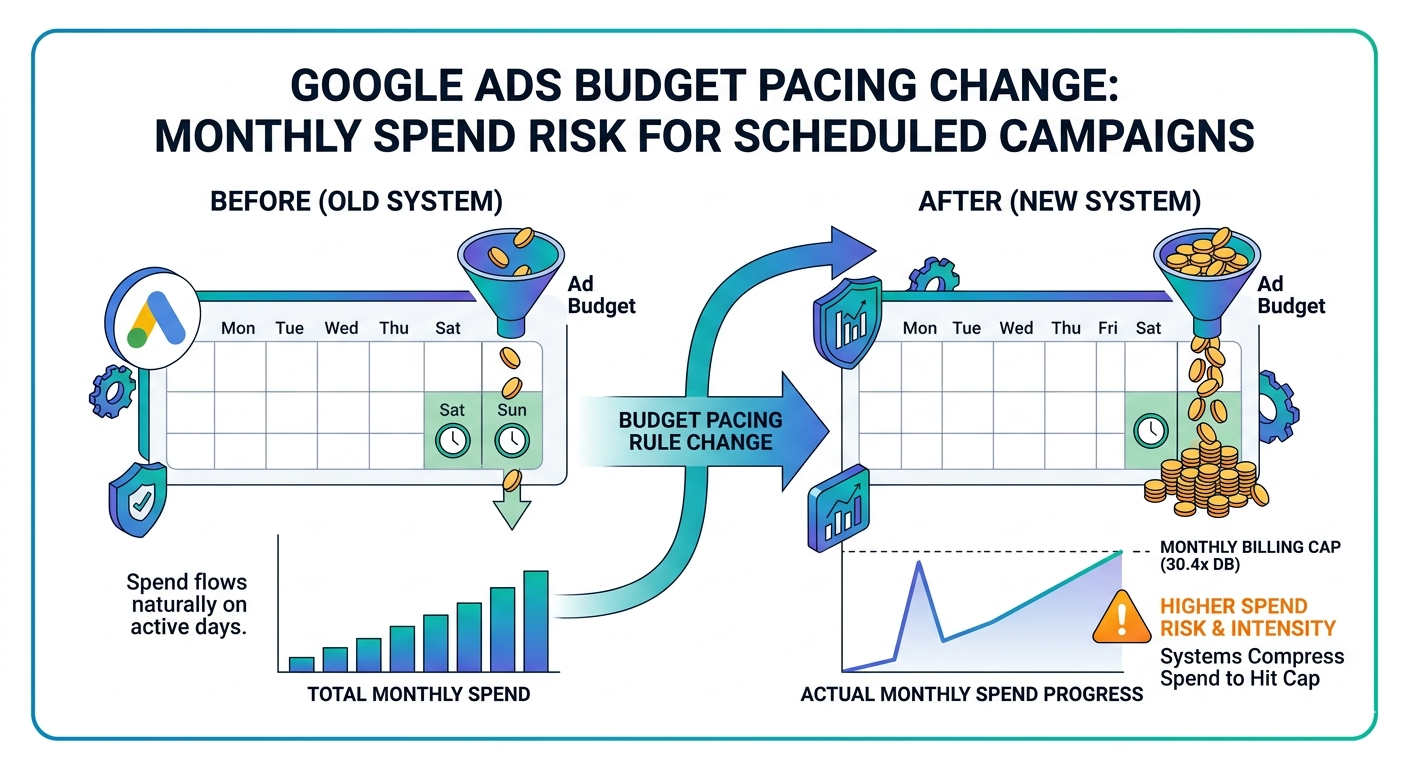
Advertisers running Google Ads campaigns on restricted day or hour schedules face higher monthly spend under a pacing rule change now rolling out across accounts. Google confirmed in a direct email to select advertisers, first made public on February 19, 2026, that its systems will now proactively pace budgets toward the full monthly spending limit, 30.4 times the average daily budget, regardless of how many days a campaign is scheduled to run.
What Google Changed and When
Google's budget pacing system for campaigns with ad scheduling now proactively attempts to spend up to the full 30.4x average daily budget monthly cap, regardless of how many days the ad schedule restricts campaign activity. Previously, the system tracked closer to active days multiplied by the daily budget; now it targets the full monthly ceiling and compresses that spend into whatever windows the ad schedule permits.
Google's rollout email, shared publicly on LinkedIn by Jordan Fry, CEO of RevAmp, stated: "Starting on March 1, 2026, we'll gradually begin rolling out a change to Google Ads average daily budget pacing for advertisers using Ad Scheduling." The email confirmed that the monthly spending limit remains 30.4 times the average daily budget, but that Google's systems will now proactively attempt to spend up to this limit regardless of a campaign's ad schedule.
The budget pacing change took effect on March 1, 2026, for accounts in the first notification wave. Starting June 1, 2026, Google will pace toward the monthly cap, 30.4 times the daily budget, across the days any ad schedule allows, regardless of how many days that actually is.
What the Spending Limits Are, and Are Not, Changing
The structural billing caps are not being altered. The monthly bill is still capped at 30.4 times the daily budget, and the daily bill is still capped at two times the daily budget. Campaigns will still not run on days when the schedule is disabled. What is changing is how aggressively Google spends on the days a campaign is active.
Google Ads Liaison Ginny Marvin addressed the change directly on X on February 19, 2026. Marvin stated: "We're making this change to brolled out graduallyt pacing functionality when ad scheduling is in place with advertisers' expectations for monthly spending limits." Marvin also confirmed that spend will still be driven by campaign objectives such as conversions or conversion value, and that no campaign will exceed the existing billing caps. She clarified that only advertisers who received direct notifications about the update will be affected, and that the change is being slowly rolled out.
Google has confirmed that Local Services Ads and select other campaign types are not affected by the pacing change. Home services businesses and other advertisers running LSAs alongside standard Search campaigns will see the change apply only to the Search campaigns, not to LSAs.
How Much Can The Spending Increase
The gap between old and new pacing behaviour is most visible in campaigns with the fewest active days. Marvin provided a concrete example: for a campaign scheduled to run weekends only with a daily budget of $100, the previous monthly spend would have been approximately $800 (8 weekend days multiplied by $100). Under the change, that same campaign could reach $1,600 per month, 8 days multiplied by the $200 two-times daily spend limit. To maintain the $800 monthly total, the daily budget would need to be reduced to $50.
The tighter the schedule, the larger the swing between the old and new pacing behaviours. For advertisers who have previously relied on ad scheduling to naturally moderate overall monthly costs, this could result in more concentrated spend during active periods.
Which Campaigns Are Affected
This change applies to all campaign types that support ad scheduling. Campaigns that do not use ad scheduling will not be affected. Advertisers who did not receive the email notification are not included in the initial phase. Google is rolling the update out gradually, and advertisers will be notified individually before the change takes effect for their specific accounts.
Practical Implications for Paid Media Management
Advertisers using ad scheduling as a passive budget control mechanism, where a restricted schedule served to keep monthly totals below the full 30.4x ceiling, will need to recalibrate daily budgets before the change takes effect on their accounts. Advertisers whose campaigns target a specific monthly spend figure should calculate the daily budget that aligns with the new pacing by dividing the monthly goal by 30.4, then update campaigns accordingly. Those who rely on evenly distributed spend to control daily pacing may see faster early depletion of budgets on active days. Automated bidding strategies may also respond unpredictably to the shift in pacing intensity, making post-rollout monitoring of hourly and daily spend velocity a necessary step for any campaign running a non-standard schedule.
In its notification to advertisers, Google stated: "We're making this change to better align budget pacing functionality when ad scheduling is in place with advertisers' expectations for monthly spending limits." Google recommended that advertisers review daily budgets in affected campaigns and adjust them if they are not aligned with monthly spend goals.