

Holiday advertisers are heading toward their busiest buying period with one cost moving in their favour: the price of display impressions.
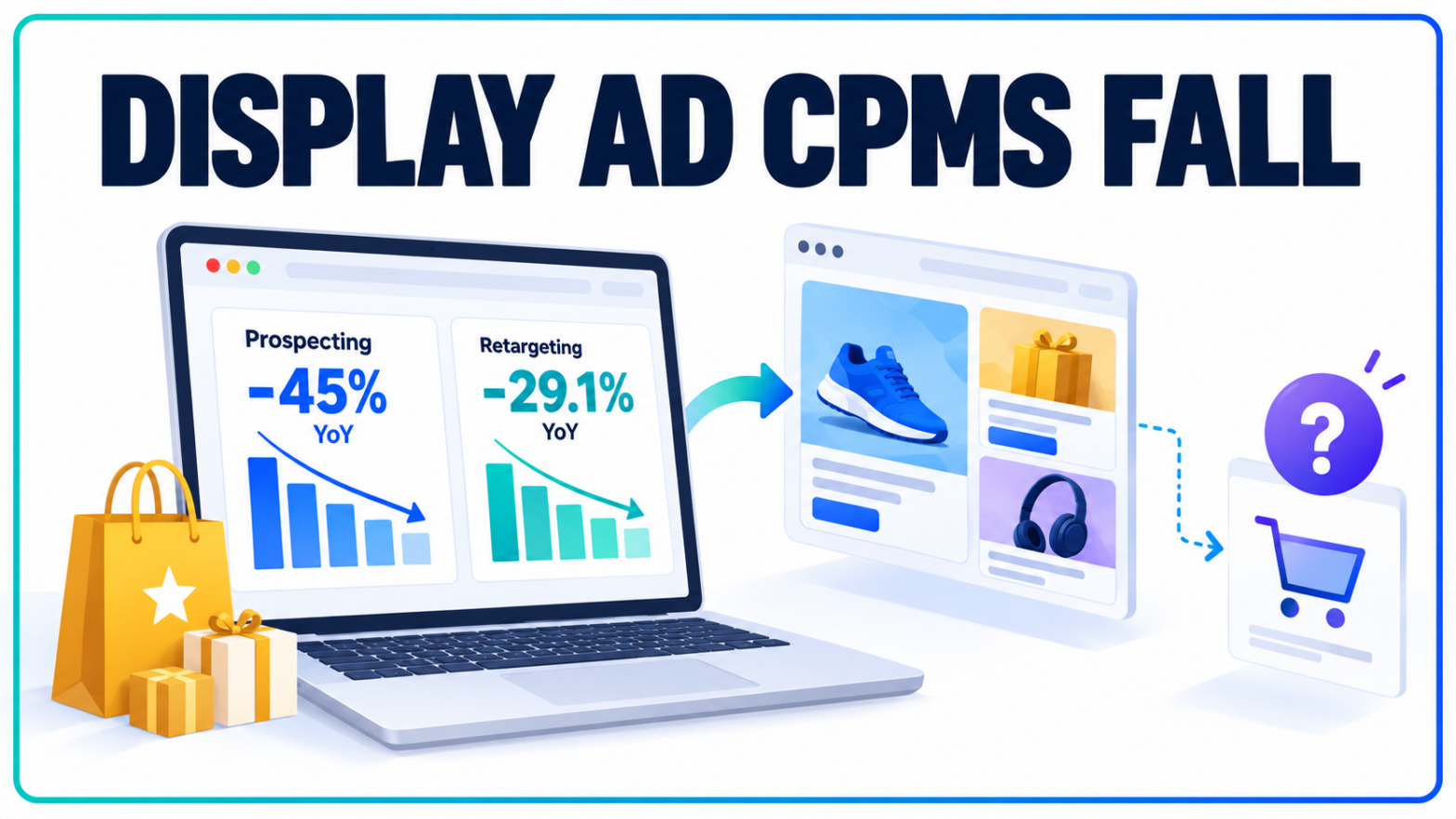
AdRoll’s latest State of Digital Advertising Report finds that display prospecting CPMs fell 45% from a year earlier between July 1 and September 8, 2026. Retargeting CPMs were down 29.1% over the same window. The figures give marketers a lower-cost opportunity to reach shoppers before peak-season competition, though they say nothing on their own about what those shoppers will buy.
That distinction is the story for holiday budgets. An impression costs less in AdRoll’s data. A sale may not.
Prospecting Shows the Sharpest Price Drop
A CPM is the cost of serving 1,000 ad impressions. It measures what an advertiser pays for exposure, rather than the number of people who respond or make a purchase.
AdRoll reports that its display prospecting CPM fell 45% year over year from July 1 through September 8. Compared with the corresponding period in the second quarter of 2026, it fell 25.5%. Prospecting campaigns seek people who have not yet engaged with an advertiser, making their pricing a useful read on the cost of reaching broader audiences within AdRoll’s platform.
The year-over-year decline is considerably larger than the quarter-over-quarter move. Both comparisons point downward, but they describe different baselines. Neither is a forecast for the rest of September or the fourth quarter.
AdRoll says its report draws on advertising performance data from more than 20,000 online businesses across several industries. That is a substantial pool of platform activity, but it remains AdRoll’s data. Its CPM changes should not be presented as a measured decline across every display advertising platform or every market.
For retail advertisers, the timing is notable. Many holiday campaigns begin reaching potential buyers well before Black Friday and Cyber Monday. AdRoll expects CPMs to rise as those shopping dates approach, based on the seasonal pattern it describes in the report. This year’s peak-season prices have yet to be measured.
Retargeting Is Cheaper, but Its Audience Works Differently
AdRoll’s display retargeting CPM fell 29.1% year over year and 40.2% against the comparable period in Q2. The steeper quarterly drop contrasts with prospecting, where the annual comparison showed the larger decline.
The two campaign types buy access to different groups. Prospecting reaches a broader pool of potential customers. Retargeting focuses on people who have already visited, browsed or otherwise engaged. The size and behaviour of that known audience can affect its price, so a lower retargeting CPM cannot be read simply as a broad fall in media demand.
Holiday advertisers also face a sequencing problem. A cheaper impression served to a recent product viewer may be useful; repeated impressions served after that person has purchased waste budget. AdRoll’s report points to browsing, cart and customer data as ways to distinguish those audiences and change the follow-up message.
Other platforms are adding their own tools for the same seasonal buying period. TechWyse recently covered Snapchat’s holiday advertising rollout, which brings catalogue products into Chat ads while introducing purchase-value controls in stages. AdRoll’s figures describe a different part of the decision: the current cost of buying display exposure before holiday competition intensifies.
Neither a lower retargeting CPM nor a new ad format establishes which campaign will produce more revenue. Advertisers need conversion and sales data to answer that.
B2B Ad Prices Did Not Follow the Retail Pattern
One category in AdRoll’s report moved against the annual display trend. Account-based marketing, or ABM, CPMs rose 4.4% year over year, although they fell 15.1% against the matched Q2 period.
ABM campaigns target a defined set of business accounts. Their audience is narrower than a general prospecting pool, and AdRoll cautions that their prices are a weaker indicator of broader advertising market conditions.
The split matters because “display costs are falling” is too broad a description of the findings. The strongest annual decline appeared in prospecting. Retargeting also became cheaper in AdRoll’s comparisons. ABM became slightly more expensive than a year earlier.
It also limits what can be inferred for a B2B advertiser planning year-end outreach. The retail shopping calendar may shape demand for broad consumer reach, while campaigns aimed at named companies operate under different audience constraints. AdRoll reports the price changes; it does not establish a single cause behind them.
Cheaper Reach Does Not Settle the Holiday Budget
The practical question for marketers is whether the lower display advertising CPM changes the economics of their own campaigns. Teams can compare the cost of reaching a prospecting audience with subsequent site visits, product interest and sales, then assess retargeting against purchases and revenue. Keeping those measures alongside CPM prevents a cheaper impression from being mistaken for a better-performing one.
That comparison is especially relevant when budgets move between channels. A display campaign may introduce a shopper to a brand before that shopper searches for it or responds to a later ad. Looking only at the final click can miss that earlier exposure; crediting every later sale to the display impression would overstate its role. The available campaign data and attribution method determine how much of the journey an advertiser can observe.
Consumer spending adds another limit to the pricing story. AdRoll’s report cites U.S. card-spending data showing continued household spending in August alongside weaker consumer sentiment in September. Those separate datasets do not show why display CPMs fell, nor do they show how any given holiday campaign will perform.
For now, the measured period ends on September 8. AdRoll’s findings describe a cheaper pre-peak window for display prospecting and retargeting on its platform. Whether that cost advantage carries into holiday sales will depend on campaign results recorded after the impressions are bought.