
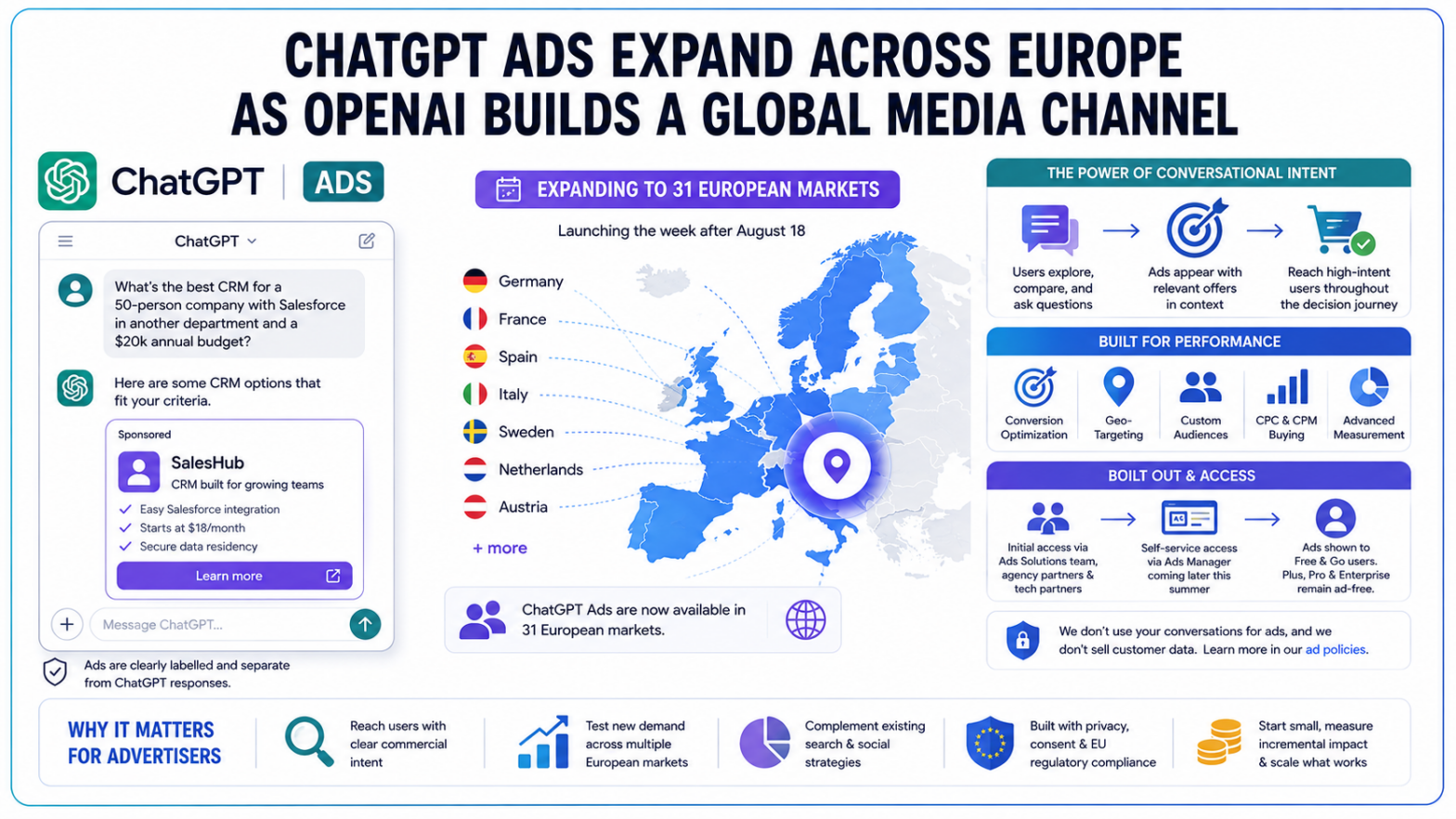
ChatGPT advertising is no longer a U.S.-centric experiment.
OpenAI is bringing ads to 31 European markets in its largest geographic expansion yet, putting a new paid media channel in front of advertisers operating across some of the world's largest consumer economies.
For enterprise marketing teams, the significance is less about adding another line to the media plan. Europe gives OpenAI a much larger test of whether conversational advertising can compete for performance budgets across multiple languages, markets and regulatory environments.
Europe Turns ChatGPT Ads Into a Multimarket Buy
OpenAI announced on August 18 that ChatGPT Ads will expand the following week to 31 European countries.
The company specifically named Germany, France, Spain, Italy, Sweden, Norway, Denmark, the Netherlands and Austria among the participating markets. It did not publish the complete 31-country list in its announcement.
This is OpenAI's biggest geographic ad rollout since testing began in the United States in February.
The platform had already expanded into eight additional markets over its first six months, including Canada, Australia, New Zealand, the United Kingdom, Mexico, Brazil, Japan and South Korea. Europe now moves the product from a collection of regional tests toward something resembling an international advertising network.
TechWyse has tracked that progression from the earlier ChatGPT Ads international expansion through the subsequent rollout of performance features and new campaign controls.
There is one important limitation at launch.
European advertisers will not immediately receive universal self-service access. OpenAI says campaigns will initially be available through its Ads Solutions team, agency partners and technology partners. Self-service access through Ads Manager is scheduled to follow later this summer.
For large advertisers already working through agency holding companies or supported ad-tech partners, that still creates a practical route into the channel.
OpenAI Is Selling the Conversation Before the Click
Google built an advertising empire around search intent. Meta built one around identity, interests and behavioural signals.
ChatGPT introduces a different signal: the problem someone is actively trying to solve.
A user might spend several turns comparing software, planning a trip, researching a purchase or narrowing a shortlist. That gives the platform context that a conventional keyword often cannot capture in isolation.
OpenAI explicitly frames the opportunity around people who are "exploring, comparing, and making decisions." It says ChatGPT Ads can reach users throughout that process rather than only at the final transaction stage.
That is the underlying proposition behind conversational advertising.
The ad is not simply being matched against a search term or demographic segment. It can appear beside a conversation where the user's constraints, priorities and commercial intent have already become clearer.
Consider a B2B buyer researching CRM platforms.
A search query might reveal that the person wants "CRM software." A ChatGPT conversation could reveal that the company has 50 employees, uses Salesforce for another department, requires Canadian data residency, wants HubSpot integration and has a fixed annual budget.
That additional context does not guarantee a better-performing ad. OpenAI has not published comparative conversion data showing ChatGPT outperforming established search or social channels.
It does explain why advertisers are paying attention.
The Ad Platform Has Grown Up Before the European Rollout
Europe is arriving after OpenAI spent six months filling in many of the basic pieces advertisers expect from a performance platform.
The company started with relatively limited advertising tests. It now supports CPM and CPC buying alongside conversion optimization. Geo-targeting and custom audiences have been added, while conversion measurement can use the OpenAI Pixel, Conversions API and third-party measurement integrations.
That progression changes how marketers can evaluate the channel.
An impression-only experiment is difficult to compare with Google Ads, Meta Ads or other mature platforms. Conversion optimization, audience controls and downstream measurement make budget allocation far more familiar.
TechWyse previously covered the introduction of ChatGPT custom audiences, which allow advertisers to activate customer or prospect lists using first-party data.
OpenAI has also opened a beta ChatGPT Ads Manager and introduced CPC bidding, reducing the amount of bespoke campaign management required to participate.
The company now says tens of thousands of marketers have advertised on ChatGPT.
That figure does not tell advertisers whether the channel is efficient. OpenAI has not released broad benchmarks for average CPC, conversion rate, customer acquisition cost or return on ad spend.
But it does show that the European expansion is not beginning with an empty advertising system.
European Scale Comes With Tighter Boundaries
OpenAI is also trying to establish a strict separation between monetization and the assistant itself.
The company says advertisements remain clearly labelled and separate from ChatGPT responses. Advertising does not influence the answers ChatGPT generates, and advertisers do not receive users' conversations.
OpenAI also says it does not sell customer data.
Those boundaries become particularly important as the product spreads across Europe, where privacy, consent and digital advertising practices face substantial regulatory scrutiny.
Ads will continue to appear only for users on the Free and Go plans. Plus, Pro and Enterprise subscriptions remain ad-free under the European rollout.
That limits available inventory.
An advertiser targeting senior enterprise decision-makers, for example, cannot assume that every executive using ChatGPT is reachable through the advertising product. Users on Enterprise or higher-priced individual plans are outside the ad-supported audience.
The practical audience may therefore look quite different from ChatGPT's overall user base.
OpenAI's ad policies create another filter. The company restricts placements around sensitive and brand-unsafe conversations, meaning not every commercially relevant discussion is necessarily eligible to carry an advertisement. Its advertising policies were most recently updated on August 10.
Europe Gives Advertisers a Real Experimental Budget Decision
For marketers, the European expansion creates a reasonable case for controlled testing rather than wholesale budget migration.
Paid media teams with campaigns running across Germany, France, Spain, Italy and other participating markets can now begin comparing ChatGPT traffic with existing search, social and programmatic channels. The useful metrics will be familiar: incremental conversions, acquisition cost, conversion quality, assisted revenue and whether ChatGPT reaches demand that established campaigns were missing.
That is a different standard from novelty.
OpenAI's expanding measurement stack makes those comparisons increasingly possible, but there is still limited public benchmark data on European campaign economics. Advertisers entering early will largely be establishing their own baselines.
The rollout also arrives while ChatGPT Ads move deeper into performance marketing, with OpenAI adding conversion-focused infrastructure rather than relying solely on reach or click metrics.
For enterprise brands, that makes an experimental allocation defensible when the audience, market coverage and measurement setup fit. It does not make ChatGPT Ads a proven replacement for existing channels.
OpenAI still describes the advertising platform as early.
What has changed is the size of the experiment. Starting the week after August 18, that experiment extends across 31 European markets, backed by conversion optimization, geographic targeting, custom audiences and measurement infrastructure that did not exist when the first U.S. ads appeared six months earlier.