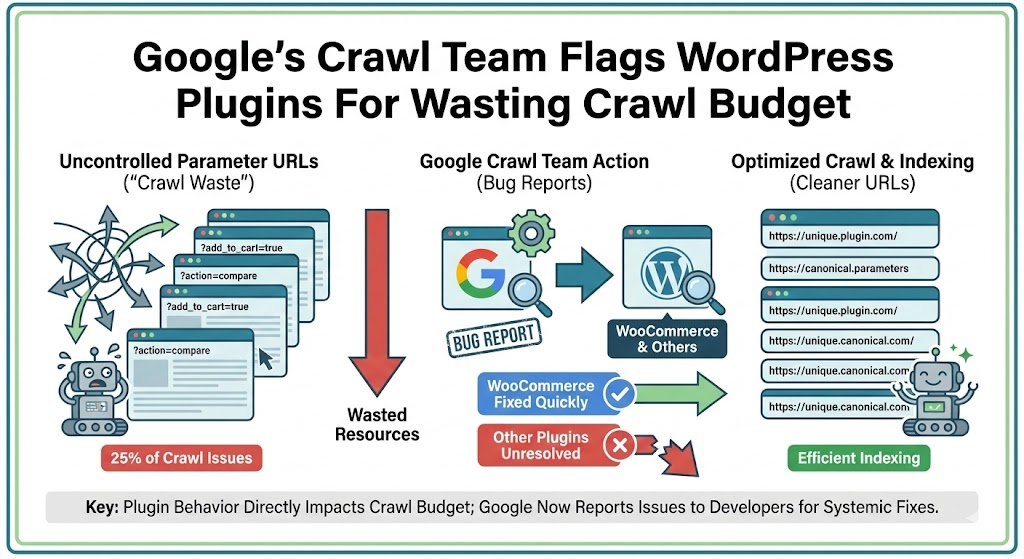
Google’s crawl team has begun filing bug reports directly with WordPress plugin developers after identifying widespread crawl budget waste tied to URL parameters.
During a recent Search Off the Record podcast, Google Search analyst Gary Illyes revealed that WooCommerce’s add‑to‑cart parameters were creating unnecessary URLs at scale. After Google flagged the issue, WooCommerce shipped a fix quickly.
Other plugins have not responded as fast, leaving crawl inefficiencies unresolved across thousands of sites.
For technical SEO teams and ecommerce operators, the message is straightforward: plugin behavior can quietly multiply crawlable URLs and strain indexing, even if you didn’t build those URLs yourself.
Action Parameters Represent A Major Crawl Problem
According to Google’s internal crawl reports, action parameters were responsible for roughly 25% of all crawl issues in 2025.
Only faceted navigation created more problems, accounting for about 50%.
Combined, those two patterns represent nearly three‑quarters of the crawl waste Google observed across the web.
Action parameters append query strings such as:
-
?add_to_cart=true
-
?wishlist=1
-
?action=compare
Each variation appears to Googlebot as a unique URL. When these stack or repeat, they can double or triple the number of crawlable pages without adding new content.
From a crawler’s perspective, this looks like an explosion of pages that must be fetched and evaluated, consuming resources that could otherwise be used for important URLs.
WooCommerce Bug Was Fixed Quickly
Google traced one of the largest sources of action parameters to WooCommerce.
Illyes said the crawl team identified the add‑to‑cart behavior as unnecessary crawl waste and filed a bug directly in the plugin’s open‑source repository.
WooCommerce responded and pushed a fix shortly after.
Google highlighted this as a positive example of how CMS and plugin maintainers can reduce crawl inefficiencies at the source rather than leaving site owners to patch around the problem.
Other Plugins Remain Unresolved
Not all developers were as responsive.
Illyes noted that two additional plugins with similar issues still have open reports. One commercial calendar plugin reportedly generates near‑infinite URL paths, while another action‑parameter tool remains unclaimed.
These unresolved issues mean affected sites may continue wasting crawl budget without realizing it.
Because the behavior lives inside the plugin layer, many site owners don’t discover the problem until crawl stats or server load spikes.
Why Crawl Budget Still Matters For SEO
While Google rarely frames crawl budget as a ranking factor, inefficient crawling has practical consequences.
Excessive parameter URLs can lead to:
-
Slower discovery of new pages
-
Delayed indexing updates
-
Increased server strain
-
Important content being crawled less frequently
Googlebot cannot determine whether a URL space is useful without crawling a significant portion of it first. By the time waste is obvious, resources have already been consumed.
For large ecommerce sites, this can directly impact how quickly products and changes appear in Google Search and Google News surfaces.
What Site Owners Should Do
Even if the root cause sits inside a plugin, site owners still need safeguards.
Google consistently recommends proactively managing parameter URLs through:
-
robots.txt blocking
-
canonicalization
-
internal link controls
-
avoiding unnecessary action parameters
Regularly auditing crawl stats and parameter behavior inside Search Console can help spot issues early.
If a plugin is generating wasteful URLs, reporting it to the developer or switching tools may be the fastest fix.
Bigger Implications For CMS Ecosystems
Google filing bugs directly with plugin developers signals a broader shift.
Instead of only advising site owners, Google is addressing crawl inefficiencies at the software layer that powers millions of websites.
As WordPress continues to dominate ecommerce and publishing, plugin design choices increasingly affect how efficiently Googlebot can crawl the web.
For SEOs and developers alike, this reinforces a simple principle: technical SEO problems often start at the platform level, not just the page level.
Cleaner URL structures mean faster crawling, better indexing, and fewer surprises.