

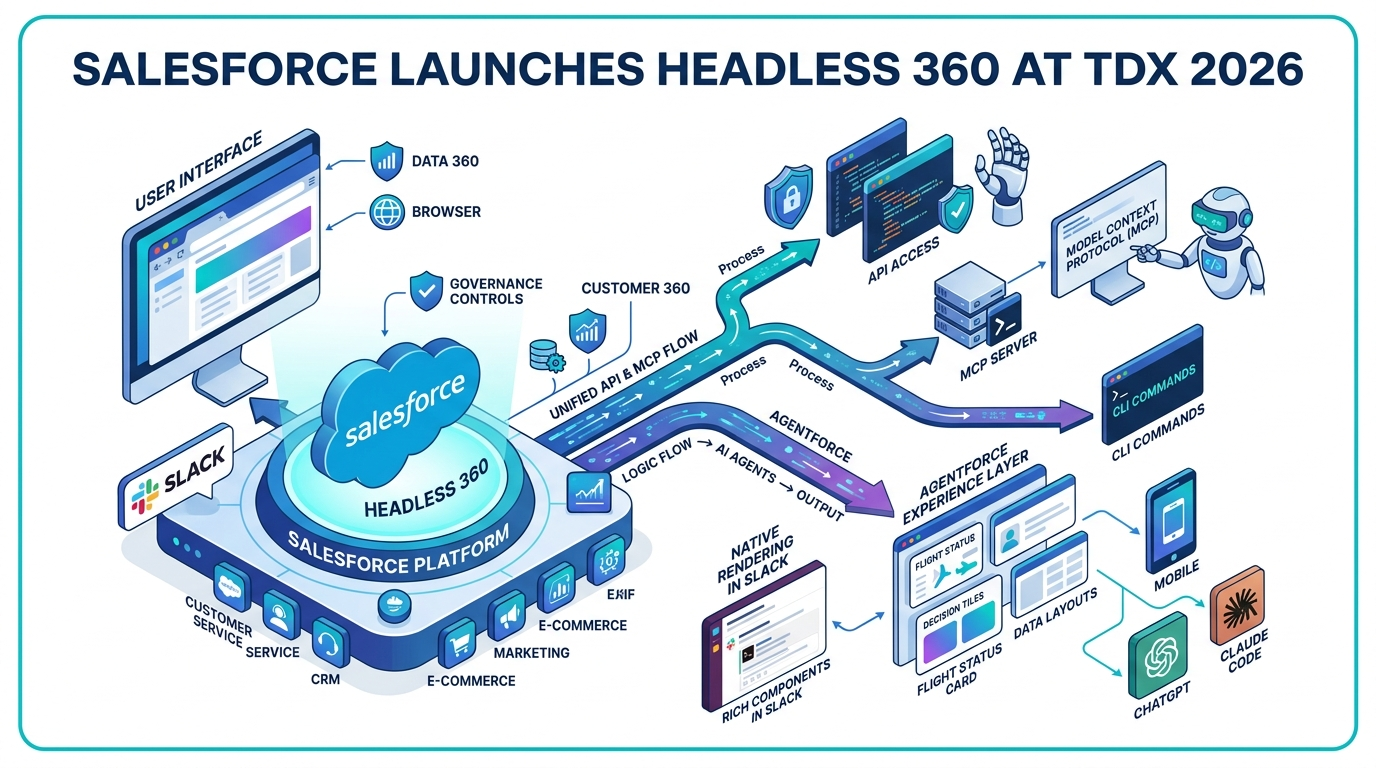
Enterprise teams using Salesforce can now access the platform's full capabilities, data, workflows, and business logic, without logging into a browser or navigating a user interface. Salesforce confirmed the launch of Salesforce Headless 360 on April 15, 2026, at its TDX developer conference in San Francisco, in a formal announcement published the same day on salesforce.com.
The goal of Headless 360 is that everything on the Salesforce platform is now an API, MCP (Model Context Protocol) server, or CLI (command line interface) command, able to be called by coding agents or by custom agents targeting specific customer requirements. The Salesforce platform includes CRM, customer service, marketing, and e-commerce, and the company also owns the Slack collaboration tool.
Headless 360 exposes Salesforce's underlying data, workflows, and governance controls as APIs, MCP tools, and CLI commands, via its existing offerings, including Data 360, Customer 360, and Agentforce, according to Joe Inzerillo, president of AI technology at Salesforce, who spoke during a press briefing. This allows agents to operate directly on the platform's existing business logic and datasets, rather than relying on separate integrations or user interfaces, Inzerillo added.
Salesforce said the decision to rebuild its code base for agentic AI was taken approximately two-and-a-half years ago, in late 2023.
Three Core Capability Areas
Salesforce organized the Headless 360 launch around three sets of new capabilities, as outlined in its April 15 announcement.
The first is an expanded developer toolset. More than 60 new MCP tools and 30-plus preconfigured coding skills give coding agents complete, live access to the entire Salesforce platform, including data, workflows, and business logic, directly in tools such as Claude Code, Cursor, Codex, and Windsurf. Agentforce Vibes 2.0 adds full org awareness from the start, multi-model support including Claude Sonnet and GPT-5, and an AI development partner designed to understand business context alongside code.
The DevOps Center MCP brings programmatic access into CI/CD pipelines, enabling natural language deployment instructions that the agent executes directly, a build loop that Salesforce says previously required context-switching across four different tools, and that the company claims can now cut cycle times by as much as 40%.
The second capability set is the Agentforce Experience Layer. The Experience Layer is a new UI service that separates what an agent does from how it appears, so agents can deliver rich interactive components, such as flight status cards, rebooking workflows, decision tiles, and data layouts, rendering natively inside Slack and across mobile, ChatGPT, Claude, Gemini, Teams, or any client that supports MCP apps.
Salesforce also reported that custom AI agents on Slack have grown 300% since January 2026.
The third area covers agent lifecycle governance. Before launch, a Testing Center surfaces logic gaps, policy violations, and inconsistent outputs before they reach users, while Custom Scoring Evals go further by scoring whether an agent made the right decision, not just whether it ran, with organizations defining what a correct outcome looks like for their specific use case. After launch, Observability and Session Tracing surface not just what happened in production but why, enabling root-cause identification when agents drift, alongside A/B Testing that allows multiple agent versions to run against real traffic simultaneously.
Salesforce also announced a major expansion of Agent Fabric, the company's trusted agent control plane for enterprises building multi-vendor agentic networks, which now includes automated discovery, agent authoring, and centralized LLM governance. Agent Broker, the deterministic orchestration component, enters beta in April 2026, with full general availability, including a visual authoring canvas and Salesforce model support, arriving in June 2026.
Feature Availability and Rollout Schedule
Not all components announced under the Headless 360 umbrella are currently generally available. Generally available features include Agentforce Vibes 2.0, the DevOps Center MCP, Session Tracing, and the Agentforce Experience Layer. Custom Scoring Evals are in early access, while the Testing Center enhancements and the Salesforce Catalog are scheduled for rollout in May and June, respectively.
Every Salesforce Developer Edition org now includes the Agentforce Vibes IDE, a browser-based, cloud-hosted VS Code environment, Agentforce Vibes with Claude Sonnet 4.5 as the default coding model, and Salesforce Hosted MCP Servers, all at no cost. Usage limits for the developer edition are set at 110 requests per month and 1.5 million tokens, refreshing monthly through May 31, after which there is a final monthly allocation with no further refresh.
Agent Script Open-Sourced
Agent Script is an agent definition language that lets developers specify when agents should use LLM reasoning and when they should follow deterministic logic, with subagents, actions, variables, guardrails, and transitions all defined in structured, strongly-typed files that coding agents can work with natively. At TDX 2026, Salesforce open-sourced Agent Script authoring; the full language specification, grammar, parser, and compiler are available at github.com/salesforce/agentscript.
AgentExchange and the $50M Builders Initiative
AgentExchange now includes 10,000 Salesforce apps, 2,600-plus Slack apps, and 1,000-plus agents, tools, and MCP servers from across the ecosystem. Salesforce has also launched an AgentExchange Builders Initiative, which it described as a $50 million pledge to help partners turn ideas into revenue, coupled with an AgentExchange Go-To-Market App enabling private offers, unified billing, and automated provisioning.
Analyst Caution on Pricing and Maturity
Industry analysts have raised questions about the announcement that Salesforce has not publicly addressed. Concerns include the absence of pricing disclosure for the headless experience and whether all tools are included at no cost, with one analyst warning that CIOs should ask about pricing before building architectural dependencies on features that might land in a premium cost tier. Analysts also noted that the announcement is silent on SLAs for operations such as MCP tool calls, which matter materially for real-time agent workflows. One analyst cautioned that most governance tools are in the early stages of release, and suggested enterprises should expect to supplement them with their own evaluation frameworks for the next 12 to 18 months.
Practical Implications for Enterprise Development Teams
For Salesforce customers running agentic workflows, the shift to a headless architecture means development teams can integrate coding agents from third-party platforms, including those already in active use, directly into Salesforce build processes without rewriting existing business logic or trust controls. Teams planning to adopt Headless 360 components should validate general availability timelines before committing to architectural changes, given that several features remain in early access or on a phased release schedule.
Analysts see Headless 360 as an effort by Salesforce to position itself as a central layer for managing agent-driven operations across different business functions in enterprises, moving from a system of record to a system of execution, a shift that one analyst described as Salesforce trying to reframe its platform "as a programmable platform for agents operating across external tools, interfaces, and environments."