
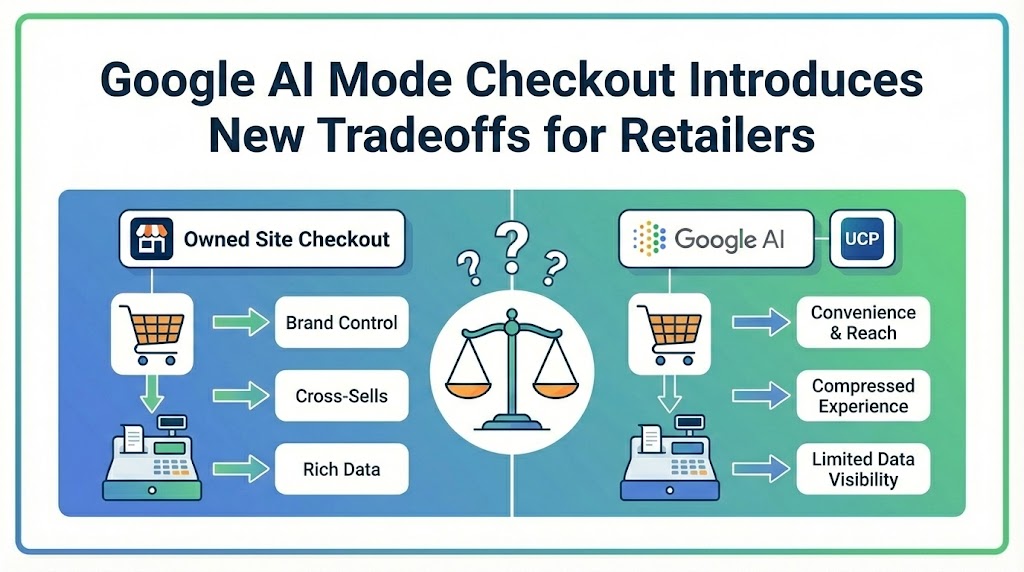
Google’s rollout of AI Mode Checkout, powered by the Universal Commerce Protocol (UCP), promises faster, lower-friction purchasing for shoppers. For retailers, however, the shift raises important strategic questions about brand control, data access, and long-term customer relationships.
While Google emphasizes convenience and conversion efficiency, many retailers are now evaluating what changes when the transaction moves off their owned sites and onto Google surfaces.
What Changes When Checkout Happens on Google
AI Mode Checkout allows users to research, compare, and purchase products without leaving Google Search or the Gemini app. Retailers remain the seller of record, but Google hosts much of the discovery and checkout experience.
This alters several core aspects of ecommerce strategy.
Reduced Onsite Merchandising and Cross-Sells
When customers complete purchases on a retailer’s site, brands control how products are presented, bundled, and recommended. Cross-sells, accessories, and complementary items are typically guided by merchandising strategy and on-site behavior signals.
With checkout occurring in AI Mode, those opportunities may be limited to what Google’s interface supports. Google has indicated plans to enable related product discovery, loyalty rewards, and more customized shopping experiences, but details around implementation, reporting, and control have not yet been fully disclosed.
For retailers that rely heavily on add-on sales to make unit economics work, this shift could materially impact revenue per order.
Brand Experience Becomes More Compressed
Retailers invest significantly in site design, content, and storytelling to communicate differentiation. When transactions occur within Google’s standardized AI interfaces, much of that brand environment is condensed into product feeds and structured data.
The result is a more uniform buying experience, where price, availability, and fulfillment speed may carry more weight than brand narrative or curation.
For brands built on discovery, education, and inspiration, this compression may change how value is communicated to customers.
Shifts in Customer Data and Attribution
One of the biggest open questions around UCP Checkout is data visibility.
Retailers traditionally rely on pre-purchase signals—such as browsing paths, product comparisons, and engagement with content—to inform merchandising, lifecycle marketing, and personalization strategies.
When those interactions happen on Google surfaces, retailers may receive fewer insights into how customers arrived at a purchase. The extent of reporting, attribution detail, and customer-level data shared back to merchants has not yet been clearly defined.
Parallels to the Amazon Marketplace Model
The dynamics introduced by UCP Checkout resemble those long familiar to sellers on Amazon.
Marketplace sellers gain access to massive demand but accept limited control over customer experience and restricted access to relationship data. Google’s approach differs in that UCP is positioned as an open protocol rather than a closed marketplace, and products remain on retailers’ own inventory systems.
Whether this distinction translates into meaningfully greater control or data access for retailers will depend on how Google implements reporting, fees, and integration requirements.
When AI Mode Checkout Makes Sense—and When It May Not
The impact of AI Mode Checkout is unlikely to be uniform across all retail models.
For retailers competing primarily on price, convenience, and fulfillment speed, reducing friction at the moment of purchase may outweigh the loss of site visits. Access to high-intent shoppers could improve conversion efficiency, even if brand exposure is reduced.
For retailers that compete on curation, expertise, or storytelling—such as specialty, luxury, or enthusiast brands—the tradeoff may be less favorable. These businesses often rely on discovery journeys and content-rich experiences to justify premium pricing and build long-term loyalty.
Customer acquisition costs also factor heavily into the decision. If paid media drives users into Google’s checkout flow without opportunities for cross-sells, retargeting, or relationship building, the economics may change.
What’s Known—and What Remains Unclear
Google has confirmed that UCP Checkout will roll out to eligible U.S. retailers and that participation will be customizable. Retailers remain merchants of record, and Google has referenced options for embedded or branded checkout experiences.
However, key operational details remain undefined, including:
-
Whether participation is fully opt-in at the product or category level
-
What funnel-level reporting and attribution data retailers will receive
-
How customer and journey data can be used for marketing and merchandising
-
What fees or revenue-sharing models may apply
Until these questions are answered, much of the impact remains speculative.
Strategic Questions Retailers Must Now Answer
As AI-driven commerce expands, retailers face a familiar strategic dilemma: trade reach and convenience for control and differentiation.
Early adopters may benefit from increased exposure in AI-driven discovery, while accepting platform constraints they do not fully control. Late adopters may preserve brand experience—but risk reduced visibility as shopper expectations shift.
The core question is not whether AI Mode Checkout will change ecommerce—it already is—but whether retailers can preserve the brand value and customer relationships that justified building owned channels in the first place.
The answer will depend on how Google executes UCP in practice.