
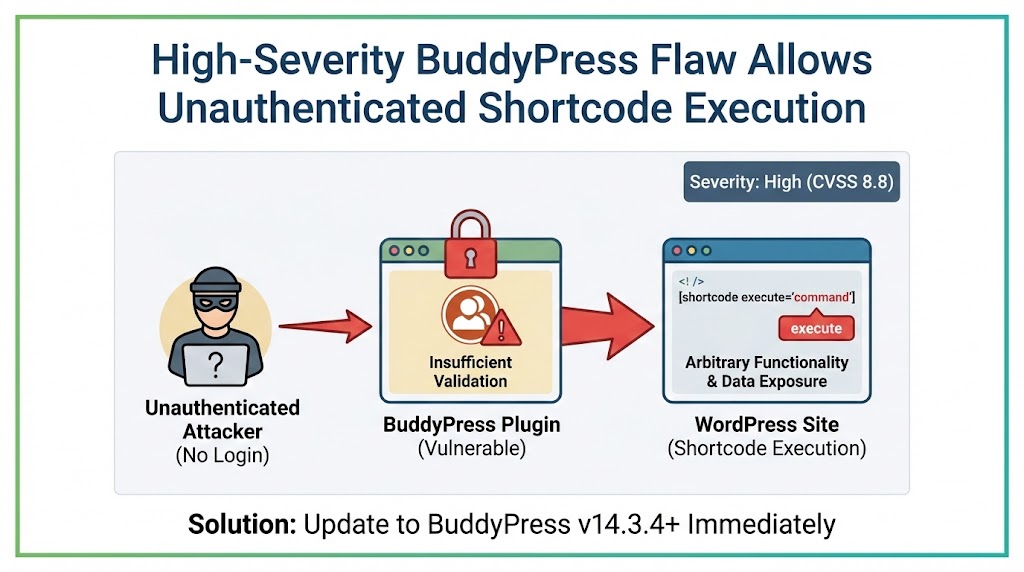
A high-severity security vulnerability has been disclosed in the BuddyPress plugin for WordPress, potentially affecting more than 100,000 websites that rely on the plugin for community and membership functionality.
The flaw allows unauthenticated attackers to execute arbitrary shortcodes, exposing affected sites to unintended functionality execution and possible data or content exposure.
Widely used community plugin affected
BuddyPress is commonly used to add social networking features to WordPress sites, including user profiles, activity feeds, group management, and private messaging. It is frequently deployed on membership platforms, forums, and online communities where user interaction is central to the site’s purpose.
Historically, BuddyPress has maintained a relatively strong security record, with few reported vulnerabilities in recent years. This latest issue stands out due to both its severity and the lack of authentication required to exploit it.
How the vulnerability works
The vulnerability exists in all versions of BuddyPress up to and including 14.3.3. It stems from insufficient validation of user-supplied input before it is passed to WordPress’s shortcode execution mechanism.
Because the plugin fails to properly restrict how shortcodes are processed, attackers can trigger shortcode execution without logging in or holding any user role. Shortcodes are designed to enable dynamic behavior within WordPress, and their misuse can lead to actions being performed outside their intended context.
Depending on which shortcodes are available on a given site, this behavior could allow attackers to expose restricted content, alter site output, or interact with other plugins in unexpected ways.
No special configuration required
The issue does not rely on uncommon server settings or optional plugin configurations. Any WordPress site running a vulnerable version of BuddyPress is exposed by default, increasing the urgency for remediation.
Security researchers classify the issue as high severity, reflecting both the ease of exploitation and the breadth of potential impact across sites with differing plugin ecosystems.
Patch released
The vulnerability has been addressed in BuddyPress version 14.3.4. Site owners using BuddyPress are advised to update immediately to the patched release or later versions to eliminate the risk.
As with many shortcode-related vulnerabilities, the actual impact can vary based on site configuration. However, given the plugin’s widespread use and the absence of authentication barriers, delaying updates leaves affected sites unnecessarily exposed.