Search has lost one of its original builders.
Bruce Clay, widely known across the industry as the “Father of SEO,” has passed away. His company confirmed the news on June 26, noting that Clay built Bruce Clay, Inc. 30 years ago and helped shape the SEO industry with “passion and dedication.”
That legacy is not just about being early.
It is about what he made SEO stand for before the discipline had settled into the language, tools, training systems, and best practices marketers use today.
Before SEO Became an Industry, Bruce Clay Treated It Like a Discipline
Bruce Clay founded his company in 1996, before Google became the search engine that would define modern search behaviour. The history of Bruce Clay, Inc. tracks closely with the rise of SEO itself, from the earliest search engines to the structured, technical, content-driven work now expected of serious digital marketing teams.
Clay was credited by many in the industry with helping establish the term “search engine optimization.” More importantly, he helped move SEO away from tricks and toward professional practice.
That distinction matters.
In its earliest years, SEO was often reduced to manipulation: keyword stuffing, thin pages, doorway tactics, and whatever else could be used to get short-term visibility. Clay’s work helped push the field in another direction: build sites that search engines can understand because users can understand them first.
User-First SEO Was Never a Trend
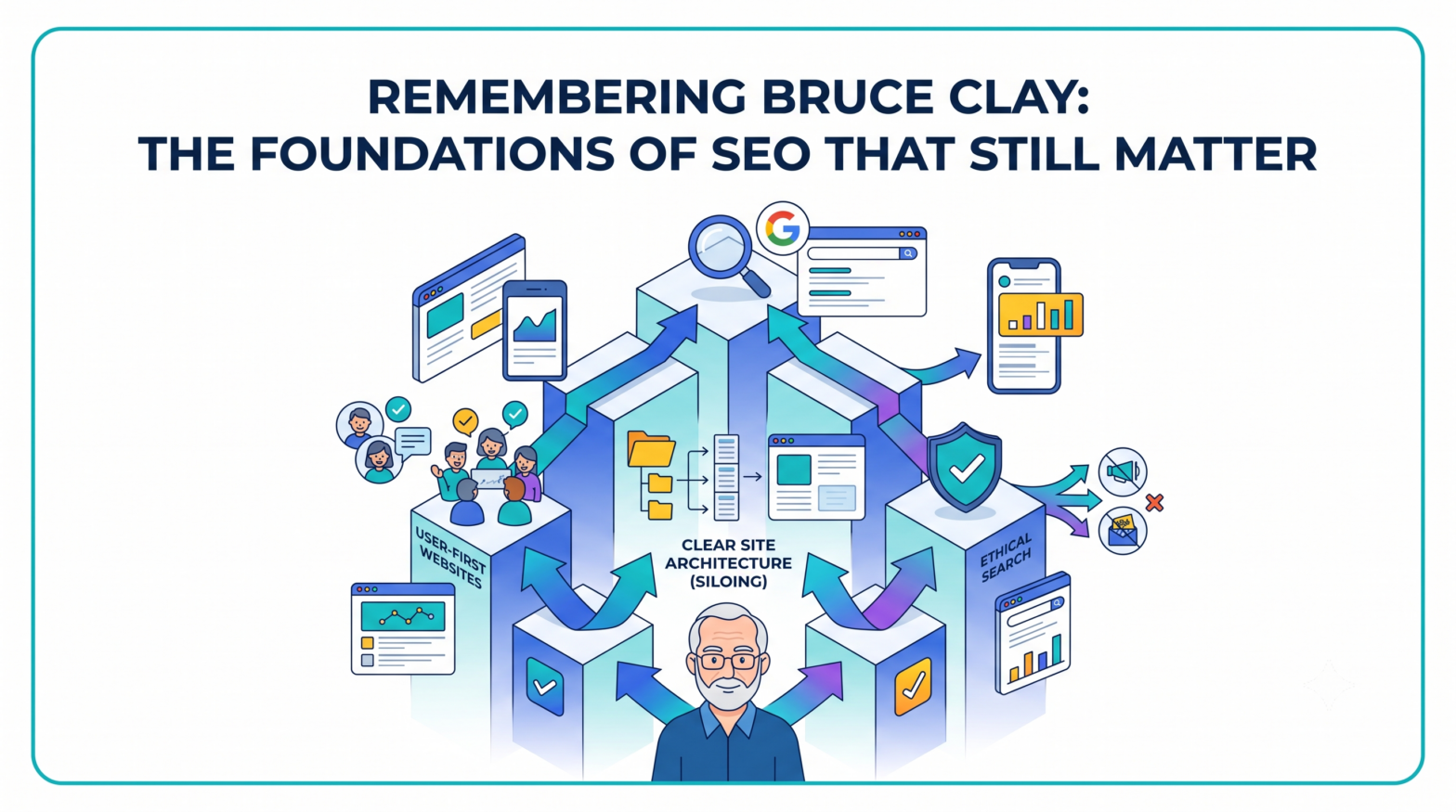
One of the core ideas associated with Clay’s approach was simple, but difficult to fake: websites should be built for users.
Not algorithms first. Not loopholes first. People first.
That principle now sits at the centre of nearly every serious conversation about search visibility, from helpful content to technical SEO, site experience, content quality, and brand authority. Search engines have changed dramatically, but that rule has held its ground.
For marketers, the lesson is still practical. A website that is hard to navigate, thin on substance, or built around spam signals may get temporary movement. It rarely earns durable trust.
Clay understood that early.
Site Architecture Became a Search Strategy
Clay was also closely associated with the concept of siloing, a method of organizing website content into clear thematic sections. The idea was never just about internal links or page hierarchy. It was about clarity.
A logical site architecture helps users move through information naturally. It helps search engines understand topical relationships. It helps content teams avoid scattered, disconnected pages that compete with each other instead of building authority together.
That thinking has aged well.
In an era shaped by AI Overviews, entity recognition, structured data, and increasingly complex search results, the need for clear topical organization has only grown. Search systems may be more advanced now, but they still reward websites that make meaning easier to extract.
Ethical SEO Is Still the Line
Clay’s career also stands as a reminder that SEO has always had a credibility problem to solve.
The industry has spent decades separating legitimate search strategy from spam. That work is not finished. Every major search update still exposes the same divide: websites built to serve users versus websites built to exploit gaps in ranking systems.
Clay’s contribution was helping define SEO as a professional discipline with standards. Technical excellence mattered. Content quality mattered. Architecture mattered. Training mattered. Ethics mattered.
Those ideas are not nostalgic. They are still the foundation.
The Work Continues
Bruce Clay’s passing is a moment for the search industry to look back, but not in a sentimental way. The better tribute is to recognize which parts of his work continue to shape the job.
Build websites people can use.
Organize information so it makes sense.
Reject spam, even when shortcuts appear to work.
SEO has changed many times since 1996. The core principles Bruce Clay helped establish have not.