

Small businesses do not have an AI access problem anymore. They have an implementation problem.
OpenAI is trying to close that gap with a new ChatGPT program built around training, ready-made workflows, partner tools and direct feedback from business owners. The initiative shifts the company’s small-business strategy beyond selling access to a model and toward showing lean teams how to make AI part of their daily operations.
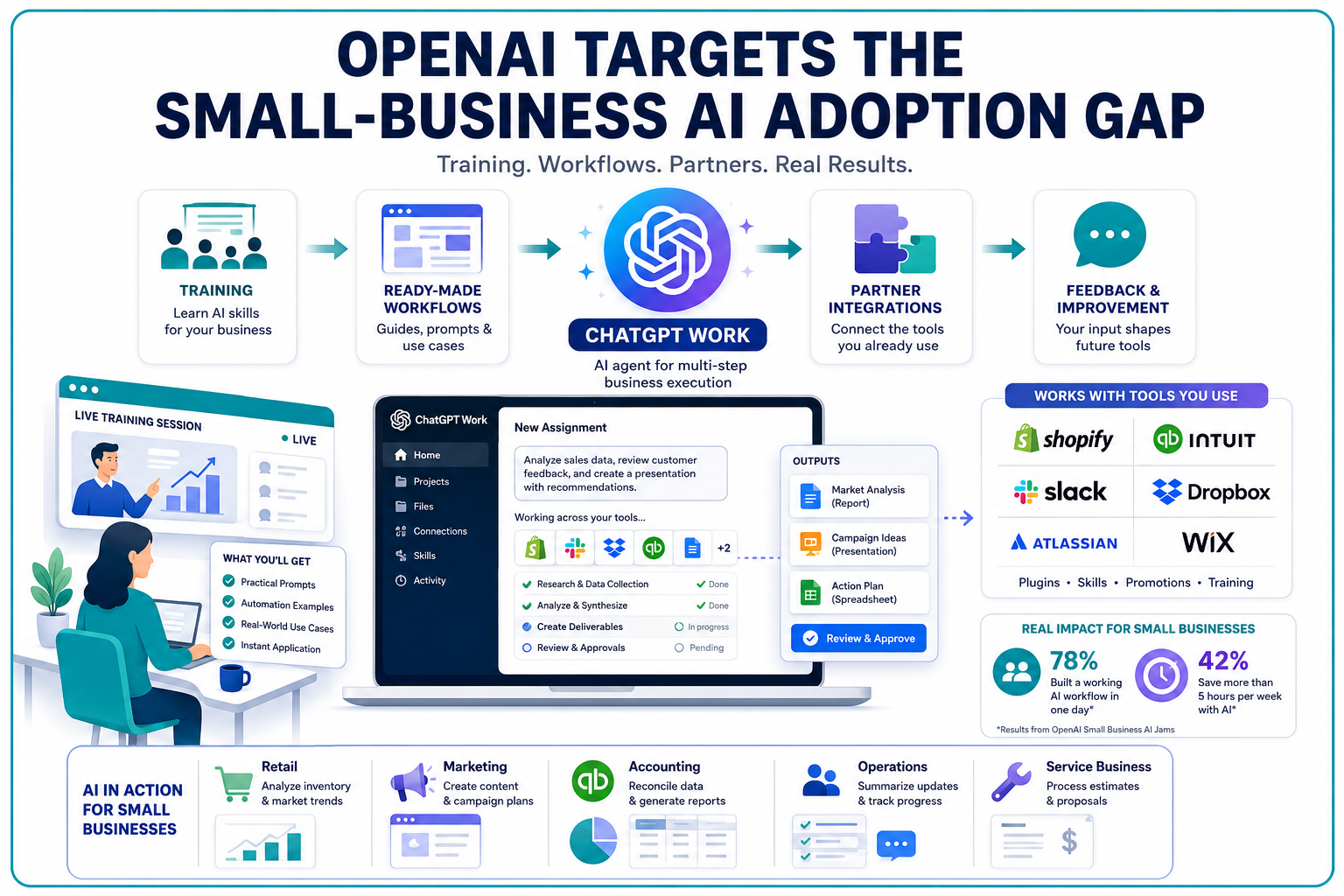
Announced on July 21, the ChatGPT for small business program combines virtual instruction, in-person academies, interactive guides and integrations with business platforms including Shopify, Intuit, Slack, Dropbox, Atlassian and Wix.
The central product is ChatGPT Work, OpenAI’s agent for completing longer, multi-step assignments across connected applications and files.
OpenAI Is Treating Adoption as the Real Product
The program is not a separate ChatGPT subscription or a stripped-down product tier for smaller companies.
Instead, OpenAI is building an adoption layer around technology it has already released.
That distinction matters. Small-business owners may have access to increasingly capable AI models, but access alone does not show a retailer how to evaluate inventory, help an agency assemble a client presentation or teach a contractor how to process a lengthy estimate.
OpenAI’s new virtual training sessions will demonstrate specific workflows across marketing, accounting, ecommerce and other business functions. Participants will receive prompts, automation examples and use cases intended for immediate application.
The company is also organizing in-person small-business AI academies across the United States. These events will combine guided instruction with practical exercises and peer support from other owners.
The structure suggests OpenAI sees training as a necessary part of its commercial expansion. The company is not simply asking owners to experiment with ChatGPT for small business. It is attempting to reduce the work required to identify, design and test a useful workflow.
That is a different sales proposition from offering a blank chat window.
ChatGPT Work Moves AI Beyond Occasional Prompts
ChatGPT Work sits at the centre of the program because it is designed to carry assignments through multiple stages rather than answer a single question.
OpenAI says the agent can research information, work across connected applications and files, create finished materials and retain context about how a person works. It can also build documents, spreadsheets, presentations, reports and web-based outputs while allowing users to review progress or approve consequential actions.
For a small business, the appeal is less about generating isolated pieces of text and more about completing work that might otherwise be delayed, outsourced or ignored.
A voice note could become a formatted Slack update. Customer reviews from several locations could be analyzed and turned into a staff training presentation. Inventory data could be compared with market information to develop product or campaign ideas.
These are operational workflows, not conventional chatbot requests.
OpenAI previously moved in this direction with workspace agents for business teams, which can maintain context, connect with external systems and complete shared processes. The small-business program brings that same general model to organizations where one person may be responsible for sales, marketing, administration and delivery.
The potential time savings are measurable, although OpenAI’s figures come from its own events. The company reported that 78 per cent of participants in its previous Small Business AI Jams produced a functioning AI workflow in one day. It also said 42 per cent saved more than five hours per week with AI.
Those results are not a broad benchmark for every company. They do show why guided implementation has become part of the product strategy.
Partner Skills Put Existing Business Software in the Loop
Small businesses rarely operate inside one platform.
Customer information may live in Shopify. Financial records may sit in Intuit software. Project discussions may happen in Slack, while documents are divided between Dropbox and other storage systems.
OpenAI’s partner component is designed around that fragmented environment.
The program will feature plugins, skills, promotions and instructional sessions from a curated group that includes Dropbox, Shopify, Intuit, Slack, Atlassian and Wix. OpenAI says the skills will address common small-business workflows, while promotions are intended to reduce the initial barrier to using participating tools.
The integrations could make AI automation more practical because an agent is only as useful as the context and systems it can reach. A tool that drafts marketing copy but cannot see current products, inventory or customer feedback still leaves much of the work with the owner.
OpenAI is not alone in pursuing this market. Anthropic introduced its own Claude package for small businesses earlier this year, with integrations spanning accounting, payments, customer relationship management and productivity platforms.
The competition is moving away from model comparisons alone. The harder question is which provider can connect AI agents to familiar software without creating another technical project for an already stretched team.
Ready-Made Guides Reduce the Blank-Page Problem
OpenAI is also developing customer stories, short videos and interactive guides that users can upload directly into ChatGPT Work.
These materials will contain prompts and examples that owners can adapt to their own operations. The goal is to shorten the distance between hearing about AI and completing a repeatable business task.
That may sound like basic onboarding, but the absence of a clear starting point remains a significant obstacle to small business AI adoption. Owners often know that generative AI can write, summarize or analyze information. They may not know which process is stable enough to automate, what data the agent needs or where human review should remain mandatory.
Templates can answer part of that question.
They can also create risks when a generic workflow is treated as universally reliable. Accounting, customer communication, pricing and marketing tasks may involve company-specific rules that cannot be captured by a standard prompt.
OpenAI’s program therefore includes feedback channels through webinar discussions, surveys and local events. The company says responses will be shared with its product and go-to-market teams and may influence future resources and product development.
That creates a direct research channel into a market where AI adoption is often informal and difficult to observe.
The Small-Business AI Race Is Becoming an Operations Race
For marketers and small-business teams, the immediate change is the availability of more structured training and workflow resources rather than a new advertising or content feature.
Teams evaluating the program will still need to decide which processes contain reliable inputs, which connected applications should be accessible and where approvals are required. Marketing reports, content briefs, review analysis and internal campaign planning may be easier starting points than customer-facing decisions or unsupervised financial work.
The larger shift is strategic.
AI providers are beginning to compete over how much work their systems can complete inside a business, not simply how well their models respond to prompts. That places greater weight on integrations, permissions, reusable skills and the quality of the instructions surrounding each agent.
It also raises the stakes for the information businesses publish online. AI agents already struggle with complex B2B pricing pages, showing that workflow automation can break when source material is inconsistent or difficult to interpret.
OpenAI says ChatGPT Work is powered by GPT-5.6 and is available to businesses across its subscription plans. Users can select different levels of model intelligence depending on the balance of quality, speed and cost required for a task.
The small-business program is now accepting registrations for updates, virtual sessions and in-person events. The product is already available. OpenAI’s next test is whether training and partner workflows can turn that availability into routine business use.