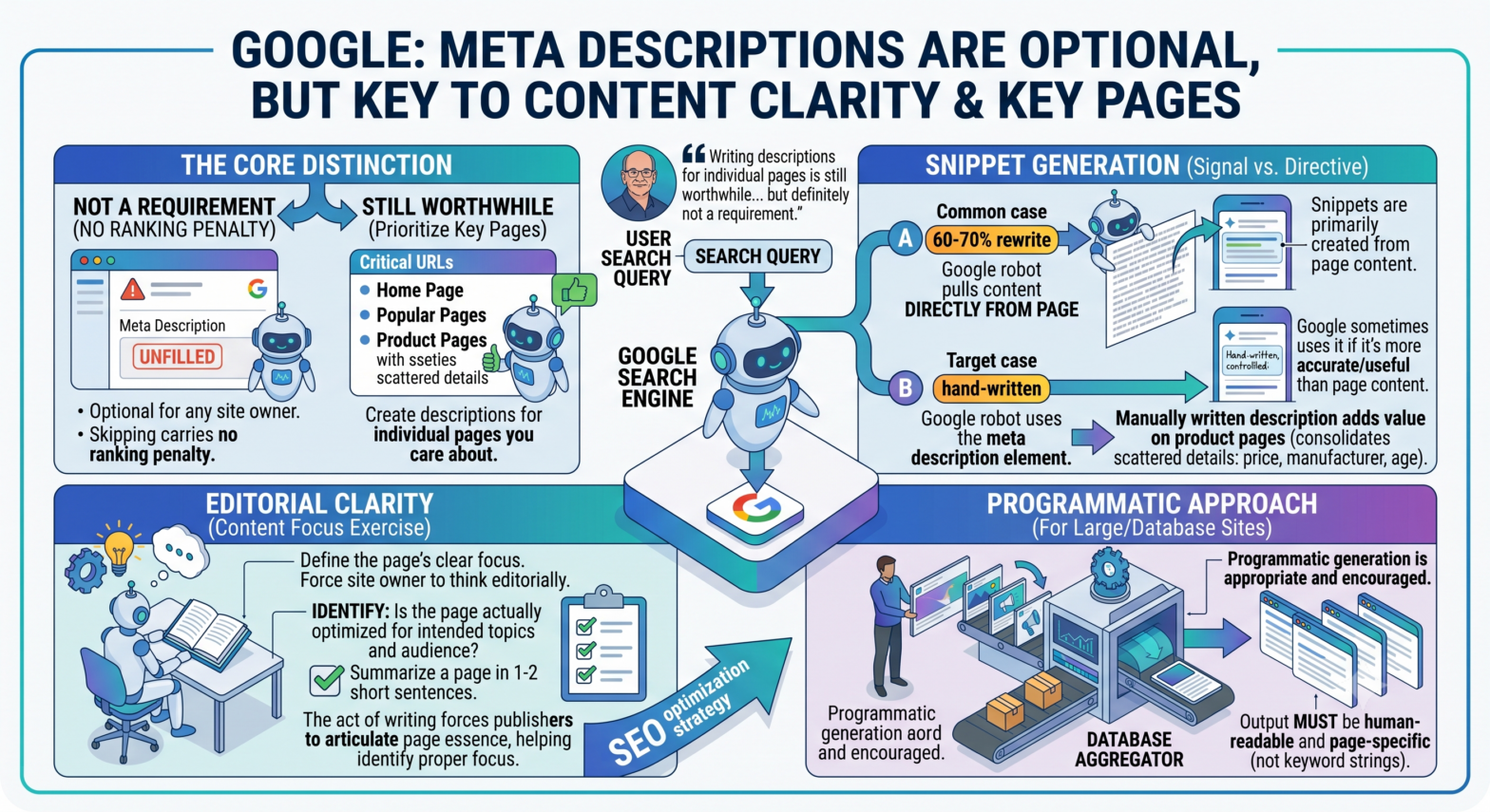
Google has no requirement that website owners write meta descriptions, and omitting them carries no ranking penalty. John Mueller, a Search Analyst at Google, confirmed this position in a Reddit thread responding to an SEO who asked whether meta descriptions have become pointless, stating directly that while they are not a requirement, writing them for individual pages "is still worthwhile."
What Mueller Said, and What Google's Documentation States
The Reddit exchange surfaced a claim circulating in the SEO community that meta descriptions have been rendered useless because Google frequently overwrites them with its own automatically generated snippets. Mueller's reply addressed this directly. Mueller wrote.
"Yes, but also, there's no penalty to writing your own, and sometimes it helps you to figure out a clear focus for a page. Overall, I think it's still worthwhile to do so for individual pages that you care about, but it's definitely not a requirement."
That position is consistent with Google's published guidance. Google's Search Central documentation states:
"If you don't have time to create a description for every single page, try to prioritize your content; at the very least, create a description for the critical URLs like your home page and popular pages."
Google's documentation also clarifies how snippets are actually generated. Snippets are primarily created from page content itself, though Google sometimes uses the meta description HTML element if it might give users a more accurate description of the page than content taken directly from the page. The practical implication is that a written meta description functions as a signal, not a directive; Google will use it when it judges the description to be more useful than anything pulled from the page body.
Why Google Rewrites Descriptions, And Why That Doesn't Make Them Pointless
The rewrite rate is significant. Current research shows that Google rewrites meta descriptions in approximately 60–70% of cases. That figure is often cited as justification for skipping them entirely. Mueller's comment pushes back on that conclusion without disputing the underlying statistic.
Google's own documentation explains one scenario where a manually written description adds meaningful value: structured data on product pages. The meta description is also a practical place to include structured information about the page; news and blog posts can list the author, date of publication, or byline information, giving potential visitors relevant details that might not otherwise appear in the snippet. Similarly, product pages may have key details such as price, age, and manufacturer scattered across different sections of the page. A hand-written meta description consolidates that information into a single, controlled summary.
The Content Clarity Benefit Mueller Highlighted
Beyond snippet control, Mueller pointed to a second, less obvious benefit: the act of writing a meta description is itself a useful editorial exercise. Mueller said the act of writing a meta description forces the site owner or SEO to think clearly about what an individual web page is actually about, and can help identify whether the web page is really about the topics the authors intended.
Even when Google ignores a meta description, summarizing a page in one or two short sentences requires a publisher to articulate what the page is actually about, and that kind of clarity has value in terms of understanding whether the page is actually optimized for the intended audience and topics.
How to Prioritize Meta Description Effort
Google's documentation is explicit that identical or similar descriptions across every page of a site are not helpful when individual pages appear in search results. Where possible, descriptions should accurately describe the specific page, with site-level descriptions used on the main home page or aggregation pages, and page-level descriptions used everywhere else.
For large sites where writing individual descriptions is not feasible, Google's guidance allows for a programmatic approach. The documentation notes that for database-driven sites such as product aggregators, programmatic generation of descriptions is appropriate and encouraged, provided the output is human-readable and page-specific rather than composed of keyword strings.
Google's Search Central documentation describes meta description tags as providing "a short, relevant summary of what a particular page is about", functioning like a pitch that convinces the user the page is exactly what they are looking for.
Practical Implications for Site Owners and Marketers
For site owners and digital marketers, Mueller's statement reinforces a practical triage approach: meta descriptions do not need to be written for every page on a site, but they warrant attention on pages where controlling the search snippet has measurable business value. This includes homepages, key landing pages, high-traffic blog posts, and product pages where relevant details are distributed across the page rather than concentrated near the top. Pages where Google is likely to pull an accurate and coherent snippet automatically, such as well-structured articles with strong opening paragraphs, are lower priority. The effort-to-impact ratio favours focusing on pages where an auto-generated snippet would be incomplete, misleading, or inconsistent with how the business wants to be represented in search results.
Google has noted it cannot manually change snippets for individual sites, but that site owners can help improve the quality of the snippet displayed for their pages by following best practices for creating quality meta descriptions.