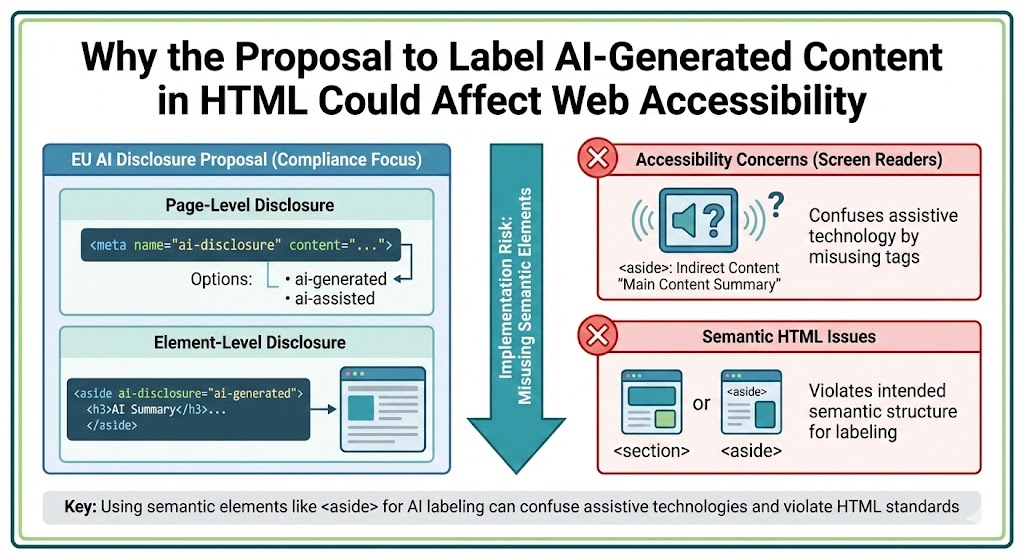
A new AI Disclosure Proposal is causing waves in the web development and accessibility communities. The proposal suggests using HTML attributes to label AI-generated content, a move that aims to comply with upcoming EU regulations. However, concerns have emerged about how this could disrupt web accessibility and semantic HTML standards.
The AI Disclosure Proposal
This new proposal introduces two methods for labeling AI-generated content:
-
Page-Level Disclosure: A meta tag indicating the degree of AI involvement on the page.
-
Examples of attributes:
-
ai-generated (AI-generated with human input)
-
ai-assisted (Human-authored, AI-refined)
-
autonomous (Fully AI-generated)
-
mixed (AI and human content)
-
none (No AI involvement)
-
-
-
Element-Level Disclosure: Labels applied directly to sections of the page, like
<section>and<aside>, to mark AI-generated content.-
Example:
-
The Semantic HTML Controversy
While the proposal introduces new ways to label AI content, it also raises concerns about semantic HTML and accessibility.
-
<aside> Element: Typically used for content indirectly related to the main content. Its use for AI-generated summaries could confuse users relying on assistive technology like screen readers. AI summaries are directly related to the main article, and using
<aside>may violate the semantic meaning of the element. -
<section> Element: Used to group related content, but it may not be suitable for labeling the origin of content. If an AI summary is part of the main flow, using
<section>for AI attribution could disrupt accessibility standards, particularly for assistive technologies.
Accessibility Concerns
The main concern with the AI disclosure proposal is how using semantic HTML elements like <section> and <aside> for AI content labeling could negatively impact accessibility. The <aside> and <section> elements are intended to organize content thematically or categorically, not to indicate the origin of the content.
-
Assistive technology, such as screen readers, may misinterpret the content of these elements, leading to confusion. For users who depend on assistive devices, this could make navigating the page more difficult.
The semantic structure of HTML elements is crucial for ensuring web accessibility, and misusing these elements could degrade the user experience for people with disabilities.
EU Regulations and Compliance
The EU AI Act mandates that AI-generated content must be labeled, pushing platforms toward greater transparency. However, critics argue that the current proposal, which applies these labels using semantic HTML elements, may not be the most effective solution. While the intent is to comply with the law, the implementation could create problems for web developers and accessibility advocates.
The proposal is still in early discussions, and some critics question whether it addresses the real needs of the web ecosystem, or whether it’s merely a compliance-driven measure without a clear user benefit.
Looking Ahead
As the debate continues, it’s clear that more work is needed to balance legal compliance with web accessibility. There are still questions regarding the best way to implement AI content labeling without disrupting the user experience.
The use of semantic HTML elements like <section> and <aside> for AI labeling might not be the perfect solution, but it offers a potential path forward for AI transparency. However, web accessibility experts and developers will likely continue to voice concerns over this approach.
Conclusion
The proposal to use semantic HTML elements for labeling AI-generated content is an interesting step toward transparency in AI usage on the web. However, it raises important questions about the accessibility implications of using elements like <section> and <aside> to mark AI authorship. As the EU regulations approach, it’s vital for developers and accessibility experts to carefully consider how AI labeling can be achieved without sacrificing web user experience.