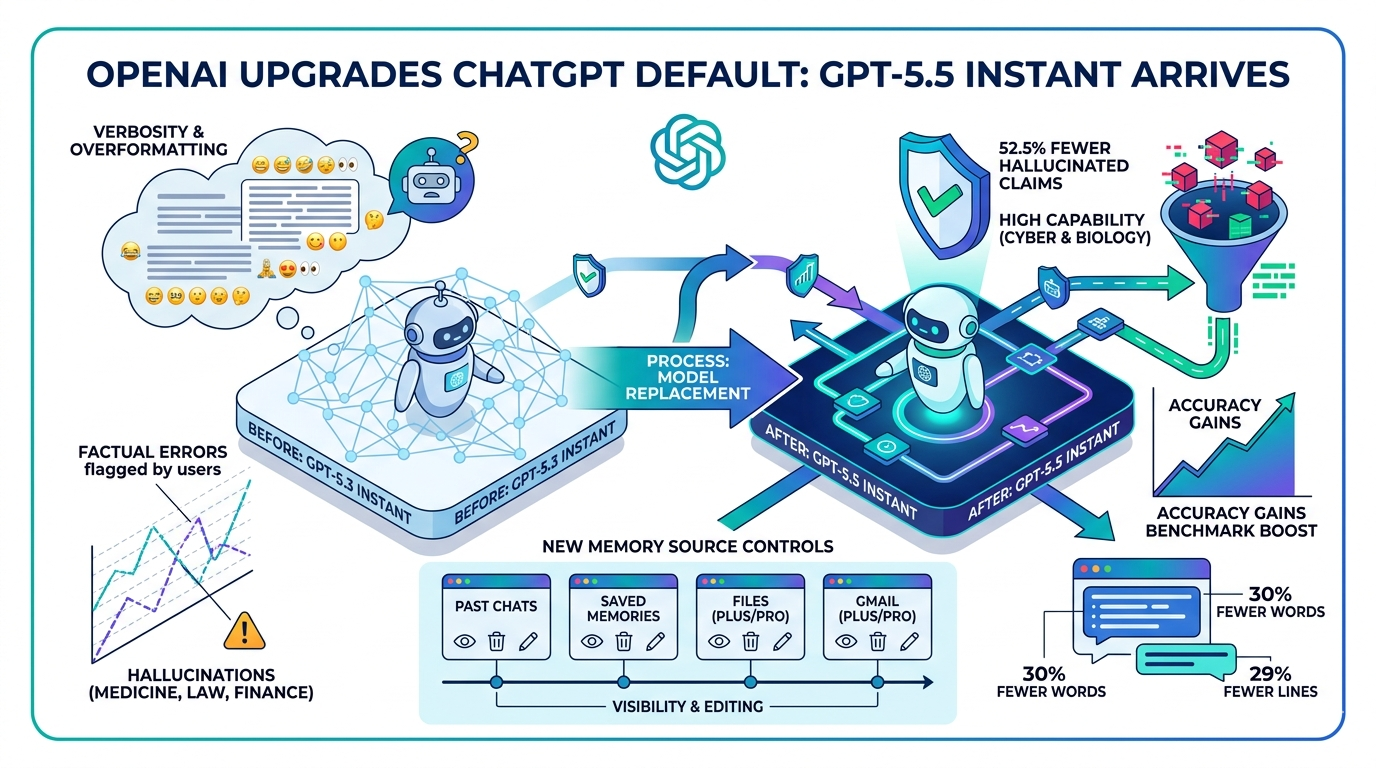
Hundreds of millions of ChatGPT users are now interacting with a different model than they were 48 hours ago. OpenAI confirmed in a May 5, 2026, blog post that GPT-5.5 Instant has replaced GPT-5.3 Instant as the platform's default model across all user tiers, effective immediately.
Hallucination Reduction and Accuracy Gains
OpenAI stated the updated model delivers significant improvements in factuality, with internal evaluations showing GPT-5.5 Instant produced 52.5% fewer hallucinated claims than GPT-5.3 Instant on high-stakes prompts covering medicine, law, and finance. The company also reported a 37.3% reduction in inaccurate claims on especially challenging conversations that users had previously flagged for factual errors.
Benchmark results published alongside the announcement show gains across multiple domains. On the CharXiv scientific chart reasoning benchmark, GPT-5.5 Instant scores 81.6%, up from 75.0% for GPT-5.3 Instant. The model scored 81.2 on the AIME 2025 competition math test, up from 65.4, and reached 76 on the MMMU-Pro multimodal reasoning benchmark versus 69.2 for its predecessor. OpenAI noted in its announcement that these figures are drawn from internal evaluations and have not been independently verified against competing models.
GPT-5.5 Instant is also the first Instant-tier model OpenAI classifies as "High Capability" in both cybersecurity and biological domains, requiring the same automated safeguards previously reserved for the more powerful Thinking variants.
Response Concision and Tone
OpenAI stated in its May 5 blog post that responses are tighter and more to-the-point without losing substance, and that the model reduces the verbosity and overformatting that can make responses too long. According to OpenAI's internal comparisons, GPT-5.5 Instant uses approximately 30% fewer words and nearly 29% fewer lines in its responses than its predecessor. The company also noted the model asks fewer unnecessary follow-up questions and avoids gratuitous emoji use that contributed to what OpenAI described as cluttered responses.
Expanded Personalization and New Memory Source Controls
OpenAI simultaneously introduced memory sources across all ChatGPT models, giving users visibility into what context was used to personalize a response, including saved memories or past chats, and the ability to delete or correct that context if it is outdated.
Memory sources are not shown to other users if a chat is shared. Users can tap the Sources icon below a response to view relevant saved memories, past chats, and custom instructions. Plus and Pro users may also see files from their library and referenced emails from a connected Gmail account. Any item that is outdated or no longer relevant can be corrected, deleted, or marked as not relevant.
OpenAI acknowledged in its May 5 post that memory sources may not capture every factor that shaped a given response. The company stated the feature is intended to make personalization easier to understand, though in some cases it will surface only the most relevant past chats or memories rather than everything the system referenced.
Rollout and Availability
GPT-5.5 Instant is rolling out to all ChatGPT users as the default model and is available in the API under the alias `chat-latest`. For paid users, GPT-5.3 Instant will remain accessible through model configuration settings for three months before being retired.
Enhanced personalization drawing on past chats, files, and connected Gmail is rolling out initially to Plus and Pro users on the web, with mobile access coming soon and plans to expand to Free, Go, Business, and Enterprise users in the coming weeks. Memory sources are rolling out across all ChatGPT consumer plans on the web. OpenAI noted that availability of specific personalization sources may vary by region.
Practical Implications for Marketers and Content Teams
For digital marketers and content teams using ChatGPT for research, copywriting, or campaign planning, the accuracy improvements in high-stakes domains, combined with more concise default outputs, may reduce the editing load on AI-assisted drafts. The introduction of memory sources gives users a more transparent view of how prior context shapes responses, which is relevant for teams using shared ChatGPT accounts or workflows that depend on consistent AI output. Marketers should note that enhanced Gmail and file-based personalization remains gated to Plus and Pro subscriptions during the initial rollout period, and that memory source visibility may not reflect the full range of context the model used in any given response.
GPT-5.3 Instant, which the new model replaces, had been ChatGPT's default since March 3, 2026.