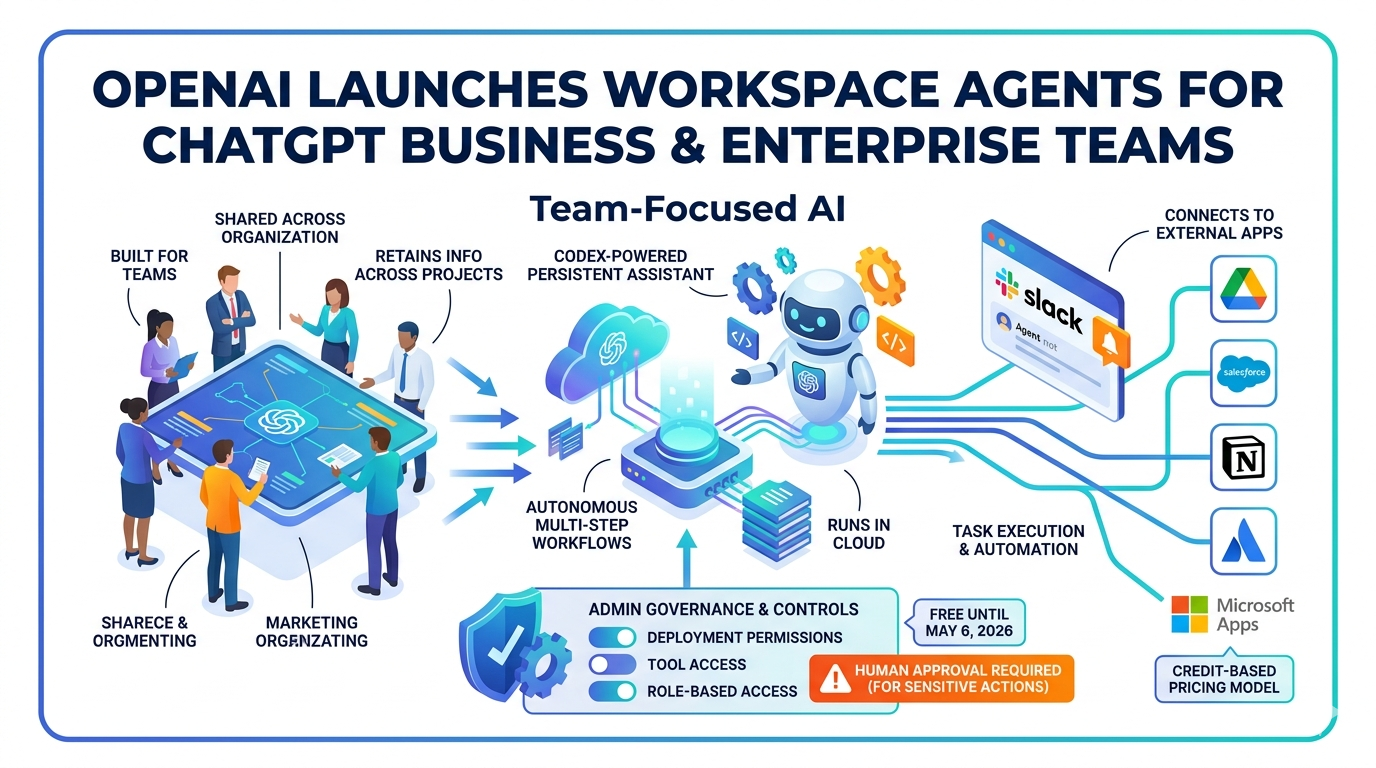
ChatGPT's organizational AI layer is changing significantly for paid subscribers. OpenAI confirmed on April 22, 2026, in an announcement published to openai.com, that workspace agents are now available in research preview for ChatGPT Business, Enterprise, Edu, and Teachers plan subscribers.
Unlike the custom GPTs users have built in the past, workspace agents are powered by OpenAI's Codex model and run as persistent assistants that can connect to external apps, retain information across projects, and complete multi-step workflows without repeated prompts. They run in the cloud, so they can keep working even when users are not active, and are designed to be shared within an organization so teams can build an agent once, use it together in ChatGPT or Slack, and improve it over time.
How Workspace Agents Differ From Custom GPTs
The primary distinction from existing GPTs is that workspace agents are built for teams rather than individuals. They can pull context from different systems, follow a team's workflow, ask for approvals, and move tasks forward across multiple tools. Each agent has its own dedicated workspace with access to files, code, tools, and memory, and agents can write and run code, use connected apps, retain information across sessions, and handle multi-step tasks.
OpenAI confirmed in the April 22 announcement that existing custom GPTs will not be immediately retired. GPTs will remain available while teams test workspace agents with their workflows, and OpenAI stated it will make it easy to convert GPTs into workspace agents at a later date.
Supported Integrations and Deployment Options
Workspace agents allow users on ChatGPT Business and Enterprise, Edu and Teachers subscription plans to design or select from pre-existing agent templates that can take on work tasks across third-party apps and data sources, including Slack, Google Drive, Microsoft apps, Salesforce, Notion, Atlassian Rovo, and other popular enterprise applications.
Teams can set agents to run on a schedule, or deploy them in Slack so they can pick up requests as they come in. OpenAI's announcement described several reference workflows its own internal teams have built, including a sales opportunity agent that aggregates call notes and account data, an accounting agent that handles month-end close tasks, and a product team agent that proactively answers employee questions in Slack channels.
Setting up a workspace agent is designed to be a fast process. Users describe a recurring workflow or upload a file, and ChatGPT turns it into an agent, defining steps, connecting tools, adding skills, and testing the result. OpenAI is also offering pre-built templates for common functions in finance, sales, and marketing.
Enterprise Governance and Admin Controls
Admins can control who is allowed to build, run, and publish agents, and which tools, apps, and actions those agents can reach. The role-based controls are more granular than those most custom-GPT rollouts had: admins can toggle, per role, whether members can browse and run agents, whether they can build them, and whether they can publish to the workspace directory.
Built-in safeguards are designed to block prompt injection attacks, and agents can be monitored through the Compliance API and paused if something goes wrong. Users decide which tools and data each agent can access, and sensitive actions such as sending an email or creating a calendar entry can be set to require approval before execution. Analytics show how often a shared agent gets used.
Among the role-based settings available, admins can separately control whether members can publish agents that authenticate using personal credentials, a setting OpenAI explicitly recommends keeping narrowly scoped.
Availability and Pricing
Workspace agents are available in research preview in ChatGPT Business, Enterprise, Edu, and Teachers plans. On Enterprise and Edu plans, admins can activate the feature through role-based controls.
OpenAI said the feature will remain free until May 6, 2026, before moving to a credit-based pricing model. The ChatGPT Business plan is priced at $20 per user per month; Enterprise and Edu plans are variably priced.
For marketers and digital teams, workspace agents introduce a meaningful operational shift: recurring tasks such as lead qualification, performance reporting, and feedback aggregation can now be delegated to shared agents that operate continuously, surface outputs directly inside Slack, and maintain persistent memory across sessions, without requiring engineering resources to build or maintain them.
OpenAI indicated that further developments are planned, including expanded automation triggers, improved analytics dashboards, and deeper integration across business applications.