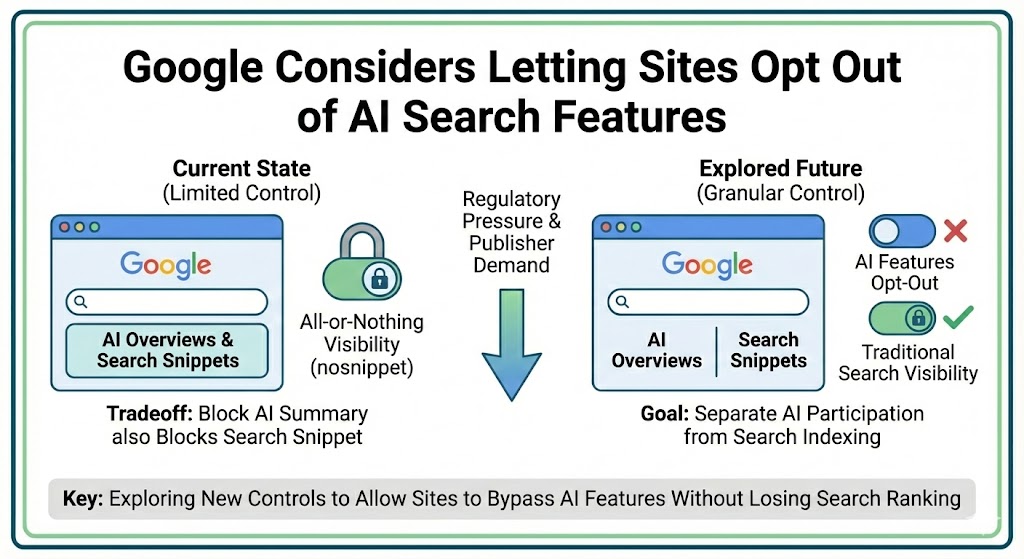
Google is evaluating new controls that could allow website owners to opt out of AI-powered search features without removing their content from traditional Google Search results.
The move comes as regulators in the United Kingdom begin formally examining how generative search tools affect publishers and competition. While Google has not committed to a timeline or technical rollout, the company confirmed it is exploring options that would give sites more granular control over how their content appears inside AI-driven experiences.
A Shift Toward Granular Publisher Control
Today, publishers have limited levers for managing how their content interacts with Google’s AI systems. Existing tools were not designed specifically for generative search.
For example, Google-Extended allows websites to block their content from being used to train certain AI models, including Gemini and Vertex AI. However, that setting does not affect whether content appears in AI Overviews or other AI-powered search features. It governs training data only, not visibility.
Other directives such as "nosnippet" and "max-snippet" do apply to AI-generated summaries, but they also suppress traditional search snippets. For many publishers, that tradeoff is too costly, as losing snippets can directly impact click-through rates and traffic.
Google acknowledged that this all-or-nothing approach leaves a gap. Any future solution, the company says, would need to separate AI participation from standard search visibility without fragmenting the user experience.
Regulatory Pressure Mounts
The timing of Google’s announcement aligns with a consultation opened by the UK Competition and Markets Authority (CMA), which is reviewing whether new rules are needed for how Google handles publisher content inside AI products.
Several industry groups have called for the ability to opt out of AI summaries while remaining fully indexed in organic search. Similar discussions are taking place in the United States and South Africa, where regulators are evaluating how generative search features may impact competition and traffic to publishers.
Publishers themselves have already taken defensive action. Many have begun blocking AI crawlers or retrieval bots via robots.txt, signaling discomfort with how their content is being reused inside AI experiences.
Google’s exploration of new controls appears to be a response to that growing pressure from both regulators and the broader web ecosystem.
What Publishers Can Do Today
Until more specific controls are introduced, options remain limited. Websites can use snippet restrictions or AI training blocks, but neither approach cleanly separates AI summaries from standard search results.
As a result, publishers face a tradeoff between protecting their content from AI features and preserving search visibility.
Still Early, No Commitments
Importantly, Google has not outlined implementation details or deadlines. The company describes its work as exploratory rather than a confirmed roadmap.
Whether this ultimately takes the form of a new robots directive, Search Console setting, or another mechanism will determine how practical the solution is for site owners.
For now, the message is clear: AI search controls are becoming a policy and regulatory issue, not just a technical one. If opt-out mechanisms do materialize, they could reshape how publishers balance visibility, traffic, and content usage in an AI-driven search environment.