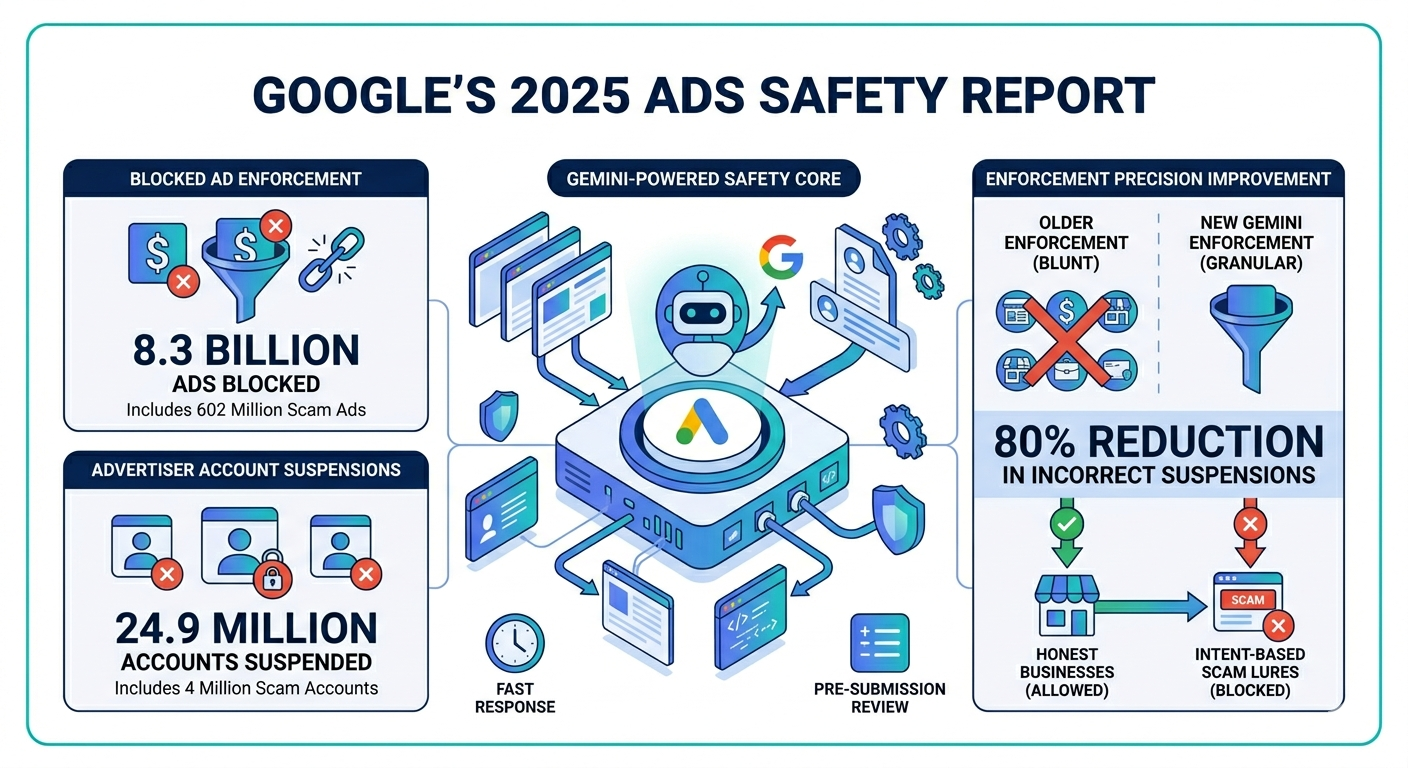
Google advertisers and users are operating in a significantly changed enforcement environment. Google confirmed in its 2025 Ads Safety Report, published April 17 on the Google product blog by Keerat Sharma, Vice President and General Manager of Ads Privacy and Safety, that Gemini-powered systems blocked or removed over 8.3 billion ads and suspended 24.9 million advertiser accounts over the course of the year.
Scale of Enforcement in 2025
Gemini-powered tools stopped over 99% of policy-violating ads before they ran in 2025, with Google blocking or removing more than 8.3 billion ads and suspending 24.9 million accounts. The totals include 602 million ads and 4 million accounts linked to scams.
The report also shows that 4.8 billion ads were restricted during the year. On the restriction side, legal requirements led with 504.4 million ads restricted, followed by financial services at 273.4 million and online gambling and games at 123.9 million.
Enforcement extended to the publisher ecosystem as well, with action taken on more than 480 million web pages and 245,000 publisher sites. Sexual content accounted for the largest share of violations at over 409 million pages, followed by "dangerous and derogatory" content at 20.5 million and "shocking content" at 15 million.
How Gemini's Detection Differs from Earlier Systems
The report explains a fundamental shift in how Google's ad review systems evaluate content. Google said Gemini analyzes hundreds of billions of signals, including account age, behaviour patterns, and campaign activity, to detect malicious intent earlier than older systems built more heavily around keywords and rule matching.
Google said the rise in blocked ads also reflects the growing use of generative AI by scammers to produce deceptive content at scale, with its Gemini models helping detect patterns across large campaigns and block them earlier.
Pre-Submission Review for Responsive Search Ads
Gemini-based systems can now review many ads automatically at the submission stage. By the end of 2025, Google said most Responsive Search Ads created through Google Ads were reviewed instantly, allowing harmful content to be blocked before publication. Google also said that by the end of 2025, most Responsive Search Ads would be reviewed instantly at submission, blocking harmful ads before launch, and it plans to expand that capability to more formats in 2026.
Faster Response to User Reports
AI tools also helped the company process user feedback more quickly, with Google's teams acting on more than four times as many user reports in 2025 as in the previous year, allowing staff to focus on cases that required human judgment.
Reduction in Incorrect Advertiser Suspensions
One of the report's more notable claims concerns enforcement precision rather than volume. At a virtual briefing, Keerat Sharma told reporters the company has shifted toward more targeted, AI-driven enforcement "at a much more granular level, on a creative level, as opposed to using a much more blunt instrument, like advertiser suspensions," adding that the approach has helped reduce incorrect suspensions by 80% year over year.
Sharma stated in the report: "By analyzing beyond images and text patterns, Gemini can better distinguish between a credible offer and an intricate lure, a level of nuance that helped us reduce incorrect advertiser suspensions by 80% last year. This accuracy allows us to focus on two things in tandem: prioritizing the removal of harmful content while helping honest businesses keep their ads running."
The report addresses the balance between enforcement and avoiding errors that affect legitimate advertisers. Google said improved analysis beyond text and image patterns helped reduce incorrect advertiser suspensions by 80% last year, a metric that matters because online ad enforcement systems face scrutiny not only for the scams they miss, but also for the businesses they wrongly penalize.
Context: Enforcement Accuracy Remains Under Scrutiny
The 80% reduction in incorrect suspensions has not ended questions about AI-driven enforcement errors. Faster automated enforcement does not always mean smoother enforcement. Some advertisers in the U.K. and U.S. have recently reported bulk ad disapproval alerts despite finding no actual policy issues, adding pressure on Google to prove that tighter AI enforcement will not create new disruptions for legitimate brands.
For digital marketers running paid search campaigns, the shift to pre-submission review for Responsive Search Ads means that policy violations are more likely to surface at the point of ad creation rather than after a campaign goes live. The expansion of that review to additional ad formats in 2026 will likely extend that dynamic further, making policy compliance a front-end consideration in campaign builds rather than a reactive one.
Sharma closed the report by stating that as threats evolve, Google will continue developing Gemini's enforcement capabilities, with additional ad format coverage planned for the current year.