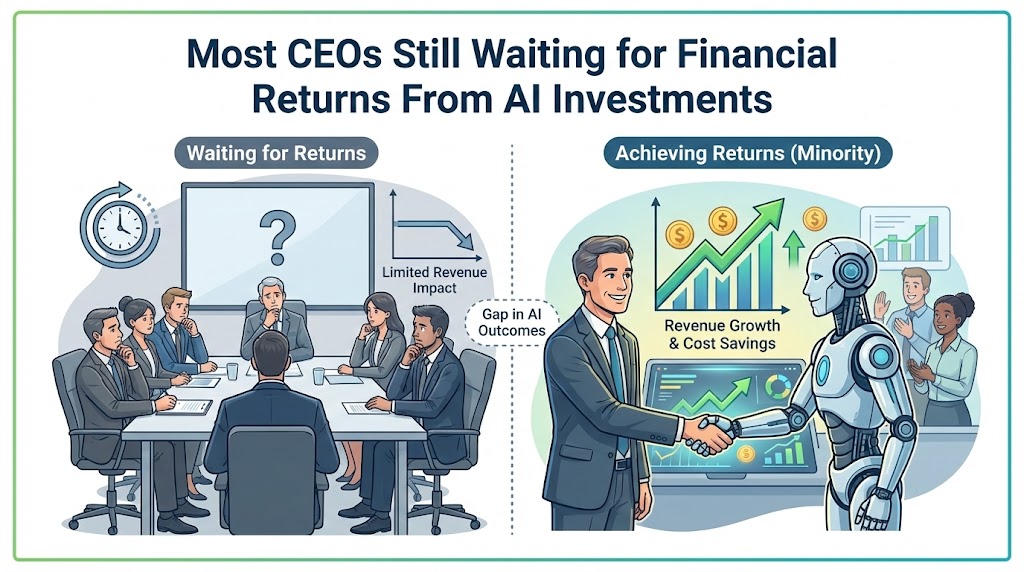
A majority of chief executives say artificial intelligence has not yet delivered measurable financial value for their organizations, highlighting a growing gap between AI adoption and realized business outcomes.
According to a new global survey of more than 4,400 CEOs across 95 countries, over half report that AI investments made over the past year have produced neither revenue growth nor cost reductions. The findings suggest that while experimentation with AI is widespread, tangible returns remain elusive for many companies.
Financial impact remains uneven
Only about three in ten CEOs indicated their organizations experienced revenue increases attributable to AI during the last 12 months. Cost outcomes were similarly mixed, with roughly a quarter reporting reductions and a smaller share saying costs increased. A relatively small group—just over one in ten—reported achieving both higher revenue and lower costs at the same time.
Executives in this high-performing segment shared several characteristics, including clearer AI roadmaps and technology environments designed to integrate AI into core operations rather than isolated use cases.
Limited penetration in marketing use cases
The survey also points to early-stage AI adoption in customer-facing functions. Fewer than one-quarter of CEOs said AI is being used extensively for demand generation, with similar levels reported for product and experience-related applications.
For marketing leaders, the data suggests that large-scale AI deployment in acquisition and growth initiatives is still the exception rather than the norm, despite high levels of interest and experimentation across teams.
Broader confidence is declining
The cautious outlook on AI returns coincides with a broader drop in executive confidence. Only 30% of CEOs said they feel highly confident about revenue growth over the next year, down from 38% a year ago and well below levels seen earlier in the decade.
This decline reflects ongoing economic uncertainty as well as rising pressure to demonstrate clear returns from major technology investments.
Foundations before scale
Survey findings indicate that organizations seeing value from AI tend to treat it as an enterprise-wide capability rather than a collection of standalone tools. Clear governance, integration-ready infrastructure, and alignment with business strategy were common factors among companies reporting positive outcomes.
For marketing and digital leaders, the results reinforce a growing consensus: AI-driven growth is more likely to follow structural investment and operational readiness than short-term experimentation alone.
As organizations continue to assess their AI strategies, the data suggests expectations around immediate financial impact may need to be recalibrated while foundational work continues.