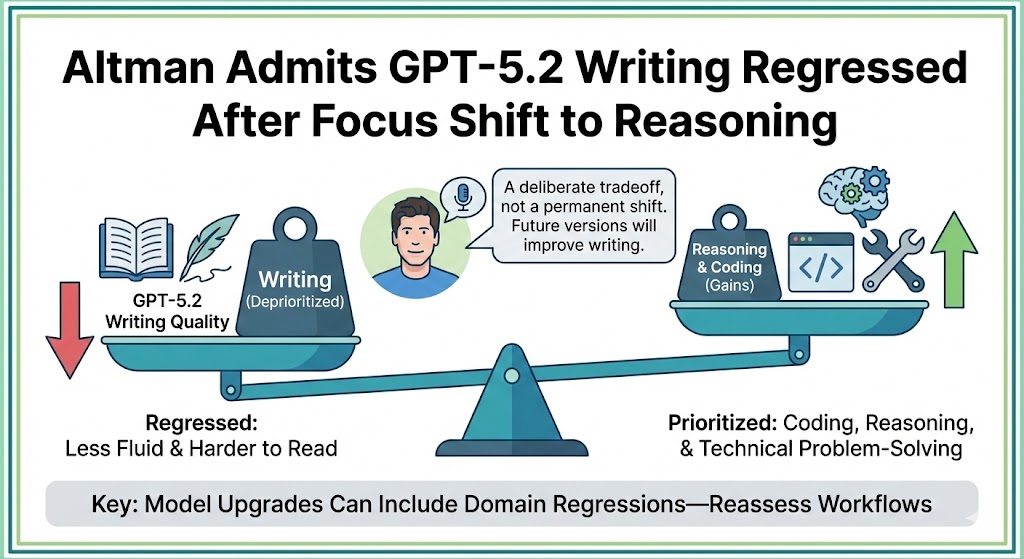
OpenAI CEO Sam Altman has acknowledged that GPT‑5.2 shipped with weaker writing quality than its predecessor, attributing the regression to a deliberate shift in development priorities toward reasoning, coding, and technical problem‑solving.
Altman made the remarks during a recent developer town hall, responding to feedback that GPT‑5.2 outputs feel harder to read and less fluid than GPT‑4.5. He characterized the issue as a misstep rather than a long‑term change in direction.
A conscious tradeoff, not a permanent shift
According to Altman, OpenAI allocated the majority of its limited development capacity to improving GPT‑5.2’s technical performance. That decision, he said, came at the expense of writing quality.
The emphasis for GPT‑5.2 was placed on reasoning, coding, engineering tasks, and complex problem‑solving. While those areas saw meaningful gains, the balance resulted in a noticeable decline in how the model handles prose‑heavy and client‑facing writing tasks.
Altman said future versions in the GPT‑5.x line are expected to reverse that gap, with writing quality improving beyond GPT‑4.5 rather than remaining behind it.
How GPT‑4.5 and GPT‑5.2 were positioned
The contrast reflects how OpenAI framed each release.
When GPT‑4.5 launched in early 2025, OpenAI highlighted natural language interaction, tone, and readability, positioning it as particularly strong for drafting, editing, and refining written content.
GPT‑5.2, by comparison, was introduced as a model optimized for professional and technical workflows. Release materials emphasized spreadsheets, presentations, tool integration, and software development, with writing framed more narrowly around technical documentation.
Altman’s comments suggest that while writing capabilities were not abandoned, they were deprioritized relative to other objectives.
Why this matters for teams using AI output
For marketers, agencies, and businesses that rely on ChatGPT for polished writing, the acknowledgement helps explain recent shifts in output quality. Model upgrades do not always represent across‑the‑board improvements; gains in one domain can introduce regressions in another.
Altman’s comments reinforce the need to treat major model updates as dependency changes. Organizations using AI‑generated content in production workflows may need to reassess prompts, adjust expectations, or retain fallback models when writing quality is critical.
What comes next
Altman reiterated that OpenAI’s long‑term goal remains highly capable general‑purpose models, not narrowly specialized systems. Even models optimized for coding and reasoning, he said, should ultimately be strong writers.
No timeline was provided for when writing improvements will appear in the GPT‑5.x series. Based on OpenAI’s past release patterns, changes are likely to arrive incrementally through future point releases rather than a single major update.
For now, the company appears to be balancing user feedback against the rapid expansion of model capabilities, with writing quality firmly back on the roadmap.