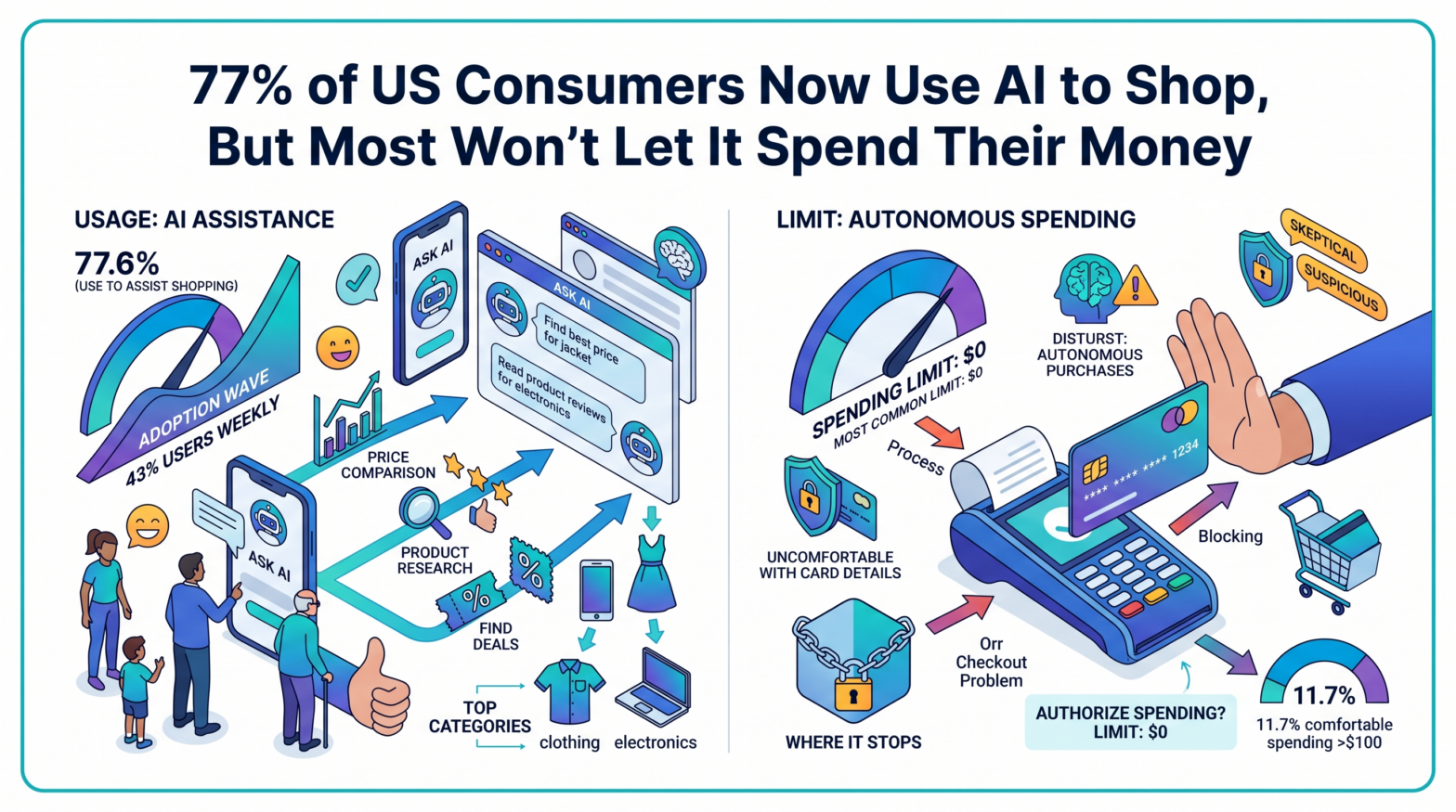
A wide gap has opened between how consumers use AI for shopping and how far they will let it go. A proprietary survey of 1,009 US consumers conducted by Exploding Topics, the Semrush-owned trend research platform, published April 27, 2026, found that 77.6% of respondents had used AI to assist with a shopping or purchasing decision in the preceding six months, yet the most common spending limit consumers would authorize for fully autonomous AI purchases was $0.
Rapid Adoption Across Demographics
43.21% of consumers are using AI to help with shopping at least once a week, with well over half of shoppers using the technology at least monthly. The survey found adoption has extended well beyond younger, tech-forward cohorts. More than three in four consumers have used AI to help with shopping in the last six months, with tools like ChatGPT and Google Gemini absorbed into weekly shopping routines as a staple of product research and price comparison. Even among respondents over 60, more than half reported using AI-assisted shopping tools in the same period.
Product research was the most cited use case, adopted by 68.5% of AI shoppers. Finding the best price or deals was reported by 55.19% of respondents. Clothing and consumer electronics ranked as the most common product categories in which shoppers applied AI assistance. Notably, grocery shopping was reported by 44.62% of AI shoppers, while furniture and jewelry ranked among the least common categories at roughly 29% and 28%, respectively.
ChatGPT Leads, Gemini Closes the Gap
Among those who use AI to shop, ChatGPT is the most popular tool at 77.56%, followed by Google Gemini at 58.21%. Gemini's share, more than double the next-ranked tool, reflects Google's embedding of the model inside AI Overviews and AI Mode, which have effectively inherited the search engine's long-standing role in product research. Claude, from Anthropic, was used by fewer than one in five AI shoppers surveyed. Grok showed the most pronounced gender gap of any tool in the survey, used by 31.98% of male AI shoppers compared with 15.16% of female respondents.
68.07% of consumers who have used AI for shopping have increased their usage in the past six months, and 68.64% say AI has directly influenced them to buy something they otherwise would not have purchased. The influence effect was most concentrated among high earners: 61.9% of households reporting income of $125,000 or more said AI had influenced a purchase "many times."
The Checkout Problem
Despite widespread adoption of AI for research and price comparison, the Exploding Topics survey found that completing a transaction inside an AI interface remains a near-fringe behaviour. Only 2.18% of AI shoppers reported completing an entire purchase within an AI tool, while 44.8% described starting their shopping on a retail website and then supplementing with AI, and 44.03% said they used AI as a starting point before completing checkout externally.
That pattern aligns with the commercial record of AI-native checkout features. OpenAI launched its Instant Checkout feature, which allowed users to purchase items from retailers including Etsy, Walmart, and Shopify directly within ChatGPT, and initially billed it as the "next step" in AI-enabled commerce. Analysts told CNBC that OpenAI underestimated how difficult enabling transactions would be, and the company struggled to onboard merchants, show accurate product data, and support multi-item carts or loyalty memberships.
OpenAI subsequently stated that "the initial version of Instant Checkout did not offer the level of flexibility that we aspire to provide," and confirmed it was allowing merchants to use their own checkout experiences while the company focused its efforts on product discovery. On March 5, 2026, the company acknowledged that the highly publicized feature would be discontinued because it wasn't generating conversions. OpenAI confirmed it will now prioritize product search and discovery inside ChatGPT, while continuing to work with Stripe on the Agentic Commerce Protocol to support app-based transactions.
Meanwhile, Google announced the Agent Payments Protocol (AP2), an open protocol developed with leading payments and technology companies to securely initiate and transact agent-led payments across platforms. Google cited collaboration with 60-plus organizations, including Mastercard, American Express, PayPal, Coinbase, Etsy, Salesforce, and Worldpay, in developing the standard. The Exploding Topics survey used AP2's stated use case, instructing an AI agent to purchase a product the moment it becomes available, as a benchmark for consumer readiness. The survey found the appetite is not yet there.
Consumer Distrust of AI Payment Handling
Awareness of AI checkout tools remains low in the general population. 42.83% of survey respondents said they were not at all aware of tools like Instant Checkout, with a further 23.01% only vaguely aware. When informed of their existence, the most common reaction was skepticism, selected by 41.08% of respondents, followed by suspicion at 33.10%. Excitement was chosen by 31.61%, with free-text responses skewing heavily negative, including terms such as "terrified" and "preyed upon."
The mode amount a consumer would authorize AI to spend autonomously is $0. 31.21% of consumers would not allow any autonomous AI spend at all, 17.45% would cap it at $20, and 20.74% would cap it at $50. Only 11.71% said they would be comfortable authorizing an AI agent to spend more than $100 in a single transaction, a threshold that would cover most event ticket purchases, one of the prominent use cases cited in Google's AP2 announcement. Among weekly AI shoppers, a group that skews toward enthusiasm for the technology, 51.84% said they would still cap autonomous spending at $50 or less.
More than half of all consumers would be at least somewhat uncomfortable with letting AI tools store their card details. Even among respondents aged 18 to 29, a demographic with the highest rates of digital payment adoption, more than a third said they would be "very uncomfortable" with an AI chatbot storing their payment credentials. The survey found that only 14.16% of respondents believed consumers were the primary beneficiaries of current AI shopping tools. The most common answers were AI companies themselves, cited by 27.52%, and brands and advertisers, cited by 27.32%.
Implications for Retailers and Marketers
The survey data indicates that AI's current commercial leverage for retailers operates primarily at the research and consideration stages, not at the point of transaction. With 44.03% of AI shoppers using AI as their first stop before going to external retail sites, and an additional 44.8% using AI as a supplementary layer during an existing retail session, brand visibility in AI-generated results carries direct implications for traffic and conversion. Generative Engine Optimization, ensuring that a brand surfaces organically in AI-driven discovery, is increasingly relevant alongside traditional SEO and Google Shopping strategy. Retailers pursuing integration with agentic payment infrastructure such as AP2 or app-based checkout within ChatGPT face the additional challenge that consumer willingness to complete transactions through those channels remains limited at present.
Majority Expect AI's Role in Shopping to Grow
55.83% of consumers expect AI to play a bigger role in how they shop in five years' time. Among non-users, 32.44% anticipated AI would play a somewhat larger role in their shopping within that timeframe. Only 12.37% of all respondents said they believed AI would play a smaller role going forward.
On the question of advertising integration, the survey found that 48.35% of respondents believed the rollout of more shopping capabilities and ad formats within AI tools would improve the overall quality of AI responses, a finding that may inform platform decisions on monetization. Fewer than one in ten of the most frequent AI shoppers said they expected ads and shopping features to make AI outputs worse.
In Forrester's Consumer Voices Market Research Online Community Survey from March 2026, online adults in the US, UK, and Canada who regularly use answer engines identified completing a purchase within the answer engine as their least-adopted use case, with asking general questions and researching a product ranking as their top two.