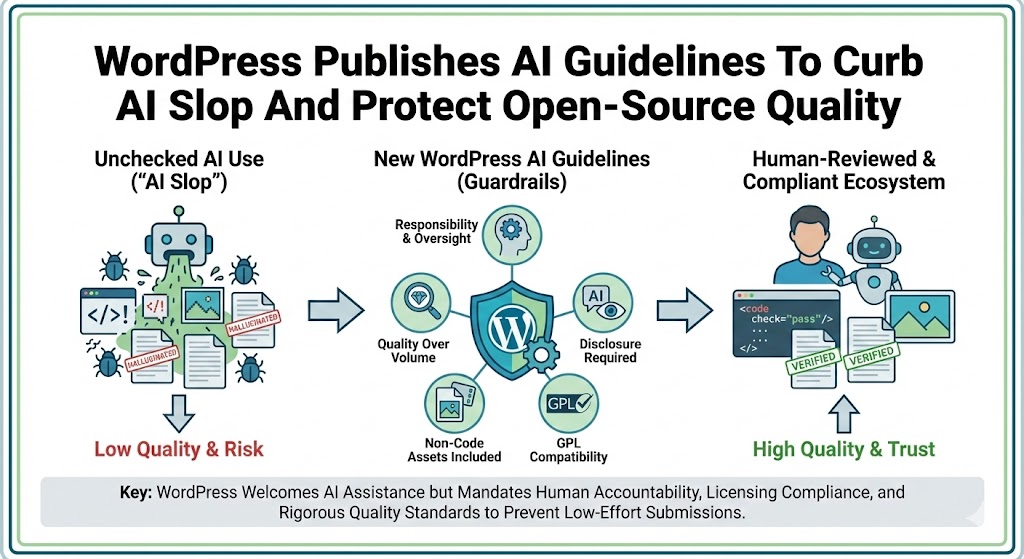
WordPress has introduced new official guidelines outlining how contributors should use artificial intelligence when building plugins, themes, documentation, and media assets.
The message is clear: AI is welcome, but accountability, licensing compliance, and quality standards still apply.
The framework is designed to prevent what maintainers increasingly describe as “AI slop,” while ensuring the open‑source ecosystem stays legally compliant and reviewable as AI‑assisted development becomes more common.
WordPress Says Quality Standards Do Not Change With AI
The WordPress project emphasized that AI does not lower the bar for contributions.
Code, documentation, and assets generated with AI must meet the same expectations as fully human‑written work. Submissions that are rushed, untested, or bloated simply because they were produced quickly with AI will not be accepted.
In short, AI can accelerate workflows, but it does not replace responsibility.
Five Core Principles For AI‑Assisted Contributions
WordPress published five principles that contributors must follow when using AI tools:
-
Contributors remain responsible for all work submitted
-
Meaningful AI assistance must be disclosed
-
Output must remain compatible with GPL licensing
-
Non‑code assets count (docs, images, tutorials)
-
Quality over volume; low‑effort AI output may be rejected
These principles apply equally to code, screenshots, training materials, and any other assets included in WordPress projects.
Transparency Is Now Required
One of the biggest changes is disclosure.
Contributors are expected to explain when AI was used and how it was used inside pull requests or Trac tickets. This gives reviewers context when evaluating logic, testing, and originality.
The goal is not to discourage AI use, but to avoid hidden automation that creates review risk or unclear authorship.
GPL Compatibility Remains Non‑Negotiable
Licensing remains central to WordPress.
Because the platform operates under GPLv2‑or‑later, every contribution must also be GPL‑compatible, including AI‑generated output.
The guidelines warn against using tools that restrict redistribution or impose conflicting license terms. Contributors are also cautioned not to rely on AI systems to “wash” incompatible code.
If output reproduces proprietary or restricted material, it cannot be merged into WordPress projects.
For developers, this means checking tool terms carefully before integrating AI‑assisted code.
What WordPress Calls “AI Slop”
The guidelines directly address low‑quality AI output, describing several common problems reviewers are already seeing:
-
Hallucinated APIs or links
-
Over‑engineered or unnecessary code
-
Generic patches with no testing
-
Unverified documentation
These submissions waste reviewer time and create technical debt.
To counter this, WordPress recommends a simple process: use AI to draft, then manually review, test, and refine before submitting anything.
Small, well‑scoped commits with clear explanations are preferred over large, auto‑generated dumps.
Why This Matters For Developers And Agencies
As AI tools become standard across development workflows, open‑source projects are facing a surge of fast but inconsistent contributions.
WordPress is attempting to set guardrails early so that speed does not erode trust or quality.
For agencies, freelancers, and plugin developers, the takeaway is practical:
AI can help you move faster, but every line still needs human oversight, testing, and accountability.
Submitting unchecked AI output may simply lead to rejected pull requests.
The Bigger Picture
WordPress is not banning AI. It’s formalizing how it should be used.
The project’s stance reflects a broader industry shift: AI is an assistant, not an author.
Human responsibility, licensing compliance, and code quality remain the deciding factors.
For the WordPress ecosystem, that approach may help balance innovation with maintainability as AI‑assisted development becomes the norm.