



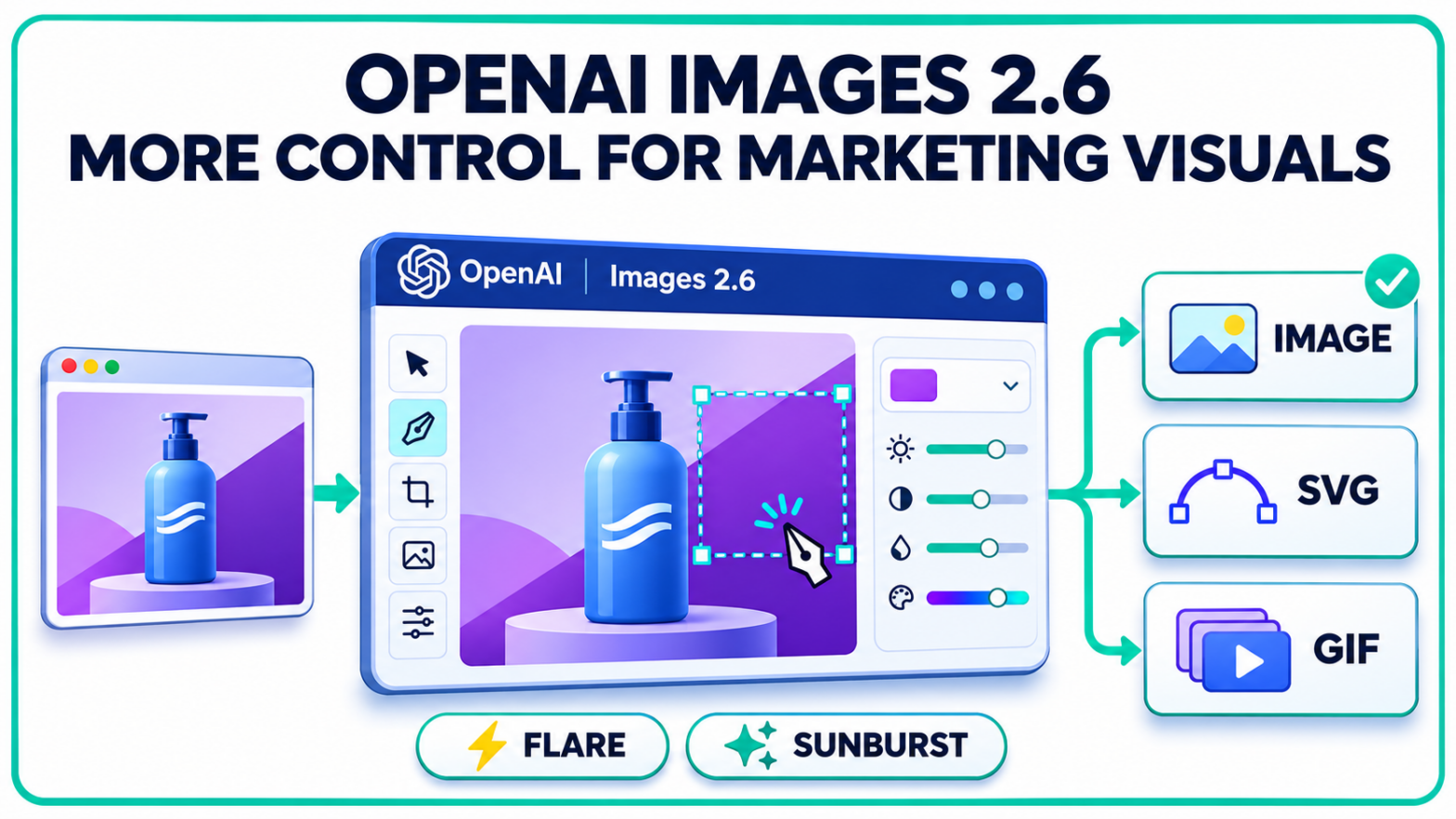
Getting an AI image right often takes several rounds of changes. OpenAI’s Images 2.6 release targets that revision cycle, adding more editing control alongside faster generation and new output formats.
The November 4 release covers ChatGPT, Codex and the API. For marketing teams, the central question is how much of an approved visual can survive the next requested change.
Flare and Sunburst Split AI Image Generation by Task
Developers have two models to choose from. OpenAI positions GPT-Image-2.6 Flare for fast, interactive generation and editing, while GPT-Image-2.6 Sunburst is aimed at detailed compositions and visual work.
Both accept text and image inputs. That supports workflows beginning with an existing asset as well as those starting from a written brief.
OpenAI says Images 2.6 generates images 50% faster than before and that Flare can produce an image in as little as six seconds at low quality. It describes Sunburst as offering higher quality and stronger consistency across edits at medium or high quality. Those are company-reported claims, rather than independently established production benchmarks.
The distinction gives teams a model choice tied to the assignment. A rough campaign concept and a detailed product composition have different review requirements, even when they begin with the same brief.
The release follows the company’s earlier expansion of AI image generation into the API and Codex. The current model pages identify separate 2.6 model names for developers integrating the new options.
AI Image Editing Gets a More Specific Target
OpenAI’s November 4 API changelog confirms markup-guided editing for supported GPT Image 2.5 and 2.6 models. The launch announcement describes it as a way to pinpoint where a specific change should happen.
For a creative team, a revision request often concerns one part of an otherwise accepted design: a background, a sign or an object. Identifying that area gives the editing request a visual reference alongside the written instruction.
The release also introduces adjustable complexity. OpenAI’s documentation separates this from quality: complexity governs planning before rendering, while quality governs rendering fidelity. Low, medium and high complexity are supported, with high used when the setting is omitted.
That default deserves attention in automated workflows. The documentation warns that higher complexity can increase latency and introduce unwanted changes; it does not carry a separate fee.
In practice, marketers evaluating AI design tools need to account for revision time as well as generation time. Product details, campaign copy and brand elements still require review against the approved brief. A faster first draft only covers one stage of that process.
SVG and GIF Output Reach Beyond Static Campaign Images
The API changelog lists SVG generation and animated GIF generation among the new capabilities. These extend the release into vector graphics and short animations, alongside conventional image generation and editing.
SVG output contains static vector content with editable paths, shapes and colours. GIF generation supports controls for frame count and duration. OpenAI’s image generation guide specifies that both formats are generated through the generation endpoint; the image edit endpoint does not support either output format.
That distinction matters when planning how an asset moves between tools. A vector illustration may need further design work, while an animated campaign visual needs review across its frames rather than at a single moment.
OpenAI’s release announcement presents brand mascots, social reactions and product loops as examples of GIF use. These are proposed creative applications, not evidence of improved campaign engagement or advertising performance.
Format support also sits alongside questions about asset origin. TechWyse has previously covered AI image verification, including the distinction between identifying a file’s provenance and establishing whether its content is accurate.
API Pricing Uses the Same Published Token Rates
The Flare and Sunburst model pages list matching token rates: $5 per million text input tokens, $8 per million image input tokens and $30 per million image output tokens. Cached input rates are $1.25 for text and $2 for images.
Those figures are token prices, rather than a fixed charge for each finished campaign asset. Equal published rates do not establish that two different requests will produce identical bills.
A production budget also includes the work surrounding the request. Teams may generate several candidates, revise one, reject another and adapt the accepted image for a placement. Comparing the cost of an approved asset captures more of that process than comparing a single generation.
The model documentation also says API rate limits depend on the account’s usage tier. Availability of a model and capacity to run a large batch are separate operational considerations.
Global Access Arrives With Familiar Review Limits
OpenAI says Images 2.6 is available globally in ChatGPT and Codex across all subscription tiers on desktop, mobile and web. Flare and Sunburst are also available through the API.
Broad access brings the release to individual creators and teams building image generation into their own software. The integration route determines where prompts, revisions and finished files enter an existing approval process.
OpenAI’s image generation guide continues to list limitations in precise text placement, recurring brand elements and structured compositions. It also warns that complex prompts can take up to two minutes to process.