
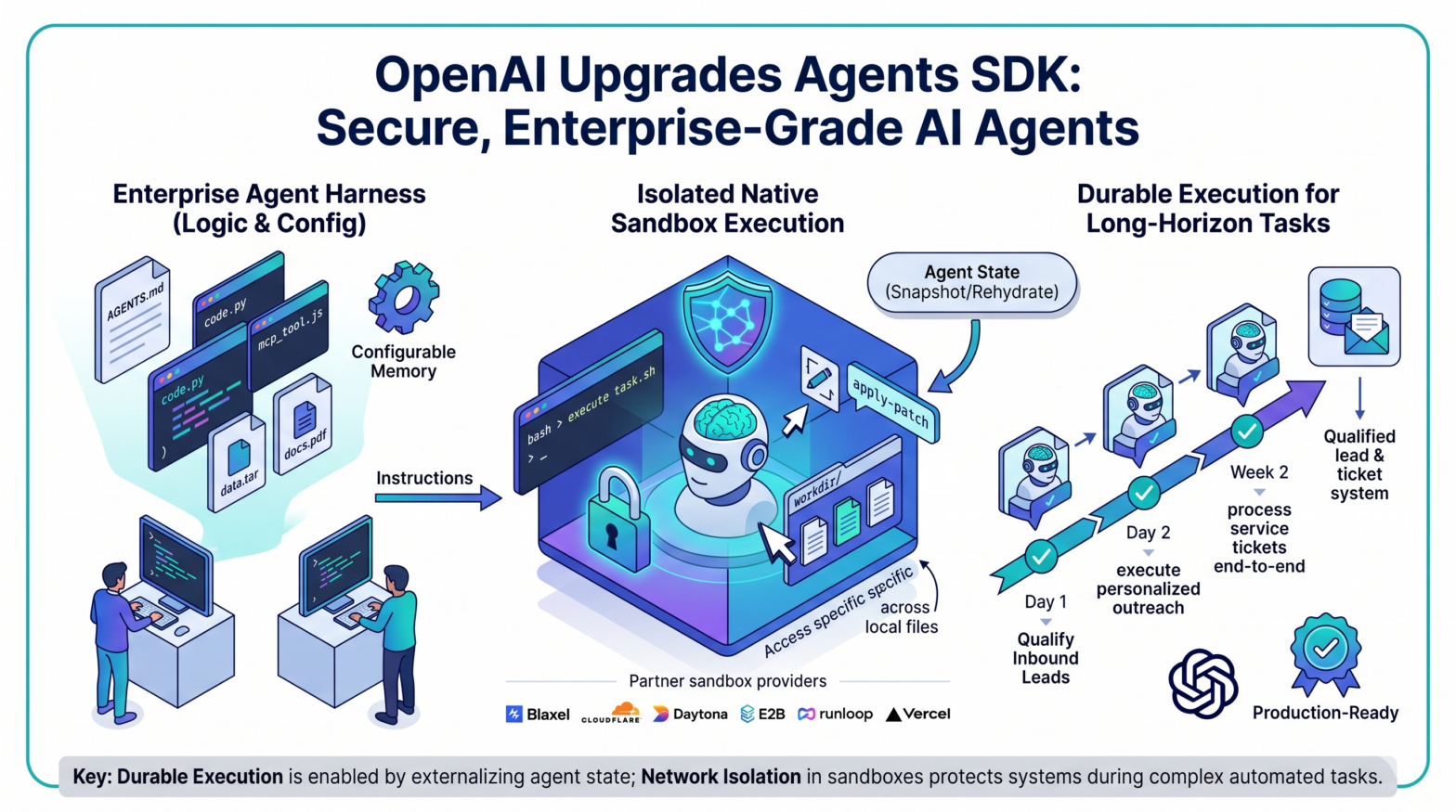
Enterprise teams building custom AI agents on OpenAI's platform now have access to production-grade infrastructure previously reserved for internal tooling. OpenAI confirmed in its April 15, 2026 announcement at openai.com that a major update to the Agents SDK is generally available, introducing native sandbox execution and a redesigned agent harness for complex, multi-step task automation.
What Changed in the April 15 Update
OpenAI announced a major update to its Agents SDK that takes the framework from a relatively bare-bones way to build agents into a fully-fledged toolbox for moving agents into production. The two core additions are a more capable agent harness and native sandbox execution, each targeting a distinct gap that enterprise teams have encountered when scaling agent deployments beyond prototypes.
The updated SDK provides developers with an in-distribution harness for frontier models that allows agents to work with files and approved tools within a workspace. The harness now includes configurable memory, sandbox-aware orchestration, and filesystem tools, allowing agents to interact with documents and systems more effectively.
The SDK bundles tool usage via the Model Context Protocol (MCP), code execution through a shell tool, file editing with an apply-patch tool, and custom instructions through AGENTS.md files.
Native Sandbox Execution
The SDK's new capabilities include a sandboxing feature that allows agents to operate in controlled computer environments, a significant consideration given that running agents without supervision can be risky due to their occasionally unpredictable nature. With sandbox integration, agents can work in a siloed capacity within a workspace, accessing files and code only for designated operations while protecting the system's overall integrity.
Developers can bring their own container infrastructure or use tools from Blaxel, Cloudflare, Daytona, E2B, Modal, Runloop, and Vercel to create a sandbox for their agents. A manifest function describes the workspace and supports local files as well as cloud storage, including AWS S3, Google Cloud Storage, and Azure Blob Storage.
OpenAI's product team framed the scope of this launch directly. "This launch, at its core, is about taking our existing Agents SDK and making it so it's compatible with all of these sandbox providers," Karan Sharma of OpenAI's product team told TechCrunch. The goal is for developers "to go build these long-horizon agents using our harness and with whatever infrastructure they have."
Security Architecture: Separating Harness From Compute
OpenAI's design separates the agent harness from compute as a deliberate security measure. This architecture helps prevent credentials from being exposed in execution environments.
There is a significant security dimension for large enterprise deployments, where agents must run in fully controlled environments. As OpenAI's Steve Coffey, tech lead for the Responses API, noted: "No API keys, no secrets in that sandbox. You want it to be totally isolated, probably isolated from the network in a lot of cases and not able to do any sort of egress."
The architecture also addresses operational continuity. Externalizing the agent's state enables durable execution; losing a sandbox container does not mean losing the entire run. Built-in snapshotting and rehydration allow agents to resume tasks in new environments from their last checkpoint. This separation also enhances scalability, allowing agent runs to utilize multiple sandboxes, route subagents to isolated environments, and parallelize work for faster results.
Implications for Enterprise Marketing Automation
For enterprise marketing and customer experience teams, the practical significance of this update lies in what the new infrastructure makes operationally viable. Custom AI agents built on the updated SDK can now manage long-running, multi-step workflows, such as qualifying inbound leads against a CRM, executing personalized outreach sequences, or processing customer service tickets end-to-end, without requiring custom infrastructure to hold state between steps. The harness's durable execution model means an agent handling a multi-day lead nurture workflow is not terminated by a container timeout. The sandbox's network isolation controls also address a recurring concern in enterprise deployments: preventing agents with access to marketing data or customer records from making unauthorized external calls.
Availability and Roadmap
There is no additional pricing for the Agents SDK. Users pay for the tokens and tool use they consume through the API, based on OpenAI's standard pricing.
The new harness and sandbox capabilities are launching first in Python, with TypeScript support planned for a later release. OpenAI is also working to bring additional agent capabilities, including code mode and subagents, to both Python and TypeScript.
As OpenAI's Steve Coffey noted, the original SDK was essentially built for chatbot use cases. "Now we have models that can kind of work for hours at a time or days or weeks."