
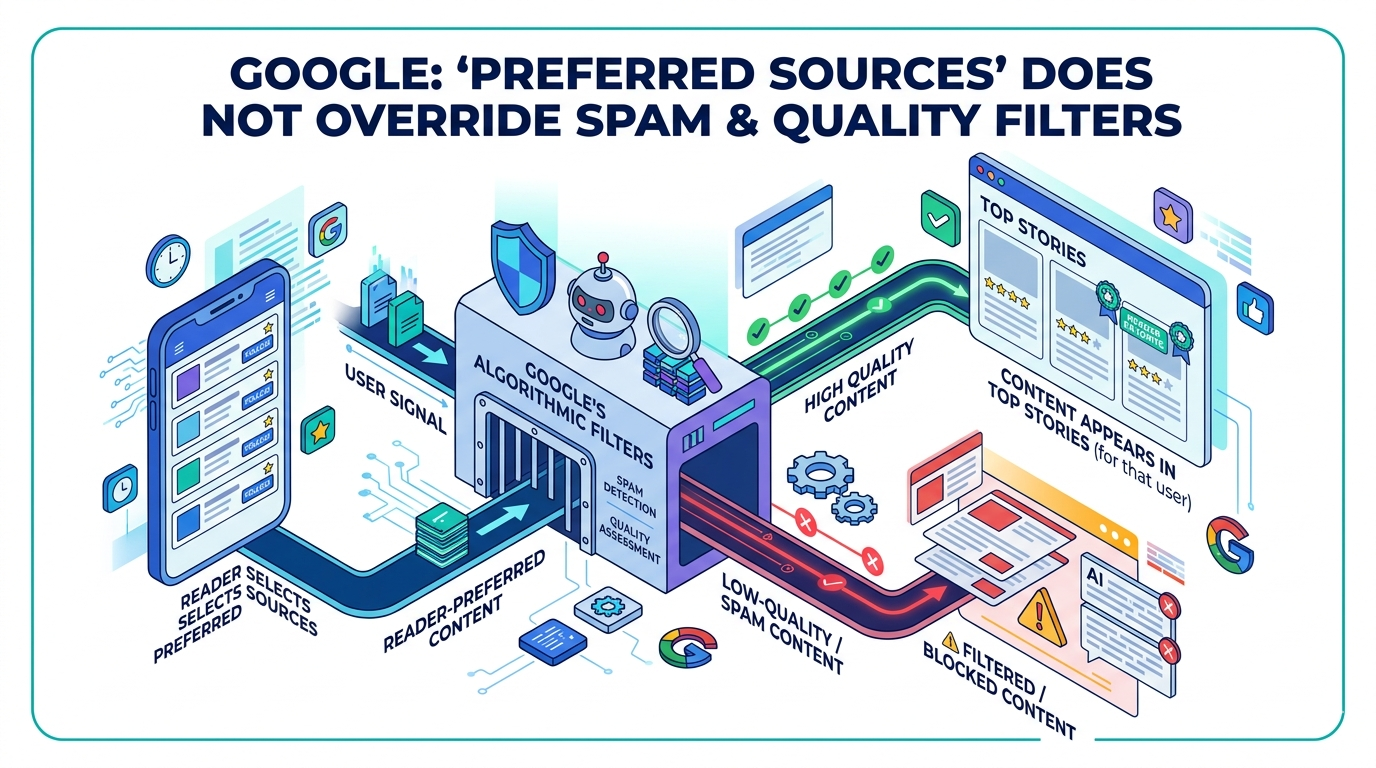
Publishers who earn a preferred source designation from their readers cannot use that signal to rank in Top Stories if their content triggers Google's spam or quality filters. Google Search Advocate John Mueller stated this position directly on Bluesky in response to an SEO who asked whether the Preferred Sources feature could override standard ranking signals for sites with low helpful content scores or AI-generated content.
What Preferred Sources Does and Doesn't Do
According to Google Search Central documentation:
If you're a website owner, you can help your audience find your publication as a preferred source in Google Search. When a user selects your site as a preferred source, your content is more likely to appear for them during relevant news queries in "Top Stories".
The feature is available globally for queries that trigger the Top Stories feature in all languages where Google Search is available.
Google expanded the feature to all languages supported by Google Search as of April 30, 2026. In December 2025, Google had rolled out Preferred Sources globally, but only in English. The April expansion brought all other supported languages into scope.
The distinction encoded in Google's own documentation is narrow but significant. The signal is limited to the audience that selected it. A preferred source has a better chance of appearing for relevant news queries to users who specifically chose it. Google's published documentation contains no language suggesting the designation helps a site rank in Top Stories for any other users.
Mueller's Response on Quality and Spam
The question posed on Bluesky was direct: whether a user-followed site could surface in Top Stories even if its content carried low helpful content scores or was AI-generated, effectively letting user preference override algorithmic quality assessment.
Mueller's answer acknowledged both sides of the tension. He stated that it does not make sense to show spam to users simply because of the designation, but that the feature does help users see their preferred sources more. In his reply, he cited Google's own Search Central documentation as the definitive external reference for how the feature operates.
Mueller's full statement on Bluesky: "We document it as 'When a user selects your site as a preferred source, your content is more likely to appear for them during relevant news queries in "Top Stories".' I don't think it makes sense to show spam to users just because of that, but it does help a user to see their preferred sources more."
The SEO who posed the question followed up to note that Google sometimes ranks low-quality sites regardless. Mueller did not address that follow-up in his published response. His statement leaves unresolved whether a site that users actively prefer, but that Google's systems flag as low quality, receives any reconsideration of its quality classification as a result of the user signal.
The Scope of the Signal
Preferred Sources functions as a user-controlled signal that works alongside Google's ranking systems to surface websites users have indicated they want to see more of. It does not replace those systems. SEO fundamentals still apply. Preferred Sources helps selected outlets appear more often for relevant news searches, but the underlying content still has to be timely, relevant, crawlable, and competitive.
Only domain-level and subdomain-level sites are eligible to appear in the source preferences tool. Publishers can direct readers to their listing using a standardized deeplink format or downloadable button assets. Google's Search Central documentation, last updated April 30, 2026, formalizes the toolset available to publishers, including deeplinks and downloadable button assets in 16 languages.
Google's own data indicates that readers are twice as likely to click through to a site after marking it as a Preferred Source. So far, people have selected over 200,000 unique sites across the feature's rollout.
What This Means for Content Strategy
For publishers and marketers, Mueller's response carries a direct implication: audience loyalty expressed through Preferred Sources selections does not function as a content quality substitute. A site with an established reader base that encourages Preferred Sources adoption can expect incremental visibility gains within that audience for relevant Top Stories queries, but only where the content itself clears Google's existing quality thresholds. Publishers relying on volume-based AI content or thin coverage to serve a loyal audience should not expect user preference signals to compensate for algorithmic quality penalties. The feature rewards loyalty-building strategies most effectively when paired with content that already meets Google's standards for Top Stories eligibility.
Google Search Central's Preferred Sources documentation, updated April 30, 2026, remains the primary reference point for publisher implementation guidance.