

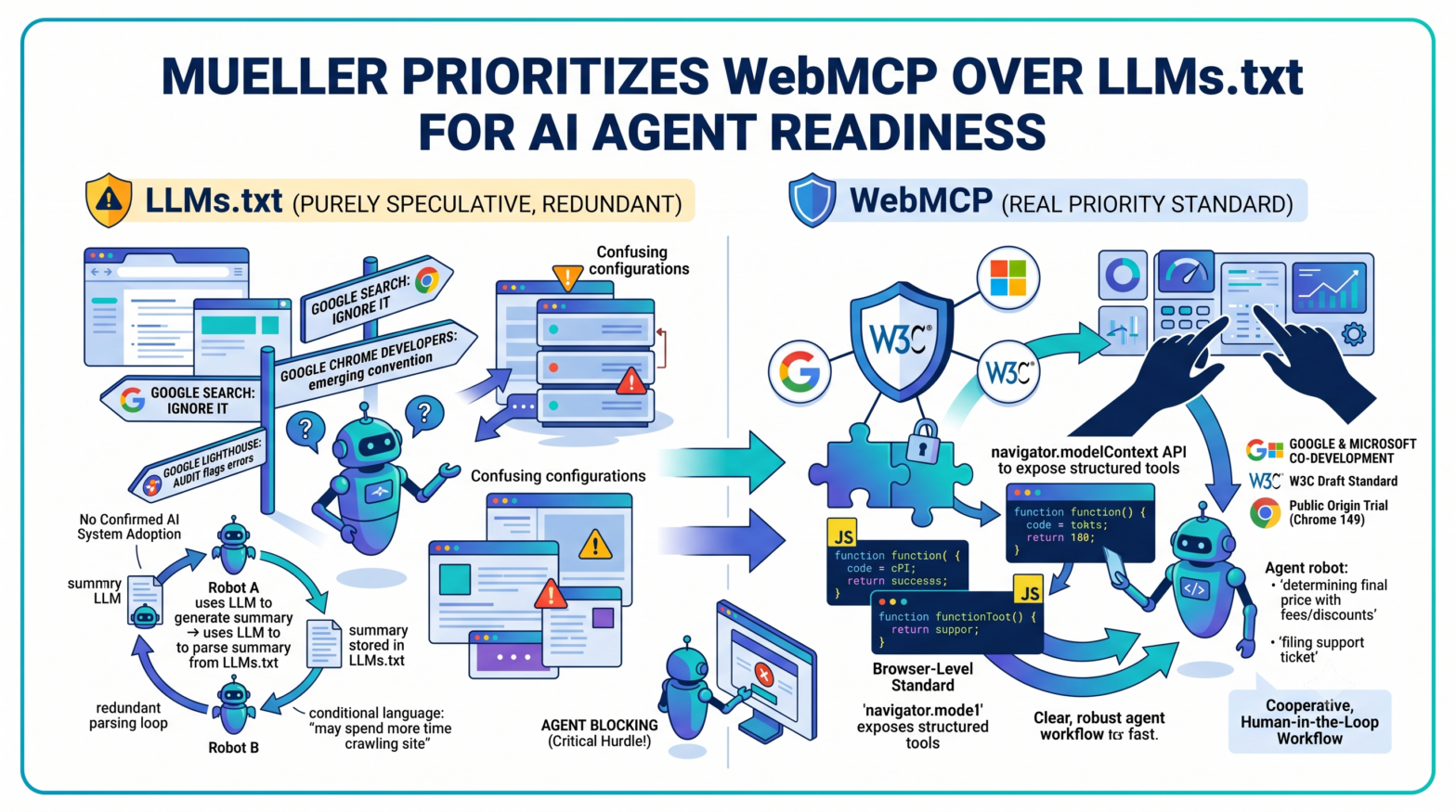
Google's Search Advocate John Mueller has publicly dismissed LLMs.txt as having no confirmed adoption by any AI system, calling it "purely speculative for now" in a Reddit discussion and directing site owners toward WebMCP, a separate browser-level standard co-developed by Google and Microsoft. The comments, reported on June 2, 2026, arrived shortly after two of Google's own product teams published guidance that pointed in opposite directions on the file.
What Mueller Said on Reddit
The Reddit thread that prompted Mueller's remarks began with a question about conflicting documentation from Google. Google's Search team and its Chrome developer tools team had issued contradictory technical instructions on llms.txt. On May 15, 2026, Google published a new guide through the Google Search Central Blog that explicitly told site owners to ignore the file. Days earlier, Google's Lighthouse tool had shipped version 13.3, which added a new Agentic Browsing category, including an llms.txt audit that checks whether a site provides the file and flags server errors when retrieving it.
A Reddit user asked whether these two positions represented a genuine contradiction from Google. Mueller answered the initial question by pointing out that no AI platform had actually required an LLMs.txt file from any site, making the premise of creating one hypothetical. He also noted an inherent redundancy: site owners are using LLMs to generate an LLMs.txt file so that another LLM does not have to parse their HTML, a circular process that Mueller questioned the logic of in his response.
When a second commenter pushed back and argued that LLMs.txt would be a "generally nice thing", reducing crawl overhead and resource consumption for AI systems, Mueller declined to accept the framing. He wrote:
"I don't think anyone knows – it's purely speculative for now (the file has existed for years, yet none of the AI systems use it, what does it mean?)."
The remarks align with positions Mueller has stated previously. Mueller has noted in earlier Reddit comments:
"AFAIK none of the AI services have said they're using LLMs.txt (and you can tell when you look at your server logs that they don't even check for it). To me, it's comparable to the keywords meta tag, this is what a site-owner claims their site is about … well, you can check it. At that point, why not just check the site directly?"
Gary Illyes also confirmed at Google Search Central Live that Google does not support llms.txt and has no plans to do so.
The Lighthouse Audit That Caused the Confusion
Chrome for Developers documentation, last updated May 5, 2026, frames llms.txt as "an emerging convention used to provide a machine-readable summary of a website's content, specifically designed for LLMs and AI agents." The Lighthouse check is not a compliance gate. It identifies broken configurations where a site appears to have attempted an llms.txt implementation, but the server returns an error. The documentation states:
"Without this file, agents may spend more time crawling the site to understand its high-level structure and primary content."
That conditional language, "may spend more time", describes a possibility, not a confirmed behaviour from any AI system. The Lighthouse documentation does not directly conflict with Google's advice on optimizing a website for generative AI features because these audits focus on AI agents and browser tools, not Google Search rankings. The distinction is a product-team distinction, however, not a widely communicated one, and guidance is split between different Google developer sites, which can lead to conflicting instructions when comparing Lighthouse or its llms.txt documentation with Google's Search docs.
Google's Lighthouse 13.3 shipped the new Agentic Browsing category. The update includes an llms.txt audit that checks whether a site provides the file and flags server errors when retrieving it. Lighthouse flags pages if a server error occurs when attempting to retrieve the file. If the file is not provided by the server, returning a 404, the audit is marked as Not Applicable, as providing the file is optional at this time.
Mueller's Preference: WebMCP Over LLMs.txt
In the same Reddit thread, Mueller identified WebMCP as the more substantive direction for site owners interested in AI agent readiness. He wrote that he likes "the WebMCP approach, as well as the commerce integrations, they have clear goals and processes: 'Given the agent is already on your site, how can it properly do task X?' (for example, determine the final price of a product, including all fees and potential discounts)."
WebMCP (Web Model Context Protocol) is a W3C Community Group standard that enables browsers to expose structured tools to AI agents through the navigator.modelContext API. Developers present their web application functionality as callable "tools", JavaScript functions with natural language descriptions and structured schemas that AI agents, browser assistants, and assistive technologies can invoke directly.
Engineers from both Microsoft and Google co-authored WebMCP, making it a cross-industry standard rather than a single-vendor initiative. WebMCP aims to provide a standard way for exposing structured tools, ensuring AI agents can perform actions on a site with increased speed, reliability, and precision. By defining these tools, site owners tell agents how and where to interact, whether it is booking a flight, filing a support ticket, or navigating complex data. This direct communication channel eliminates ambiguity and allows for faster, more robust agent workflows.
A critical architectural decision separates WebMCP from the fully autonomous agent paradigm. The standard is explicitly designed around cooperative, human-in-the-loop workflows, not unsupervised automation. Anthropic's MCP runs on servers, connecting AI platforms to service providers through back-end integrations. WebMCP runs entirely client-side, inside the browser tab.
Google's Chrome team confirmed on May 19, 2026, that WebMCP will move into a public origin trial in Chrome 149. The specification remains a W3C draft. It is being developed with Microsoft and incubated through the W3C Web Machine Learning community group.
The Bigger Hurdle: Agent Blocking
Mueller extended the discussion to a point he described as more pressing for most site owners than either LLMs.txt or WebMCP. He stated that the most basic form of agent optimization is ensuring that AI agents are not blocked from accessing a site at all, and that this hurdle will be the biggest for most publishers.
Mueller added that current AI agents can use the standard HTML-based user interface built for humans, meaning that even without WebMCP implementation, an agent can still complete tasks on a site. The practical implication is that sites actively blocking AI agents through robots.txt or server-level rules are cutting off that access entirely.
What This Means for Site Owners and SEOs
For site owners and SEO practitioners, the immediate practical separation is this: llms.txt is not a factor in Google Search rankings, AI Overviews, or AI Mode visibility, based on the May 15 Search Central guide. However, the presence of the file, or a server error when it is requested, is now a named signal in Lighthouse's default Agentic Browsing audit. Sites with server misconfigurations that generate errors on unfamiliar file requests may surface a flag in that audit category.
WebMCP represents a more substantial but longer-horizon investment. The spec is still early, available only in Chrome Canary behind a flag, and not suited for production use. The fact that both Google and Microsoft are authoring it together, with W3C providing governance, suggests it has a real path to becoming a stable web standard.
Mueller addressed the apparent contradiction between Google's product teams on Bluesky on May 20, 2026, explaining that the question of whether to publish llms.txt or Markdown pages is separate from the question of search performance; it is a question of site functionality for agents that are already on the page.