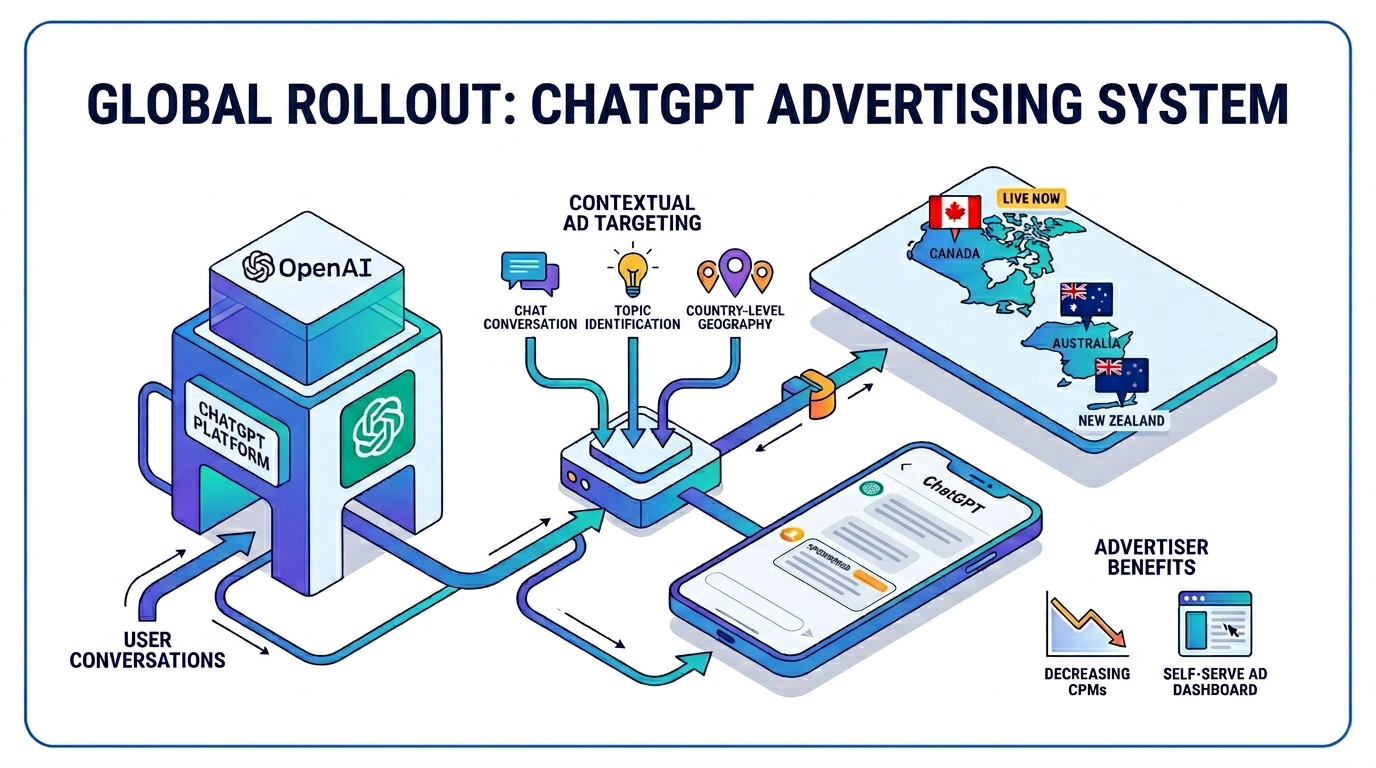
Advertisers in Canada, Australia, and New Zealand now have access to a new paid channel inside one of the world's most widely used AI platforms. OpenAI confirmed in its official ChatGPT Release Notes, updated April 16, 2026, that ads are actively rolling out to ChatGPT users on Free and Go plans in those three markets.
The Rollout: Who Sees Ads and Who Doesn't
The ad rollout is limited to logged-in adult users on the Free and Go subscription tiers. Plus, Pro, Business, Enterprise, and Education tiers will not have ads.
OpenAI first confirmed advertising plans on January 16, 2026. The U.S. pilot launched on February 9, 2026, with Criteo named as the first ad tech partner on March 2. International expansion to Canada, Australia, and New Zealand was announced on March 26, 2026. The April 16 release note entry marks the confirmed start of that live rollout.
OpenAI has stated it is working with more than 600 advertisers and has seen no impact on privacy-related trust metrics.
How ChatGPT Ad Targeting Works
The targeting model differs meaningfully from what advertisers are accustomed to on Google and Meta. OpenAI selects which ad to display by matching advertiser submissions against the topic of the user's current conversation, their past chats, and past interactions with ads. For example, a user researching recipes may see ads for meal kits or grocery delivery. When multiple advertisers compete, OpenAI selects the most relevant one for that chat.
At launch, targeting is limited to country-level geography plus plain-language "context hints." No conversation data flows to advertisers.
Advertisers do not have access to users' chats, chat history, memories, or personal details. They receive only aggregate performance data, such as the number of views or clicks.
When an ad appears, it is clearly labelled as sponsored and visually separated from the organic answer.
Ads do not appear in chats covering sensitive or regulated topics, including health, mental health, or politics, and are not shown to users who tell OpenAI or who are predicted to be under 18.
Ad Format and What's Available Now vs. Later
ChatGPT ads in their current state function as a reach medium, not a performance medium. A CPM-based Reach objective without clicks or conversions priced in is positioned against brand-awareness KPIs, awareness lift, unaided recall, and consideration, not cost-per-action.
Reach and CPM objectives are live at launch; clicks and conversions are listed as coming soon.
ChatGPT ad CPMs have dropped from $60 to as low as $25 in nine weeks, as OpenAI cut its minimum spend threshold from $250,000 to $50,000 for the pilot. OpenAI plans to introduce self-serve ad tools to broaden access beyond large advertisers.
The Competitive Context
The emergence of ads inside ChatGPT puts OpenAI in direct competition with platforms that already monetize AI-assisted discovery at scale. For years, AI platforms avoided advertising entirely, preferring subscription revenue and enterprise contracts. That stance is now clearly shifting.
Nearly 80% of small and medium-sized businesses have signalled interest in ChatGPT ads, but the $200,000 minimum spend floor that characterized the early pilot kept most of them out. The reduction of that threshold to $50,000, with self-serve tools in development, indicates OpenAI is moving toward broader market access.
ChatGPT reports more than 800 million weekly active users globally, and OpenAI has confirmed that Australian usage has more than doubled in the past 12 months. The company has also established a local Australian team to support the expansion.
What This Means for Marketers
Brands considering early-stage allocations to ChatGPT ads should account for the channel's current limitations. Targeting remains thin by Google Ads or Meta Ads standards, country-level geo and conversation context only, with no audience segmentation, no conversion tracking, and no individual-level reporting. This is a significant limitation for performance marketers accustomed to detailed attribution on established paid platforms. Budget decisions at this stage are better framed around brand awareness and market positioning than direct-response outcomes.
OpenAI's official ChatGPT Release Notes, updated April 16, 2026, confirm the rollout is now active: "Ads do not influence the answers ChatGPT gives you, and we keep your conversations with ChatGPT private from advertisers. Our goal is for ads to support broader access to more powerful ChatGPT features while maintaining the trust people place in ChatGPT for important and personal tasks."