
ChatGPT advertising took less than seven months to become a billion-dollar business.
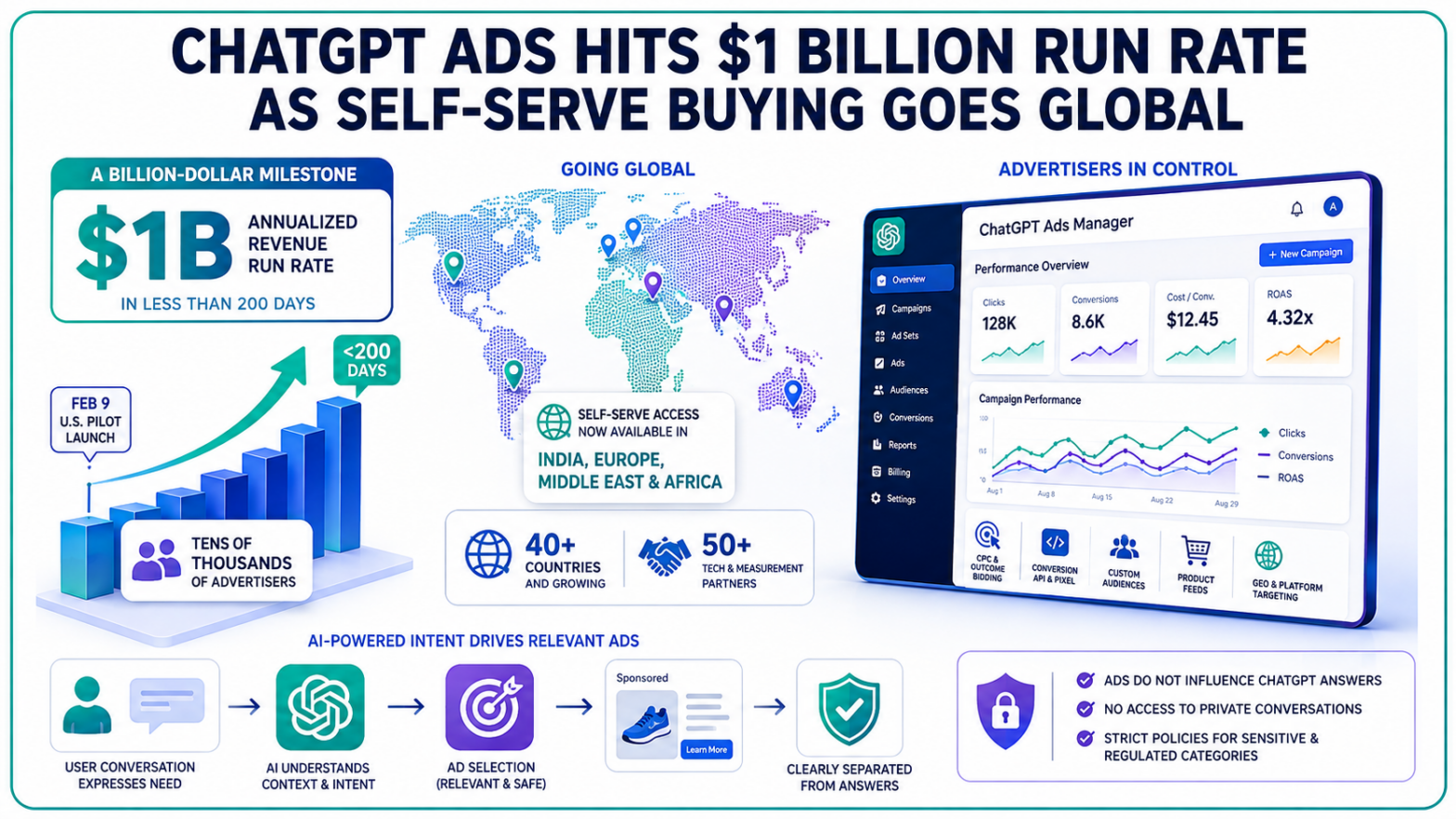
OpenAI says ChatGPT Ads has reached a $1 billion annualized revenue run rate fewer than 200 days after its U.S. pilot began, while tens of thousands of advertisers are now using the platform. The company is following that milestone by opening direct Ads Manager access across India, Europe, the Middle East and North Africa.
The number matters because OpenAI is no longer asking advertisers to evaluate a small experimental placement inside an AI product. It is building a global advertising operation with automated bidding, conversion measurement, audience targeting and enough advertiser demand to generate revenue at meaningful scale.
OpenAI confirmed the milestone in an August 31 announcement, describing advertising as one component of its broader business alongside subscriptions, enterprise products and API usage. The company also says ChatGPT now serves more than one billion weekly active users.
$1 Billion Arrived Before the Platform Turned Seven Months Old
OpenAI began testing advertising in ChatGPT in the United States on February 9, initially limiting placements to a subset of logged-in adults using its Free and Go plans.
What followed was unusually fast commercialization.
By May, advertisers could create campaigns through a beta Ads Manager instead of relying exclusively on OpenAI's managed sales operation or agency partners. CPC bidding and expanded conversion measurement arrived with it.
Those changes moved ChatGPT Ads away from a placement-buying experiment and closer to the infrastructure media teams already use to manage digital campaigns.
Now there is a revenue number attached to that shift.
OpenAI says the advertising business has reached a $1 billion annualized run rate less than 200 days after launch. An annualized run rate extrapolates current revenue over a full year, so it is not the same as saying ChatGPT Ads has already generated $1 billion in cumulative revenue.
Still, the pace is significant. Tens of thousands of advertisers are participating, according to OpenAI, and advertisers outside the United States now represent a growing portion of the platform's revenue.
The company also says some of its largest customers are already running ChatGPT campaigns across multiple markets.
Self-Serve Access Is Following the Inventory Across Borders
Geographic expansion has been happening in stages.
After its initial U.S. pilot, OpenAI took ChatGPT advertising into Canada, Australia and New Zealand, followed by the United Kingdom, Mexico, Brazil, Japan and South Korea. In August, another 31 European markets were added.
Advertiser access has not always expanded at the same pace as ad availability.
That gap is now closing.
Starting August 31, OpenAI said businesses across India, Europe, the Middle East and North Africa could begin purchasing ads directly through Ads Manager. ChatGPT advertising is now available in more than 40 countries when OpenAI's sales team, agencies and technology partners are included.
For smaller advertisers, self-serve advertising changes the economics of trying the channel.
A company no longer necessarily needs a managed relationship or agency-led buying arrangement simply to launch a campaign. OpenAI says small and medium-sized businesses already represent a material part of its advertising business following the May launch of Ads Manager.
Its surrounding ecosystem is getting larger as well. More than 50 technology and measurement partners now work with the platform, according to OpenAI.
That starts to solve one of the less visible barriers facing any new ad network. Buying inventory is only part of the job. Advertisers also expect integrations, campaign management workflows, measurement systems and data connections that fit into an existing media stack.
Most Campaigns Are No Longer Using Basic Reach Buying
Revenue is only one sign of maturation.
The campaign mix is another.
OpenAI says CPC and outcome-optimized bidding now represent the majority of campaigns running on ChatGPT Ads. Pixel tracking and its Conversions API are also becoming core components of the platform's measurement and optimization systems.
That is a notable change from the earliest version of the product.
In May, OpenAI introduced CPC bidding alongside its beta Ads Manager and conversion measurement. It has since added conversion-oriented optimization, custom audiences, product feeds, geographic controls and platform targeting across web, iOS and Android.
The progression gives AI advertising inside ChatGPT a much more familiar operating model.
Advertisers can capture conversion events, feed those signals back into campaign delivery and give OpenAI's bidding system more information about which interactions are producing business outcomes. Custom audience lists add another established targeting mechanism, while product feeds give ecommerce advertisers a structured way to connect inventory with relevant conversations.
OpenAI is still calling Ads Manager a beta product.
The underlying feature set, however, is increasingly shaped around campaign optimization rather than simply selling sponsored exposure.
OpenAI Is Building Around a Different Intent Signal
ChatGPT's advertising proposition does not begin with a search keyword or social feed behaviour.
It begins with a conversation.
OpenAI's ad system can use the context and intent of the current conversation to determine whether an ad is relevant. Where personalization settings and local rules permit it, additional signals from a user's broader ChatGPT experience may also contribute to selection.
That gives advertisers access to intent that may develop across several exchanges rather than appearing in a single query.
Someone might explain a problem, narrow their requirements, reject an option and ask for alternatives before reaching a point where a commercial recommendation becomes relevant. OpenAI is positioning that decision process as the inventory around which its advertising business can grow.
There are boundaries.
OpenAI says ads remain clearly separated from ChatGPT answers and do not influence the responses the system generates. Advertisers do not receive access to private conversations. The company also restricts advertising around sensitive or brand-unsafe conversations and maintains separate eligibility rules for regulated categories.
Those constraints are particularly important as revenue increases. The commercial opportunity depends on conversational context, while the product's trust model depends on maintaining a visible separation between paid placement and the answer itself.
The Performance Marketing Test Is Becoming Easier to Run
For media teams, the practical change is straightforward: ChatGPT can increasingly be evaluated using the same operational discipline applied to other paid channels.
Reliable conversion tracking remains the starting point. CPC results, outcome-optimized delivery and view-through attribution become far more useful when advertisers can reconcile those signals against their own analytics and conversion data.
That makes performance marketing comparisons more practical than they were during the early pilot. Media buyers can assess cost per click, conversion performance, audience behaviour and incremental customer acquisition rather than judging ChatGPT Ads primarily by novelty or reach.
There is still limited long-term performance data compared with established platforms, and OpenAI continues to change its buying, reporting and optimization systems during the beta.
The $1 billion run rate does not remove those limitations.
It does remove one question.
Advertisers are putting real money into the platform at scale.
OpenAI says its next phase will add more markets, ad formats, campaign objectives, buying methods and measurement capabilities. The company is also exploring advertising experiences that allow businesses to interact with users more directly inside ChatGPT rather than relying exclusively on conventional sponsored units.
Less than 200 days after the first U.S. ads appeared, ChatGPT's advertising business has moved from a controlled pilot to tens of thousands of advertisers, more than 40 markets and a billion-dollar annualized revenue pace.
The next test is no longer whether OpenAI can attract advertisers. It is how much of their performance budget the platform can keep.