
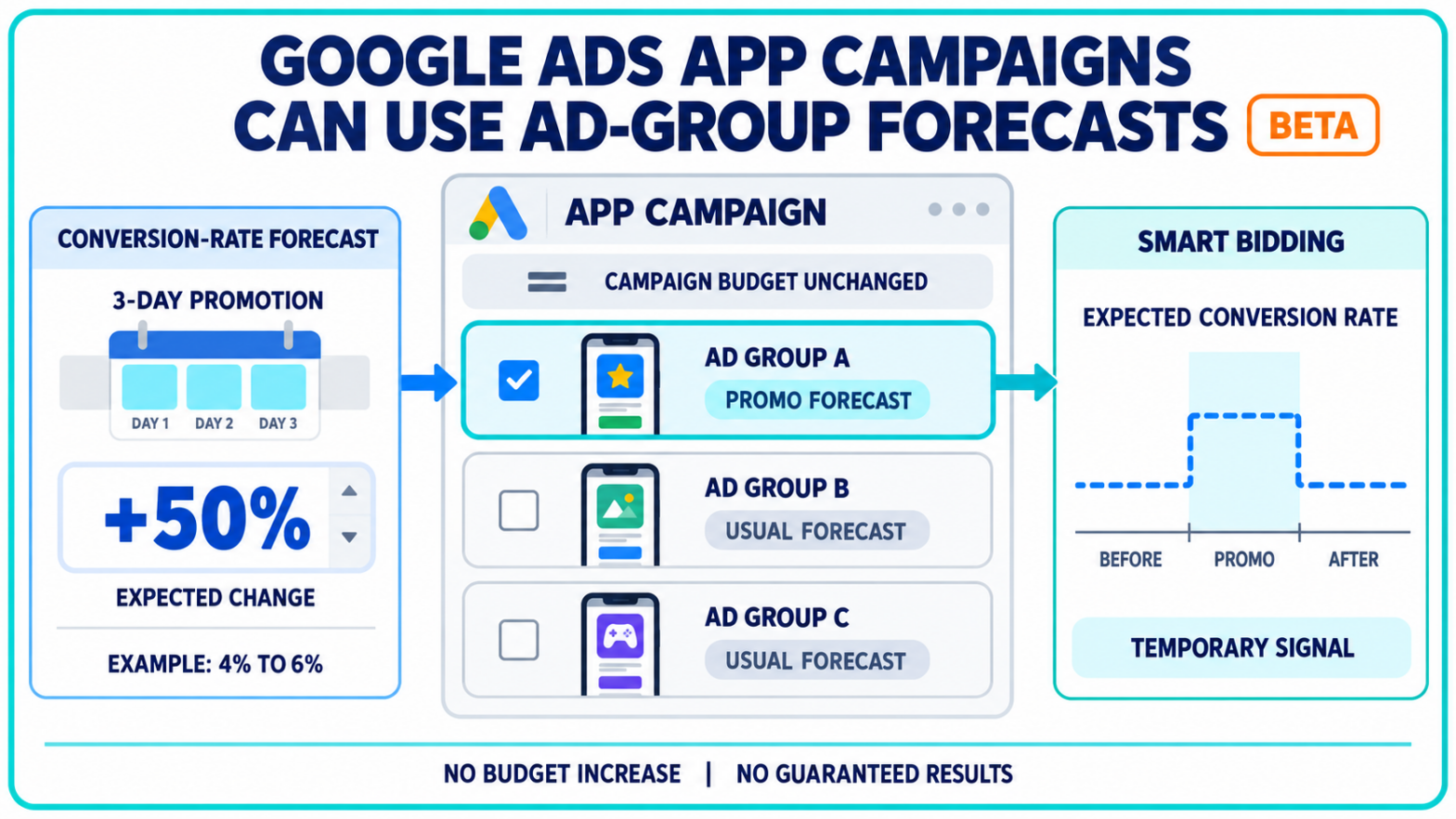
A promotion affecting one App campaign ad group does not need the same conversion-rate forecast applied across the campaign. Google’s current documentation confirms an ad-group scope for seasonality adjustments, with App campaign support still labelled beta.
The option gives app advertisers a narrower way to communicate expected promotional changes to automated bidding. It does not increase a campaign’s budget or guarantee additional conversions.
App Campaigns Can Apply Seasonal Signals to Selected Ad Groups
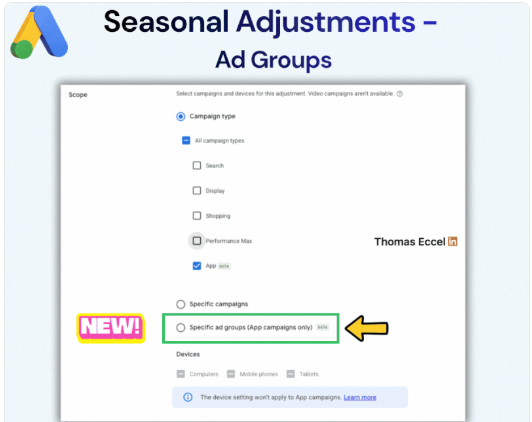
Google’s seasonality adjustment setup instructions list three scope options: campaign type, specific campaigns and specific ad groups. The ad-group option is restricted to App campaigns.
Advertisers select a conversion-rate adjustment, define the event’s dates and choose the relevant scope. Device selection does not apply to App campaigns.
The practical distinction is where the forecast applies.
Consider an app advertiser running promotional creative in one ad group while other groups continue with their usual messaging. An ad-group adjustment allows the advertiser to associate the expected conversion-rate change with the selected group, rather than applying that estimate across the entire campaign.
That is more specific input for the bidding system, not independent budget control for each ad group.
Google’s documentation lists App campaign seasonality adjustments as beta across all bidding strategies. It does not establish that every account has access or provide a country-by-country rollout schedule.
A Conversion-Rate Adjustment Is Not a Sales Target
Google Ads seasonality adjustments communicate an expected temporary change in conversion rate. They are not instructions to increase sales, clicks or spending by the percentage entered.
Google’s explanation of how seasonality adjustments work uses a three-day sale with an anticipated 50% conversion-rate increase as an example. The advertiser can enter an adjustment reflecting that expectation for the event.
The percentage is relative.
As a mathematical illustration, a conversion rate rising from 4% to 6% represents a 50% increase. It does not represent a 50-percentage-point increase, and it does not establish that conversion volume will rise by the same proportion.
The promotional discount is a separate figure. A 20% price reduction does not, by itself, justify a 20% conversion-rate adjustment.
Once the scheduled event ends, Google says bidding returns to its pre-adjustment behaviour. Advertisers do not need to create a negative adjustment simply to reverse the completed promotion.
Actual results still depend on demand, competition, available budget and the accuracy of the forecast.
Seasonal Budget Adjustments Are a Different Google Ads Tool
The similar terminology can obscure an important distinction.
Google separately offers seasonal budget adjustments, which schedule a temporary increase to a campaign’s average daily budget. That tool changes the amount available to spend, rather than supplying a conversion-rate forecast.
Its documented campaign eligibility is also different. Google lists Search and Shopping campaigns for seasonal budget adjustments, subject to exclusions. That documentation does not extend the budget tool to App campaigns.
A conversion-rate adjustment should therefore not be read as permission to spend beyond the campaign’s existing budget settings.
The difference also affects performance analysis. Increasing spending capacity and changing the bidding system’s expectations are separate interventions. If both are changed during a promotion, a rise in conversions cannot automatically be attributed to the seasonality forecast alone.
Short Promotions Still Depend on Reliable Conversion Data
Google says seasonality adjustments are intended for major conversion-rate changes, because Smart Bidding already accounts for ordinary seasonal patterns. Its recommended window is generally one to seven days; adjustments may work less effectively over periods longer than 14 days.
A short promotion is not automatically a suitable promotion.
The forecast needs to describe a credible departure from normal conversion behaviour. Google’s retail app guidance recommends using historical promotional events to estimate the adjustment.
Measurement remains central to that estimate. Google’s App campaign troubleshooting documentation identifies conversion-tracking problems, conversion delays, budget limitations and changes to campaign settings as potential causes of performance fluctuations.
Those issues can resemble a change in customer demand.
Google also advises assessing performance against the campaign’s optimization goal. For a campaign using Target CPA, conversion-related measures can be more informative than movements in clicks or impressions alone.
For marketers, the practical implication is to align the selected ad groups, promotion dates and expected conversion-rate change before interpreting results. Campaign changes made at the same time should be recorded separately. Otherwise, the effect of the promotion becomes difficult to distinguish from tracking changes, revised targets or new creative.
TechWyse’s earlier coverage of Smart Bidding examines another part of that measurement problem: automated strategies may need time and conversion data to calibrate after changes.
The Recent Beta Sighting Does Not Establish a New Launch Date
Google Ads specialist Thomas Eccel recently reported seeing the ad-group scope marked as beta, drawing attention to the control ahead of Black Friday.
That observation supports the presence of the option in the interface he examined. It does not establish a universal release date.
There is also an important historical qualification. Google’s retail app guide already describes creating a seasonality adjustment for an ad group and refers advertisers to an account manager for information about beta access.
The available evidence therefore supports coverage of a documented beta capability and a recent interface sighting, rather than a confirmed first-time launch in October 2026.
The retail guide carries a last-updated date of April 7, 2023. Its instructions recommend creating the ad-group adjustment at least two business days before the promotion.