

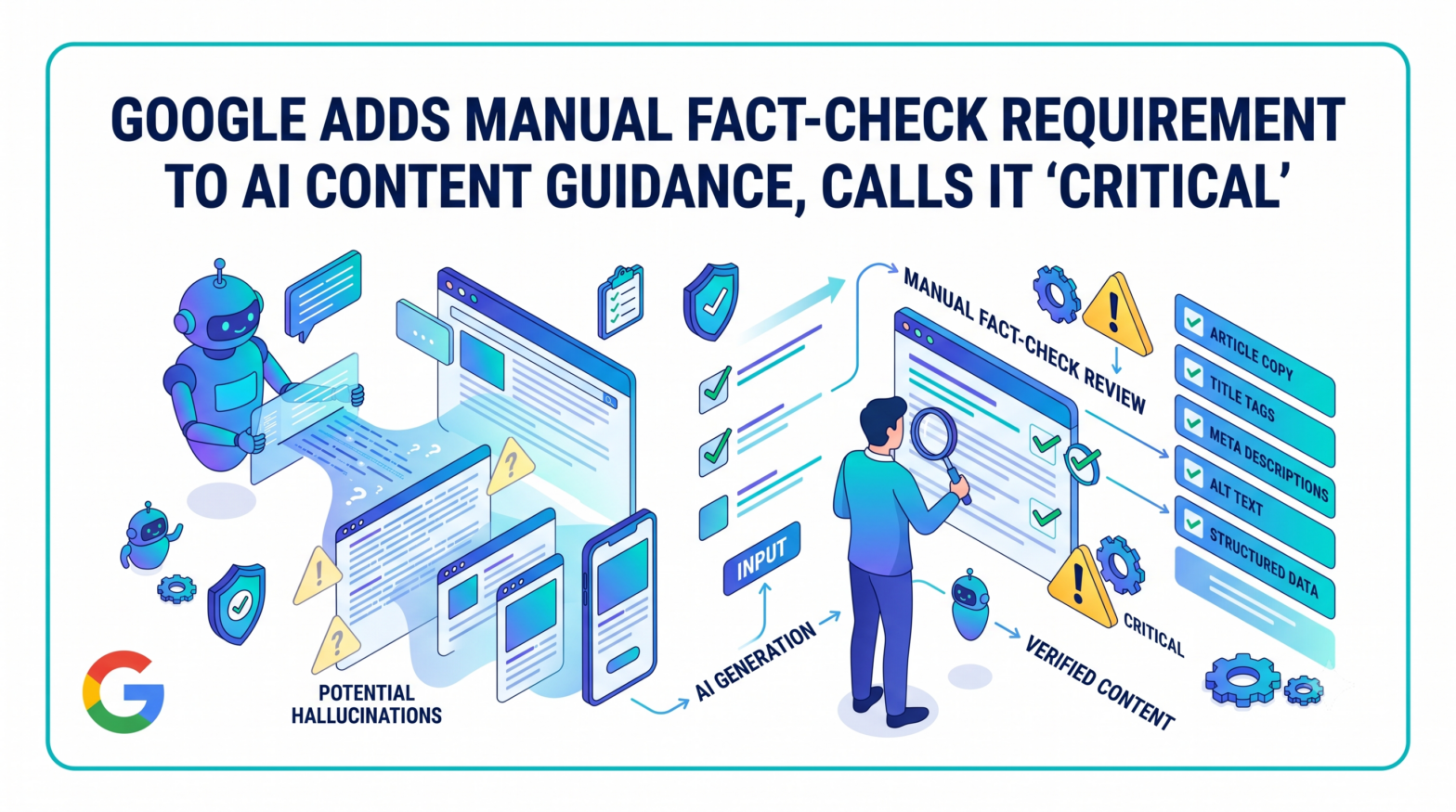
Website operators using AI-generated content now face a stronger directive from Google: review every piece of it by hand before it goes live. Google updated its guidance on using generative AI content on October 1, stating the change brings the document in line with information from the Search Quality Raters guidelines.
What Google Changed in Its Guidance Document
On October 1, Google updated its guidance on using generative AI content by adding three sentences to the "Focus on accuracy, quality, and relevance" section. The prior version of the document, which had not changed since October 2025, asked for accuracy but contained no explicit instruction to manually fact-check AI output before publishing.
The three new sentences now read in the document:
"Keep in mind that generative models don't retrieve facts, but predict a likely sequence of words based on their training data. Because of this, generative AI outputs may contain inaccuracies (also known as hallucinations). It is critical to manually fact-check and review all AI-generated content for accuracy and trustworthiness before publishing."
Google rarely uses the word "critical" in its Google Search help documentation.
Scope Extended to Metadata
The update did not stop at article copy. In the metadata line that followed the new sentences, "This includes metadata" was changed to "This review also applies to metadata." The metadata line was revised to show that this review process applies to titles, meta descriptions, structured data, and image alt text.
Where the old document said the accuracy advice includes metadata, the new one says the fact-checking review applies to metadata: title elements, meta descriptions, structured data, and image alt text, the part of the page most ecommerce catalogues, programmatic SEO builds, and agency content pipelines generate automatically, often without a human ever reading the output.
Google's Stated Reason for the Update
Google's documentation changelog entry for October 1 describes the update as bringing the guide in line with "presentations we use at our developer events." The changelog entry for October 1 reads:
"Updated the using generative AI content guide with information from the Search Quality Raters guidelines."
The paragraph citing raters' sections 4.6.5 and 4.6.6 was already present in the document before October 1. Comparisons made against earlier archived versions found that paragraph unchanged, with the three accuracy sentences confirmed as new additions. None of the added sentences mentions the raters' guidelines directly, and Google has not specified which passage in those guidelines the new wording draws from.
What the Guidance Document Retains
The rest of Google's AI content guidance page matches the December 10, 2025 version. It still opens by saying generative AI can help with research and with adding structure to original content, and the same paragraph warns that using AI tools to make many pages without adding value for users may violate the company's spam policy on scaled content abuse.
The document continues to cite sections 4.6.5 and 4.6.6 of the Search Quality Raters guidelines. Section 4.6.5 deals with scaled content abuse, describing the practice as creating large amounts of content with little effort or originality and without editing or manual curation. Section 4.6.6 covers main content with little effort, originality, or added value, regardless of who or what produced it. Neither section affects rankings directly, as raters are contractors whose assessments evaluate ranking systems rather than score individual sites.
Implications for Content Teams Using AI
Content teams whose workflows rely on AI to produce title tags, meta descriptions, or image alt text at scale now fall within the scope of Google's updated guidance, not only those using AI for article drafts. A review process designed only for body copy does not satisfy what the October 1 document now describes. A review process focused only on the main content might overlook other important fields that Google mentions can show up in Search results. The guidance does not specify a minimum review standard, but the inclusion of the word "critical" suggests Google regards the step as non-discretionary.
Google rarely uses the word "critical" in Search documentation, and the timing, one week into the September 2026 spam update, did not go unnoticed. Google's documentation updates page logged October 1 as the only change recorded on that date.