

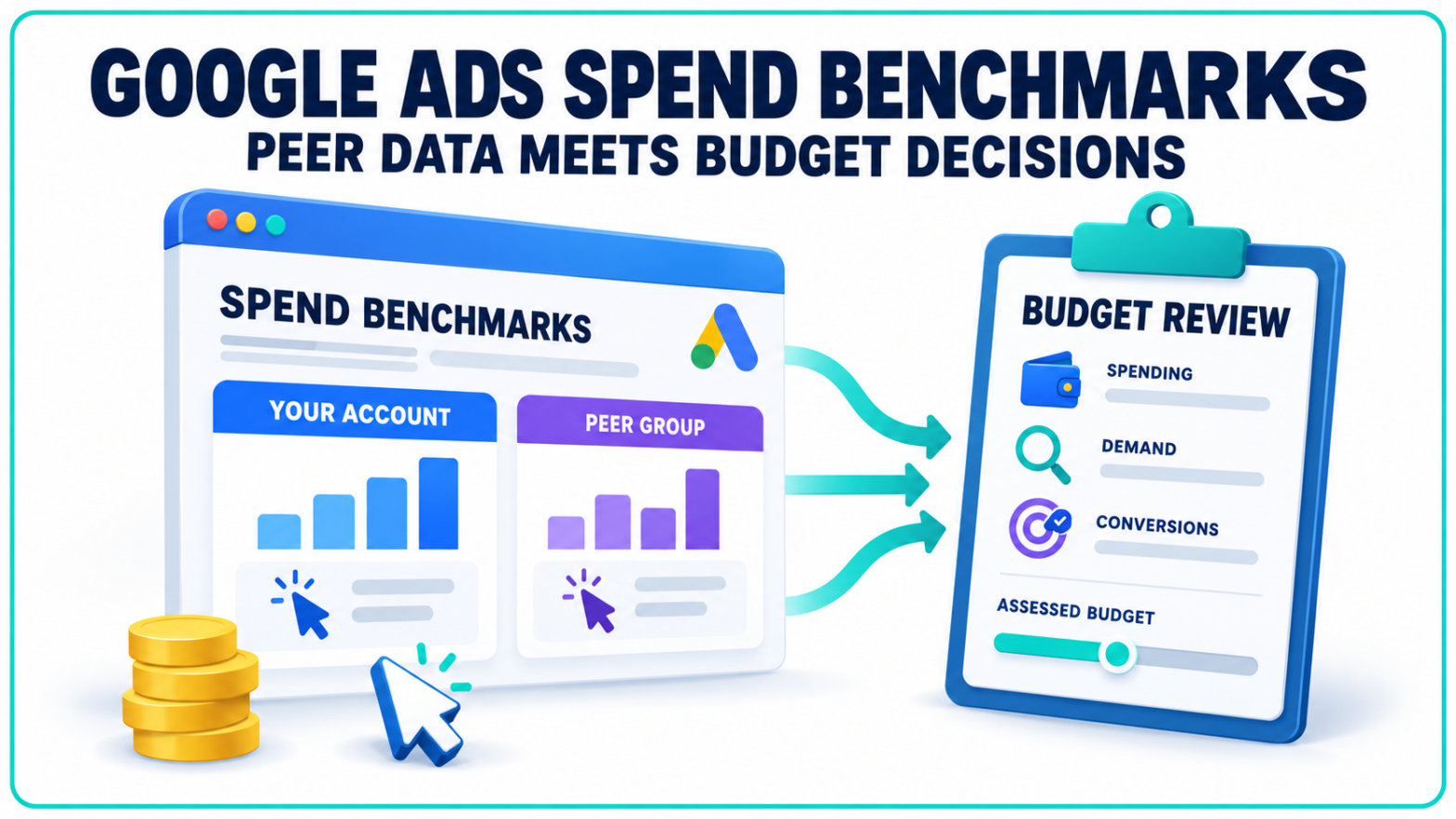
A budget request is easier to discuss when there is something concrete to compare. Google Ads is surfacing peer spending data, adding an external reference point to conversations previously built around an advertiser’s own results.
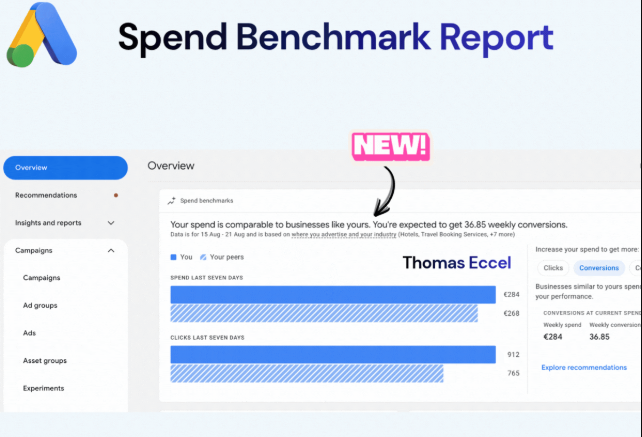
The Spend Benchmarks report was documented by paid search specialist Thomas Eccel in the account Overview. His example compares weekly spending and clicks with businesses Google identifies as peers.
For account managers, the central question is whether that comparison supports a specific spending decision. A peer figure can establish context. Evidence that a campaign is missing valuable demand requires a closer look at the account.
Google Ads Benchmarks Put a Number Beside the Budget
Eccel’s example shows an account spending €284 a week and receiving 912 clicks, against peer figures of €268 and 765 clicks. According to his description, Google considers factors including industry and advertising location when forming the comparison.
Those figures describe spending and traffic. They do not establish how many customers either side acquired.
The distinction starts with the word budget. Google’s spending documentation defines an average daily budget as the amount an advertiser is willing to spend per day, on average, for a campaign. Actual delivery can vary. A weekly spend comparison therefore does not, by itself, reveal another business’s configured budget or unused capacity.
The appearance of Google Ads benchmarks also extends the range of comparisons available inside Google’s marketing products. For a client reviewing an account, the immediate addition is straightforward: an external spending figure alongside familiar activity metrics.
A Peer Group Answers a Different Question From Auction Insights
Google already gives advertisers a way to examine businesses competing in their auctions.
Its Auction Insights documentation describes comparisons with advertisers participating in the same auctions. Available measures include impression share, overlap rate and outranking share, with the precise set depending on campaign type.
That is a different basis for comparison from grouping businesses by characteristics such as industry and advertising location.
Auction overlap describes where advertisers meet. A peer benchmark describes where an account sits against a selected group. Treating the two as interchangeable would turn a general comparison into a claim about direct competition that the evidence does not support.
Even Auction Insights has boundaries. Google explains that a competitor’s impression share in the report can differ from the figure that competitor sees in its own account, because the eligible auctions only partly overlap.
For budget discussions, the distinction matters. A statement about peer spending and a statement about losing visibility to a particular rival require different supporting data.
Cost per Click Cannot Establish the Value of More Traffic
Spending and click counts invite an efficiency comparison. Neither measures what happened after the visit.
Google’s guidance on bidding objectives separates strategies focused on clicks from those focused on conversions or conversion value. Maximise Clicks pursues traffic within a budget. Conversion-focused strategies pursue recorded actions, while value-based strategies use the values assigned to those actions.
A lower cost per click can reduce the price of acquiring traffic without establishing whether that traffic meets the business’s objective.
For example, in a hypothetical comparison, one campaign could generate twice as many visits as another while producing fewer completed purchases. The click figures would be accurate. Calling the first campaign commercially stronger would require information those figures do not contain.
This is where conversion tracking changes the discussion. A recorded form submission, a qualified enquiry and a completed sale represent different stages of customer acquisition. The outcome being measured determines what an apparent improvement actually describes.
A Budget Request Still Needs Evidence of Missed Demand
Google’s existing reporting offers a more direct way to investigate whether a Search campaign’s budget is restricting delivery.
The company defines Search lost IS (budget) as the percentage of time ads did not appear on the Search Network because the budget was insufficient. A separate measure, Search lost IS (rank), identifies missed appearances associated with poor Ad Rank.
These measures address different causes. An account spending below its peers does not automatically have a budget constraint; a campaign losing eligible impressions because of budget has a documented delivery limitation.
The metric still stops short of proving that every missed impression would have produced a worthwhile sale. It measures lost visibility, not the commercial value of recovering it.
In practice, account managers can place peer spending beside campaign budget constraints, conversion results and the advertiser’s acquisition targets. That gives a budget review three distinct pieces of evidence: how spending compares, whether delivery is constrained and what current activity produces. An increase can then be assessed against the account’s own results.
Conversion Tracking Shapes the Forecast, Too
A comparison with peers describes relative activity. Estimating the effect of a proposed budget requires a forecast.
Google’s Performance Planner lets advertisers explore how campaign changes could affect spending and results. Google says its forecasts use recent auction activity and factors including seasonality, competitor activity and landing pages. Forecast conversions depend on the conversion actions or goal selected.
That dependency matters when an account manager presents a projected gain. A forecast of additional enquiries is not automatically a forecast of additional customers, and changing the measured goal changes what the projection represents.
Eccel’s observation also describes a prompt encouraging more spending. Such a prompt can start a review; it does not supply the missing sales outcome.
As of September 17, the publicly documented Spend Benchmarks example places the report in account Overview. Its availability across countries, account types and campaign configurations remains unconfirmed.