
Googlebot cannot be bullied into showing up every morning.
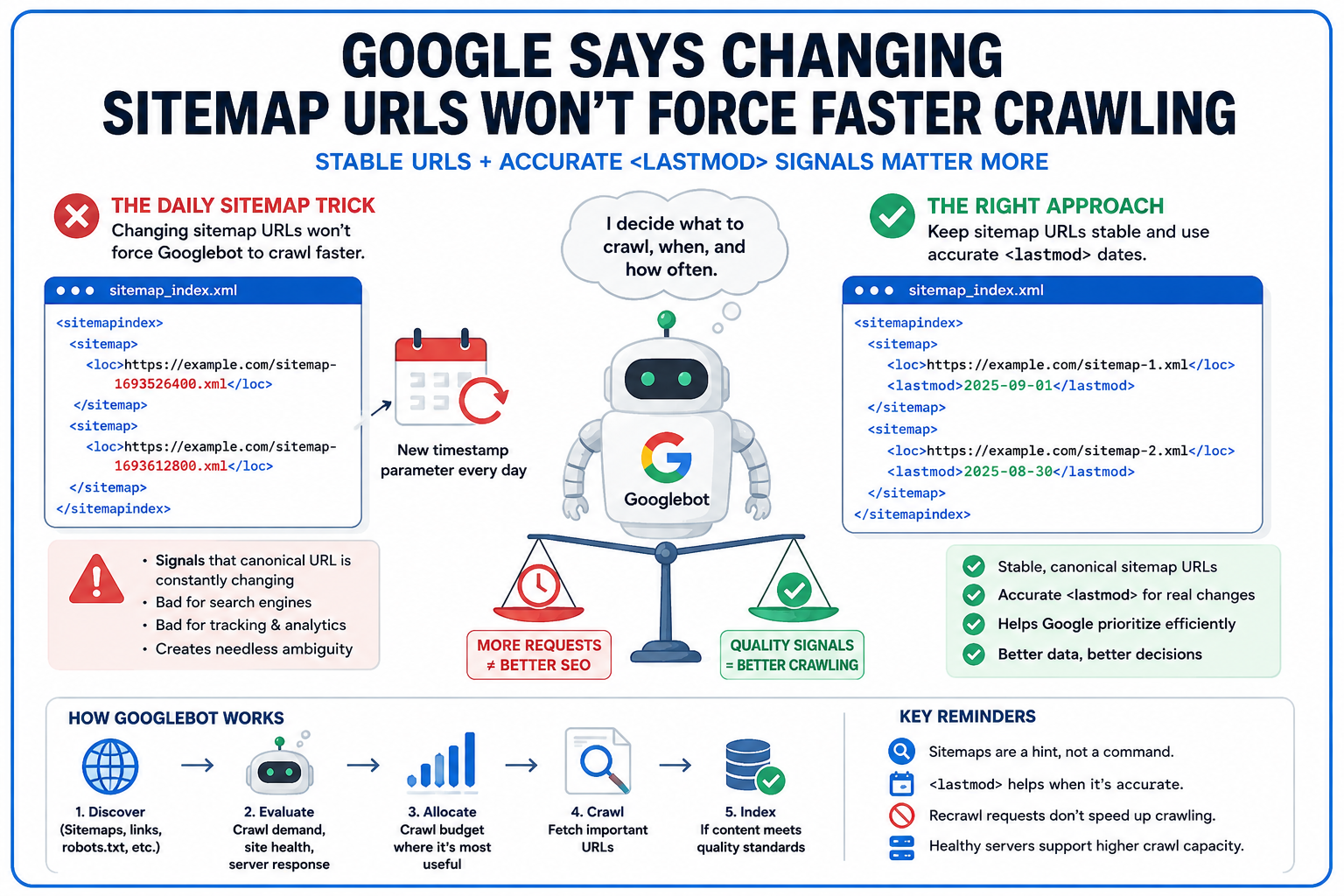
A sitemap tactic circulating among SEOs attempts to manufacture that behaviour by changing sitemap URLs every day. Google Search Advocate John Mueller has now pushed back on the approach, calling it a bad idea and pointing to a much less exciting principle: keep URLs stable.
The technique involves adding a changing parameter, such as a Unix timestamp, to child sitemap URLs inside a sitemap index. Each new parameter makes the sitemap appear to have a different URL, with the apparent goal of getting search engines to fetch it again.
It is an inventive use of cache busting.
It is also solving a problem Google's crawling systems were not designed to solve that way.
Cache Busting Works for Files. Sitemaps Are Different
Cache busting itself is not unusual.
Developers commonly append version parameters to CSS, JavaScript and other static resources when they want browsers or intermediary caches to retrieve a newly updated file instead of serving an older stored copy. A file might move from style.css?v=1 to style.css?v=2, for example.
Applying that logic to an XML sitemap creates a very different signal.
The question surfaced publicly on Bluesky on September 1, when an SEO practitioner asked Mueller about a large site whose child sitemaps received a fresh timestamp parameter every day. The theory was that creating a new sitemap URL could force search engines to fetch it daily.
Mueller's response was direct:
“I think that’s a bad idea because you’re signalling that the canonical URL for a piece of content should be constantly changing. That’s not good for search engines, it’s not good for your tracking. Having clean, stable URLs is important.”
The problem is not simply that the tactic is unnecessary. Constantly changing resource URLs can create needless ambiguity around what is supposed to be the persistent sitemap location.
For a sitemap, freshness already has a defined place.
It is not the URL.
Google Already Has a Signal for Changed Pages
Google's sitemap documentation tells site owners to use the <lastmod> field when a page has received a significant update.
Google says it can use accurate <lastmod> values as a signal when scheduling crawls of URLs it already knows about. The date should represent a meaningful change to the page, such as an update to its primary content, structured data or links. Changing a copyright year does not qualify.
Accuracy is the important part.
A sitemap that tells Google every page changed today when nothing actually changed gives the crawler less reliable information, not more useful information.
The same principle applies to XML sitemaps generally. Google describes sitemap submission as a hint rather than a command. Submitting one does not guarantee that Google will download it immediately, crawl every listed URL or index those pages.
That distinction matters because crawl manipulation tactics often start with the assumption that a technical action can compel Googlebot to return.
Google's own documentation says otherwise.
Googlebot algorithmically determines which sites to crawl, how frequently to visit them and how many URLs to fetch. That process considers crawl demand and how a site's servers respond rather than simply obeying a request for more activity.
TechWyse recently covered another part of this system when Google expanded its crawl budget guidance around HTTP 304 responses. The recommendation there moves in almost the opposite direction: when content has not changed, help Google avoid downloading it unnecessarily.
Manufacturing a fresh sitemap URL every day introduces artificial change where Google is asking sites to communicate real change accurately.
Google Retired the Old Sitemap Ping Shortcut Years Ago
There is another reason the daily-sitemap concept runs against Google's direction.
Google previously offered an unauthenticated sitemap ping endpoint that websites could call when they wanted to notify the search engine about a sitemap.
Google deprecated it in 2023.
The company's internal studies found those submissions were “not very useful,” and Google said the vast majority of sitemap pings it received were spam. The endpoint subsequently stopped functioning, with requests returning a 404 response.
Google did not abandon sitemaps themselves.
Site owners can still submit them through Search Console, reference them in robots.txt or use the Search Console API. What disappeared was the idea that repeatedly pinging an endpoint was a useful mechanism for creating additional crawl activity.
Google's current recrawling documentation makes the same point from another direction. Requesting the same page multiple times through URL Inspection will not make Google crawl it faster. Crawl requests can take days or weeks, and submitting one does not guarantee immediate inclusion in Search.
There is a consistent thread across those policies.
Google accepts information that helps its crawler understand what exists and what changed. It does not promise that repeated submission creates repeated crawling.
More Google Crawling Is Not Automatically Better SEO
The appeal of the tactic is understandable on very large websites.
Publishers, marketplaces and ecommerce sites can have thousands or millions of URLs competing for crawler attention. Faster discovery of changed products, newly published pages or updated inventory can have a direct operational value.
But more requests are not inherently better.
Google's crawling systems have to allocate resources across the web while avoiding unnecessary server load. For large sites, crawl budget becomes partly an exercise in helping Googlebot spend requests where they are useful.
That can involve keeping internal linking clean, eliminating unnecessary duplicate URLs, responding efficiently at the server level and accurately identifying pages that changed.
It does not require making stable files look new.
Google also ignores the sitemap <changefreq> and <priority> fields. Its documentation says <lastmod> can be useful when it is consistently accurate, reinforcing that Google's interest is in evidence of genuine change rather than a publisher's preferred crawling schedule.
The distinction can become especially important when diagnosing indexation. A sudden increase in crawling does not prove pages will enter the index, just as a stale Search Console report does not prove crawling stopped. TechWyse's coverage of Google Search Console indexing data examined the same separation between crawl activity, indexing status and what reporting tools happen to display.
They are related systems.
They are not interchangeable metrics.
Technical SEO Still Works Better With Stable Signals
For marketers and SEOs, the practical response is fairly narrow.
There is no reason to rotate sitemap URLs simply to trigger Googlebot. Keep sitemap locations stable, maintain accurate <lastmod> timestamps when important pages genuinely change and use Search Console or robots.txt to make the sitemap discoverable. On very large sites where crawling is a measurable constraint, server logs and Google Search Console can show whether Googlebot is reaching high-value sections often enough.
That is ordinary technical SEO, but it produces cleaner diagnostic data too.
Changing sitemap URLs every day can make logging, monitoring and historical comparisons harder because the resource identifier itself keeps moving. Mueller specifically called out tracking as one of the problems with the approach.
Google's crawling documentation also makes clear that crawl frequency is adaptive. Googlebot may slow down when servers become less responsive or start returning errors, while healthy infrastructure can support greater crawl capacity when demand exists.
So the real constraint is not finding a URL trick that forces another fetch.
It is giving Google reliable reasons to crawl the right URLs.
Google still recommends sitemaps for discovering and revisiting pages, particularly on larger websites. But submission remains a hint, <lastmod> needs to reflect actual changes, and repeated recrawl requests do not accelerate Google's systems.
The timestamp trick changes the sitemap address every day.
Google's advice is to leave it alone.