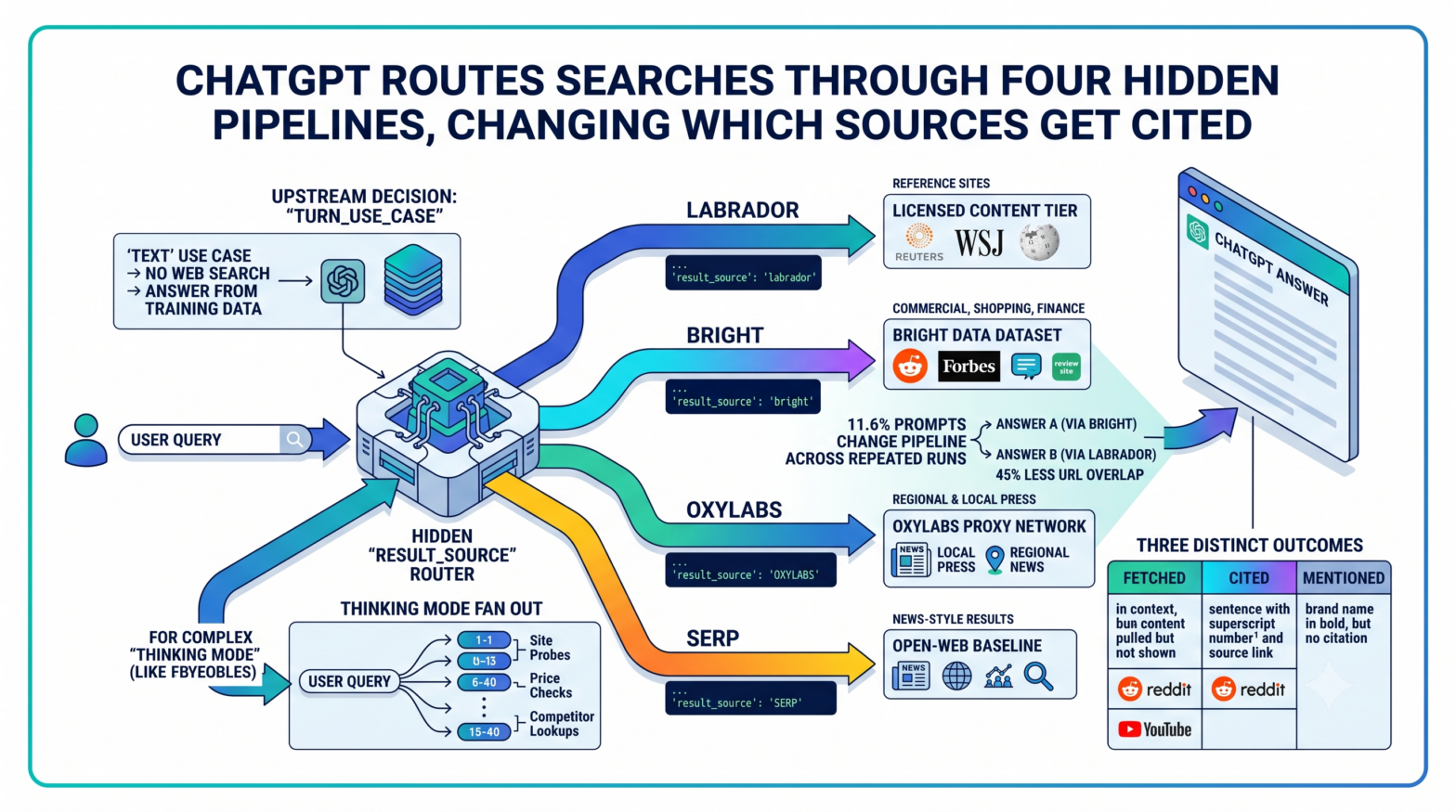
Websites competing for citations in ChatGPT answers may be competing in entirely different retrieval systems depending on the query, and in over one in ten cases, which system fires is not consistent. Two independent analyses published in June 2026, one by researcher Suganthan Mohanadasan and one by researcher Chris Green, confirmed that ChatGPT routes web searches through four separate backend pipelines, each drawing from a different pool of sources, none of which is disclosed to users in the citation cards they see.
OpenAI has not publicly documented these pipelines. Both analyses were conducted through browser-level network traffic inspection and independent prompt testing, not through official disclosures.
Four Pipelines Sit Behind Every ChatGPT Answer
The field that identifies which pipeline fetched a given result is called `result_source`. It is attached to every web result ChatGPT pulls but never surfaced in the answer itself, and it carries one of four values.
Mohanadasan described Labrador as a tier of established publishers and reference sites, Bright as tied to Bright Data, Oxylabs as tied to Oxylabs, and SERP as an open-web baseline that appeared mostly in news-style results. In his traffic sample, the Labrador pipeline carried results from publishers such as Reuters, the WSJ, and Wikipedia, while Bright pulled from Reddit, Forbes, and review sites, and Oxylabs returned regional and local press.
Across Mohanadasan's logged queries, Bright did the bulk of the fetching, particularly on commercial, shopping, finance, and weather queries, while Oxylabs skewed regional and local, and Labrador stayed concentrated on news and reference content.
Based on the publishers appearing under the Labrador label in the traffic, Mohanadasan characterized it as resembling a licensed content tier, noting that several of those publishers have signed content deals with OpenAI.
Switching Pipelines Cuts URL Overlap by Roughly 45 Percent
Green's analysis tested the consistency of pipeline selection at scale. He ran 1,000 prompts up to ten times each, capturing 9,946 completed search runs. Most prompts remained on a single retrieval source. Labrador accounted for 88.1% of primary search sources in his dataset, followed by Bright at 9.9%, Oxylabs at 1.7%, and SERP at 0.3%.
However, 11.6% of prompts changed primary search source across repeated runs. That shift had a measurable effect on which content entered the answer process. When the source changed between runs, URL overlap dropped by roughly 45%. Domain overlap fell by approximately 42% under the same conditions, according to Green's published figures.
The practical implication is that pipeline assignment, not just content quality, determines which URLs ChatGPT considers as evidence for a given answer. There is not one ChatGPT to rank in. There are several retrieval pipelines, and the one that answers a given user's query is not a choice publishers can control.
Some Queries Never Reach the Web
Both analyses found that pipeline routing is only one factor. A separate upstream decision determines whether ChatGPT searches the web at all.
Mohanadasan found that ChatGPT classifies some queries before searching, using a field called `turn_use_case`. Some prompts are filed as "text" and skip web search entirely, even when the question appears to be about current information. The routing decision is not probabilistic. It is a hard per-turn determination: either the pipeline reaches out to the live web, or the answer comes entirely from the model's training data, two fundamentally different answer-generation paths, chosen before generation begins.
For queries classified as text turns, which often include definitional, conversational, or evergreen topics, no amount of crawling, structured data, or ranking performance puts a page into the answer, because it is generated from training data.
Thinking Mode Fans Out Into Dozens of Sub-Queries
For complex queries routed through ChatGPT's reasoning mode, the retrieval process expands further. On the fast model, retrieval involves a single reworded query. On the thinking model, asked to compare a few products, ChatGPT ran roughly 15 to 40 sub-queries off a single question.
Mohanadasan found that ChatGPT in thinking mode can fan out into searches including direct site probes, pricing checks, and lookups for unnamed competitors. That behaviour changes which pages can enter the answer process, because ChatGPT may run rewritten queries, direct site probes, or follow-up checks rather than searching the exact phrase a user typed.
Fetched, Cited, and Mentioned Are Three Separate Outcomes
Mohanadasan's analysis distinguished three distinct outcomes that researchers and marketers often conflate. He separated fetched, cited, and mentioned as separate outcomes. A page can be pulled into ChatGPT's context without being shown to users. It can be cited as the source behind a specific sentence. Or a brand can be mentioned without being the source of the claim.
In Mohanadasan's sample, Reddit was retrieved 278 times and cited just 11 times. YouTube was retrieved 201 times and cited zero times. He attributed the gap to text availability: Reddit threads expose full text, while YouTube search results typically return metadata rather than video transcripts.
The distinction between vendor-owned and third-party pages also affected citation patterns. Mohanadasan found that ChatGPT appeared to prefer official pricing pages as a primary source, then fell back to third-party sources when prices were hidden behind JavaScript or otherwise difficult to parse. In cases where the model's own reasoning trace was captured, it explicitly noted the fallback, citing a third-party review aggregator in place of a vendor's page it could not read.
What the Analyses Mean for Technical SEO and GEO in Practice
Both studies were observational and not based on official OpenAI documentation. Mohanadasan's data came from one logged-in Pro account across a few days of traffic, with approximately 1,240 source records. Green's dataset was larger but acknowledged potential capture bias from the collection method used. Neither study represents all ChatGPT users, account types, or model versions.
That said, the structural findings- that the `result_source` field exists, carries four documented values, and is attached to every web result- are confirmed by direct traffic inspection and are reproducible through browser DevTools without special access.
For marketers and SEO practitioners, the findings carry concrete technical implications. Plain HTML, crawlable facts, clear pricing and specs, strong third-party coverage, and text-heavy pages become more important when source selection depends on retrieval and readability. Content locked behind JavaScript rendering, image-based pricing tables, or dynamically loaded data may be bypassed at the retrieval stage, regardless of a page's authority or ranking in traditional search. Earning third-party coverage on review sites, editorial outlets, and discussion platforms that expose machine-readable text affects whether a brand is cited rather than merely fetched or mentioned.
Mohanadasan noted in his June 24 analysis that the system changes week to week. The structure holds; the numbers move.