Google’s latest spam update did not need weeks to make its point.
The June 2026 spam update is now complete after a two-day rollout, closing a short but important window for SEOs, publishers, and account teams monitoring search volatility. For agencies that warned clients while the update was still active, the message landed at the right time: rankings may move first, explanations come later, and spam enforcement is no longer confined to blue-link search.
Google’s Search Status Dashboard shows the update began on June 24 at 9:00 a.m. Pacific Time and ended on June 26 at 10:00 a.m. Pacific Time. The release applied globally and across all languages, according to Google’s notice.
Short rollout. Broad scope.
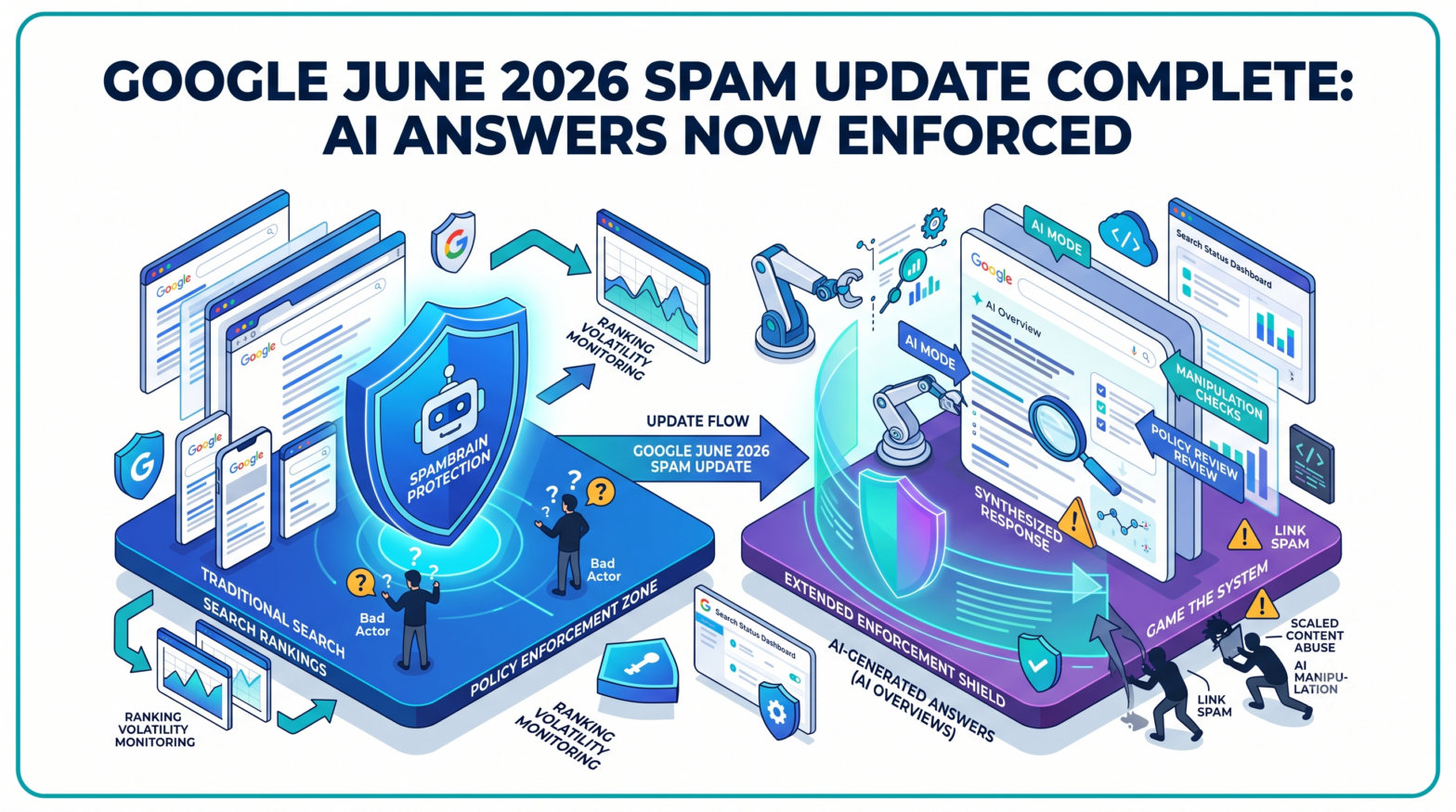
The more important detail sits inside Google’s spam policy language. Google now defines spam as techniques used to deceive users or manipulate Search systems, including attempts to manipulate generative AI responses in Google Search. That puts AI Overviews, AI Mode, and other AI-generated answer surfaces inside the same policy conversation as traditional ranking manipulation.
For marketers, that changes how a spam update should be read.
It is not only a rankings event. It is an AI search trust event.
The Rollout Ended Fast, But The Review Window Is Just Starting
Google’s June 2026 spam update moved quickly compared with longer ranking updates. The dashboard entry lists the incident affecting ranking from June 24 to June 26, with completion confirmed on June 26.
That does not mean every site owner gets an instant diagnosis.
Spam updates are improvements to Google’s automated spam-detection systems. Google says those systems operate continuously, with occasional notable improvements shared as spam updates. The company also points to SpamBrain, its AI-based spam-prevention system, as one example of the type of system it improves over time.
For account teams, the short rollout creates a practical distinction.
The update may be complete, but performance interpretation still needs restraint. Organic traffic, rankings, impressions, and click-through behaviour can shift during the rollout and settle afterward. A sudden drop may connect to policy enforcement, but it still needs to be separated from seasonality, tracking issues, site changes, indexing problems, and normal search volatility.
That is why early client communication matters.
A warning during the rollout gives clients context before charts start moving. It also prevents the wrong reaction: rewriting pages overnight, removing useful content, disavowing links without evidence, or treating every impression change as a penalty. Good SEO monitoring is not panic management. It is pattern recognition.
AI Answers Are Now Part Of The Spam Conversation
Google’s spam policies now explicitly mention attempts to manipulate generative AI responses in Google Search.
That language matters because AI-generated answers are built differently from traditional ranked listings. A standard search result sends users to pages. An AI answer synthesizes information, selects sources, and presents a response before the user clicks. That creates a new incentive for bad actors: influence the answer, not just the ranking.
The policy update draws a clearer line around that behaviour.
Attempts to game Google’s AI-generated search responses can now sit under the same broad spam framework that covers cloaking, doorway abuse, expired domain abuse, hacked content, hidden text, keyword stuffing, link spam, scraped content, scaled content abuse, and other manipulative practices.
This is where enforcement gets difficult.
Manipulating a ranking signal is one thing. Manipulating an AI answer may involve planted mentions, manufactured consensus, fake reviews, spammed forums, low-quality “best of” pages, or altered third-party content designed to be cited by an AI system. Some of those tactics happen off the brand’s website. Some can look like ordinary content until patterns emerge.
That is why Google’s updated spam wording is more than a documentation change.
It gives Google policy cover to treat AI answer manipulation as search spam, even when the manipulation is not aimed at a conventional ranking position. That becomes increasingly important as more users encounter AI-generated responses during commercial, local, informational, and brand comparison searches.
TechWyse has covered this broader shift in AI search visibility, where Google’s position has remained consistent: AI surfaces still rely on search systems, but the way users encounter information is changing.
The Old Spam Playbook Has A New Surface Area
The spam risks are not new. The exposure is.
Google’s policies already cover tactics that many SEO teams know well: doorway pages, unnatural link schemes, keyword stuffing, scraped content, expired domain abuse, and scaled content produced mainly to manipulate search rankings. Those risks remain relevant in standard organic results.
AI search adds another surface for the same underlying behaviour.
A site built around thin, templated pages may not only struggle to rank. It may also struggle to be trusted as a source for AI-generated answers. A brand using paid mentions, manipulative affiliate pages, or synthetic review networks may face a different kind of scrutiny if those assets appear designed to steer AI recommendations.
That is why Google’s spam policies are becoming more important to content governance, not less.
The policy language does not say AI-written content is automatically spam. Google’s long-running position is that automation is not the issue by itself. The problem is content or activity designed primarily to manipulate Search systems, mislead users, or manufacture visibility without real value.
That distinction matters for legitimate marketers.
Using AI to draft, summarize, organize, or support content production is different from using automation to mass-produce low-value pages, fake authority, or artificial brand signals. The same standard applies in AI search as in traditional SEO: the page, mention, citation, or asset needs to serve users first.
The shortcut economy is being squeezed from both sides.
Search rankings are one side. AI answers are the other.
Proactive Account Management Beats Post-Update Guesswork
The June spam update is a reminder that client communication is part of technical SEO work.
When an update starts, clients do not need alarmist predictions. They need to know what changed, what is known, what is not known, and what will be monitored. That is especially true for spam updates, where the word “spam” can create anxiety even for sites that have not used manipulative tactics.
A proactive note during the rollout gives account managers room to set expectations.
It can explain that the update is global, that ranking movement may appear during the rollout, that not every change is a penalty, and that the first response should be data review rather than rushed edits. It can also clarify that Google’s enforcement environment now includes AI-generated search responses, which means SEO risk assessments should include content quality, link practices, brand mentions, review ecosystems, and third-party visibility signals.
That is the account management win.
The update did not have to be complete before clients were warned. Waiting until after the rollout would have turned a known industry event into a reactive explanation. Early communication made the volatility easier to interpret and gave teams a cleaner basis for follow-up reporting.
For marketers and SEOs, the practical implication is straightforward: spam update monitoring should now include traditional ranking data, Search Console patterns, known site changes, link acquisition history, content quality signals, and AI answer visibility where relevant. The review should focus on evidence. A ranking drop during a spam update is a signal to investigate, not proof of a violation.
That approach also avoids overcorrecting.
Some sites may see little movement. Some may recover from previous spam suppression. Others may lose visibility because older tactics no longer pass Google’s systems. The account team’s job is to separate update noise from actual risk.
AI Search Makes Spam Enforcement More Public
AI answers raise the stakes because the output is more visible.
When a spam result ranks, users can sometimes judge the source before clicking. When an AI answer presents a synthesized recommendation or fact, the source relationship is less obvious. That creates a trust problem for Google and a compliance problem for marketers trying to understand where legitimate optimization ends and manipulation begins.
Google’s answer is to pull AI response manipulation into the spam framework.
That will not make enforcement simple. AI systems can be influenced through scattered signals across the web, and some manipulative tactics are designed to look like normal brand-building activity. The challenge for Google is to distinguish authentic authority from manufactured consensus at scale.
For brands, the safer path is becoming clearer.
Build assets that can survive policy review. Use original content. Avoid paid or hidden influence schemes. Keep location and service pages useful rather than duplicative. Review old link-building tactics. Watch for hacked or injected content. Treat third-party mentions as reputation signals, not objects to manipulate.
Google’s completed June 2026 spam update gives SEOs a new checkpoint.
The rollout is over. The audit work is not.