

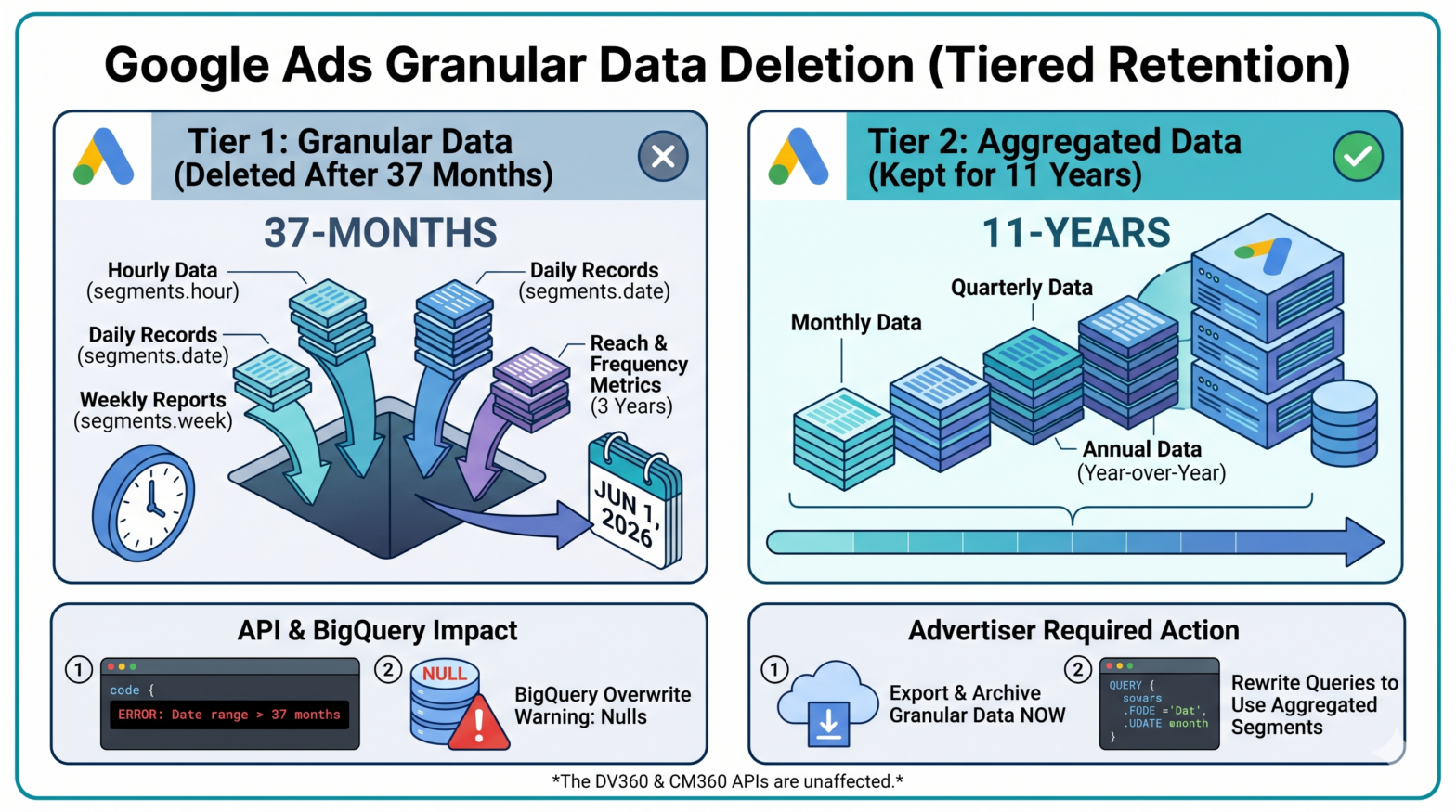
Google Ads advertisers will permanently lose access to years of granular historical reporting data under a new retention policy taking effect in days. Google's Ads Help documentation confirms that beginning June 1, 2026, hourly, daily, and weekly reporting data collected for periods shorter than one month will be available for 37 months, while monthly, quarterly, and annual data will remain accessible for 11 years.
What the Policy Covers
After the applicable retention period expires, data will not be accessible via the Google Ads interface or APIs. The policy introduces a tiered structure based on reporting granularity rather than a single uniform cutoff. The new 37-month window represents a significant contraction from the 11-year retention window Google established less than 18 months ago.
The developer-facing notice was published on May 1, 2026, on the Google Ads Developer Blog by Nadine Wang of the Advertising and Measurement APIs Team. A parallel update to the Google Ads Help Center confirmed that the 37-month window applies to the Google Ads interface as well as APIs.
Reach and Frequency Metrics Face a Shorter Window
Reach and frequency metrics carry an even shorter retention limit of three years, after which they will not be accessible via the Google Ads interface or APIs. Affected metrics include unique users, average impression frequency per user, 7-day and 30-day average impression frequency per user, and frequency distribution thresholds at 1+, 2+, 3+, 4+, 5+, and 10+.
API and BigQuery Impacts
The policy extends beyond the Google Ads interface. The announcement affects the Google Ads API, Google Ads scripts, the Google Analytics Data API, and the BigQuery Data Transfer Service, with different technical consequences for each.
According to the Google Ads Developer Blog, starting June 1, 2026, Google Ads API and Google Ads Scripts queries requesting granular segments such as segments.date or segments.week for date ranges older than 37 months will return a date range error. To retrieve older data, queries will need to use monthly, quarterly, or yearly segments instead.
Also starting June 1, 2026, the BigQuery Data Transfer Service for GA4 will stop populating data for backfill runs with dates older than 37 months. More significantly, if a transfer is manually triggered for a report date that is 37 months or older, the data in that BigQuery table will be overwritten by an empty value — meaning a manual backfill triggered after June 1 for an old date could actively destroy existing historical data rather than simply failing to add new data.
The DV360 API and CM360 API are not affected by this transition. According to the announcement, these APIs currently maintain a 24-month retention period, which remains unchanged.
Data Google Still Retains Long-Term
The new policy does not eliminate all long-horizon reporting access. It limits access specifically to older data at the hourly, daily, and weekly level. Monthly, quarterly, and annual data remains available for 11 years. Advertisers conducting year-over-year comparisons at the monthly level retain that capability; the constraint falls on granular daily breakdowns.
Practical Implications for Advertisers and Agencies
For paid search teams, analytics practitioners, and agencies managing accounts with multi-year campaign histories, the June 1 enforcement date means any granular data not independently archived before that date will be permanently inaccessible. Reporting workflows that rely on automated live pulls from the Google Ads API — including dashboards in Looker Studio, Power BI, or similar tools — may return incomplete results once data ages past the 37-month threshold. Teams using BigQuery should verify that historical backfill runs are complete before June 1, and should avoid triggering manual backfills for dates older than 37 months after the deadline to prevent overwriting existing records with null values.
Any query requesting granular segments — segments.date, segments.week, segments.hour — for date ranges beyond 37 months must be rewritten to use monthly, quarterly, or yearly segments. According to the Google Ads Developer Blog post, "If you require granular historical data beyond 37 months, we recommend exporting it prior to the June 1, 2026 deadline."